🎓Epistemic Authority as Social Reproduction in Algorithmically Influenced Public Spheres: A Structural Model of Susceptibility to Disinformation
Doctoral project at a glance
Departments and Instituts
Funding type
Period
02.04.2026 to 30.12.2029



Project Description
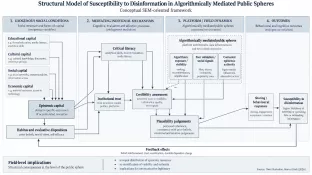
MARCO ETTELT’s PhD project investigates why young people, in particular, are subject to varying degrees of vulnerability to disinformation in digital public spheres. The focus is on how social factors such as education, cultural resources and trust in institutions interact with the visibility and evaluation mechanisms of digital platforms.
The research examines how algorithmic recommendation systems influence which information becomes visible, to whom credibility is attributed, and how epistemic authority – that is, the socially recognised ability to help determine knowledge and its validity – changes.
Rather than viewing susceptibility to disinformation solely as an individual cognitive deficit, this work understands it as the result of social inequalities and technologically structured information environments. Methodologically, the thesis combines quantitative and experimental approaches with qualitative methods. The aim is to develop an integrated model that explains how social position, platform structures and information evaluation interact.
PhD programme: Promotionskolleg NRW, Abteilung „Medien und Interaktion“
PhD programme: „Mensch, Digitalität, Gesellschaft“
Part of the BMFTR-project MARSS