Department of Engineering and Communication
Sustainable Industrial Engineering degree programme
Programme description
The Bachelor's degree programme Sustainable Industrial Engineering (B. Eng.) combines engineering, business and sustainability. Students acquire knowledge in engineering, computer science, business administration and environmental sciences, supplemented by topics such as artificial intelligence, renewable energies and sustainable materials. Practical semesters and semesters abroad, project work and ethics promote interdisciplinary thinking and prepare students for sustainable, future-oriented professional fields.
Study content (profile and qualification objective of the degree programme)
Students acquire the ability to holistically combine engineering fundamentals with business management thinking and tackle complex future tasks in a solution-oriented manner.
Graduates analyse and optimise technical and economic processes in terms of ecological, social and economic sustainability. They design innovative, resource-efficient and climate-friendly solutions in production, energy or mobility and assume responsibility in transformation processes. The interdisciplinary and practical study approach promotes analytical thinking, creativity and leadership skills and optimally prepares students for activities at the interface between technology, management and sustainable development.
Study programme
In the first two semesters, students acquire the basic knowledge of engineering and economics. They deal with the basics of electrical engineering, mechanical engineering, computer science and materials science as well as business administration, economics, investment and controlling. This is followed by topics such as production planning, logistics, artificial intelligence, digitalisation, statistics and sustainability with renewable energies and life cycle analyses. After the practical semester or semester abroad, the courses in the sixth semester are held in English. Here, students deepen their knowledge of leadership, sustainable technologies and human resource management. The programme concludes with a Bachelor's thesis and subsequent colloquium.
Perspectives and job prospects
A degree in Sustainable Engineering qualifies students for jobs in the energy, production, environmental and mobility sectors as well as in research, consulting or administration. Typical professional fields are in project and process management, development, digitalisation, sustainability management or technical corporate management. The degree programme optimally prepares students for management tasks in a sustainable, digital economy.
Practical relevance and teaching formats
An essential part of studying at Bonn-Rhine-Sieg University of Applied Sciences is to apply the knowledge acquired in a practical and solution-oriented manner:
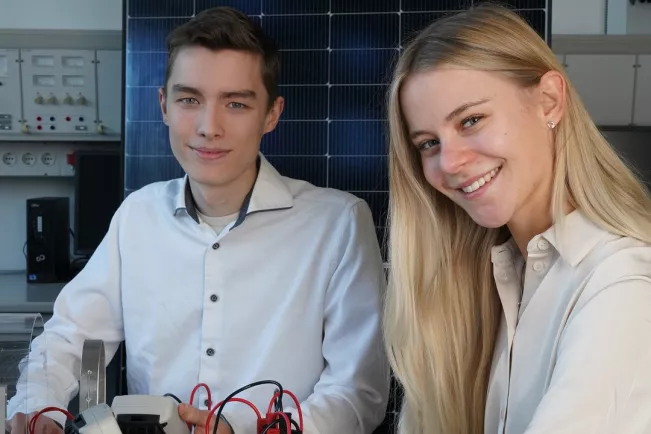
- in laboratory practicals in which, for example, physical principles are tested and materials are examined.
- during the three project weeks per semester, which offer the opportunity to work on projects in small teams (four-one-model).
- during an internship semester in Germany or abroad, during which students gain their first work experience.
- in the final thesis, which can be written in cooperation with companies or research institutes.
Study location and learning environment
The city of Sankt Augustin with the university campus borders the city of Bonn to the north-east. The state university is easy to reach by public transport from Cologne, Bonn, Düsseldorf or Koblenz. The campus is modern and the classrooms, laboratories, workshops and library are excellently equipped. Small study groups enable good contact with other students and lecturers. The university is well networked and cooperates with around 90 foreign universities in more than 40 countries.