Language Centre
Deep Learning Through Escape Rooms: A New Approach to Student Presentations
When Learning Becomes Interactive: A Different Approach to Student Presentations
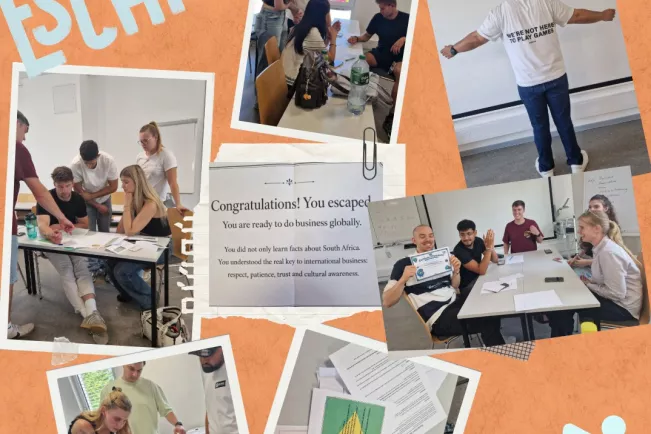
The Format
Each escape room game was built around the cultural concepts covered in the course: communication styles, leadership approaches, decision-making processes, trust-building, negotiation styles, time orientation, and relationship dynamics. To progress through the game and "escape," players had to solve cultural puzzles that required understanding the actual practices and values of that country. For example, one puzzle asked players to match management scenarios to the correct cultural context. Another required them to decode a message using knowledge about that culture's communication style. A third presented a business negotiation scenario and asked players to predict how that culture would approach it.
When other student groups played the games, something notable occurred. Rather than passively listening to presentations, they actively engaged with the content. They discussed answers, debated cultural interpretations, asked questions of the game designers, and worked collaboratively to solve puzzles. The experience was memorable in a way traditional presentations rarely are. Students didn't just hear information about Brazil's relationship-focused business culture, they experienced it through game design. They didn't just learn about Japanese business hierarchy; they worked through a puzzle that made them think like someone in that culture. The designers, for their part, had to think deeply about their assigned country. Creating an escape room requires more than surface-level knowledge. It demands understanding the why behind cultural practices, the logic that makes sense within that culture, and how to translate that into engaging, solvable puzzles that teach and impart information
The Learning Difference:
This format produced several measurable differences from traditional presentations:
Engagement: All students in the room participated actively, not just the few asking questions.
Retention: Playing through a puzzle to learn something is more memorable than hearing it presented.
Understanding: Creating a game forces designers to understand content deeply. Solving a game forces players to think critically about culture, not just absorb information.
Interaction: Designers received immediate feedback from players, real reactions and questions that showed what was understood and what was unclear. They became the country experts.
Fun: The learning experience was engaging rather than obligatory, and a competitive element charged the atmosphere as teams competed against each other to solve the clues and unlock access to a business contract.
Why This Works
Escape room games require active problem-solving. They create a shared challenge. They're interactive by design, and perhaps most importantly, they force both designers and players to engage with cultural content as something to understand and navigate, not just memorise. Traditional presentations position knowledge as something to transmit from speaker to listener. Escape room games position knowledge as something to discover and apply.
Broader Implications
This approach has applications beyond this single course. When students design learning experiences for their peers, they think differently about the content. When peers solve puzzles rather than listen to lectures, they engage differently with the materials and their classmates. The format also reflects a key learning objective of the course: understanding culture requires active engagement, not passive reception. It requires asking questions, testing assumptions, and working through scenarios, exactly what escape room games require.
Student Response
Feedback from students was consistently positive. Several commented that they learnt more from playing the other groups' games than they expected. Game designers noted that creating an escape room forced them to think about their country's culture far more deeply than a traditional presentation would have required. One student reflected: "Creating the game meant we had to really understand why things work the way they do in our chosen country. We couldn't just list facts. We had to think about the logic behind the culture."
Looking Forward
This format is being incorporated into the course structure going forward. The course will use escape room games as a capstone activity where groups can demonstrate deep understanding of cultural content through interactive design. The experience suggests that traditional presentation formats may not be optimal for all learning objectives. When the goal is deep understanding and peer engagement, alternative formats, particularly interactive ones, can be significantly more effective.
For educators, the takeaway is clear: how we ask students to demonstrate learning shapes what they actually learn. An escape room game doesn't just present information differently, it fundamentally changes how students engage with that information, from passive reception to active problem-solving.
Contact

Eileen Küpper
M.Sc., Lecturer in English and Intercultural Communication, Coordinator of the English programme (Department of Management Sciences)
Location
Rheinbach
Room
A 156
Address
von-Liebig-Straße 20
53359 Rheinbach
Contact hours
wednesdays, 10:00 a.m. - 12:00 p.m. (only during the lecture, by phone): by appointment (to be arranged by email or phone)
Telephone
+49 2241 865 765