Diversity at H-BRS
Diversity Thursday: Gender Bias
The gender bias is a systematic error in thinking that leads us to treat or judge people differently based on their (perceived) gender. As a rule, this happens completely unconsciously and often in contradiction to our conscious values. Traditional gender roles and automatic associations often lead us to think that men are smarter and more competent.

For example, how do you imagine a genius? For most people, Albert Einstein comes to mind rather than a female read person such as Marie Curie, Frida Kahlo, Virginia Woolf, Tu Youyou or Katherine Johnson.
How can we work on something that usually happens unconsciously? And how does gender bias manifest itself in everyday (working) life?
Our brain "sees" what it expects
The way we perceive, process and remember information is by no means objective and rational. Our brain has to make more than 20,000 decisions every day. It can only do this by processing only a fraction of the information and categorising it in such a way that it fits into our "normal" world view. Contradictions are automatically suppressed. Our brain "sees" what it expects - not what is really there. This is referred to as systematic errors in thinking or cognitive bias. For example, we tend to expect men when reading literature lists, so that female scientists are often incorrectly cited with male pronouns when using initials ("Dr B. Apple"). We are all affected by cognitive biases, but it is easier for us to recognise them in other people than in ourselves ("bias blind spot").
Intuition is recognition
The good news: what we know as our "normal" view of the world is absolutely changeable. Intuition is recognition. That's why it's important to create more representation for women in science and men on parental leave. In addition, we are able to consciously reflect on our automatic associations so that they do not lead to discriminatory actions.
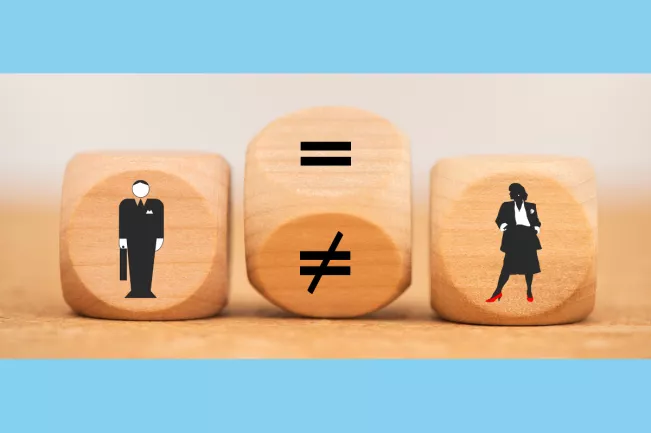
Gender bias
Gender bias refers to the distorted perception and assessment based on gender-related prejudices and stereotypes, i.e. the assumption of differences where there are none or the different interpretation of the same behaviour. For example, we may judge the same monologue as "self-confident" for a man but "aggressive" for a woman. Gender bias often occurs unconsciously and in contradiction to our conscious values. It works on the basis of external attribution of gender - regardless of how a person identifies themselves.
The decisive factor for gender bias is not the actual gender identity, but how we perceive a person - e.g. as "female" or "male".
Microaggressions
In the university context, gender bias can lead us to perceive men as generally more competent and to rate women lower despite equal performance, and to appoint them less frequently to leadership positions. Gender bias often does not manifest itself in overt discrimination, but in so-called microaggressions against women. Their competence is questioned, they are interrupted in meetings and we expect them to take minutes and get coffee.
If you notice microaggressions directly, you can speak up in a friendly and firm manner ("I think we just interrupted Ayçe" or "Good idea, Maria suggested that yesterday"). If this is not possible for hierarchical reasons or because you are personally affected, a later conversation in private can help. Those affected by microaggressions often doubt themselves: "Am I reacting too sensitively?". A supportive word can help prevent such doubts and strengthens the person affected.
The term 'microaggressions' was coined by the American psychiatrist Dr Chester Pierce in the 1970s to describe the regular insults and devaluations to which black people in the USA are exposed in commercials and in everyday life in higher education. The concept was subsequently expanded to include other marginalised groups.
Microaggressions manifest themselves in short, everyday and often casual remarks or actions that convey discriminatory messages due to implicit prejudices." (Debora Nsumbu 2024)
The online workshop on gender bias
In this online workshop, you can deepen your new knowledge and put it to the test in a variety of tasks. To cater for the different target groups, the workshop is available as a 120-minute intensive version, but also as a 30-minute version for managers and professors. The workshop was designed as part of the PeP@H-BRS project (Future-oriented recruitment and development for professorial staff at H-BRS). PeP@H-BRS aims to further develop the university as an attractive employer, promote diversity and create sustainable career paths for professors.
Sources
- https://www.gesis.org/cews/daten-und-informationen/forschungsfelder/gender-bias/studien
- https://www.youtube.com/watch?v=CjVQJdIrDJ0&t=1s
- https://www.youtube.com/watch?v=APJcN60RFX0
- van der Lee, R., & Ellemers, N. (2015). Gender contributes to personal research funding success in The Netherlands. Proceedings of the National Academy of Sciences, 112(40), 12349-12353. https://doi.org/10.1073/pnas.1510159112
- Boring, A., Ottoboni, K., & Stark, P. B. (2016). Student evaluations of teaching (mostly) do not measure teaching effectiveness. Science Open. http://dx.doi.org/10.14293/S2199-1006.1.SOR-EDU.AETBZC.v1
- Burns, K.E.A., Straus, S.E., Liu, K., Rizvi, L., and Guyatt, G. (2019). Gender differences in grant and personnel award funding rates at the Canadian Institutes of Health Research based on research content area: a retrospective analysis. PLoS Med. 16, e1002935.
- Feigt, N. D., Domenech Rodríguez, M. M., & Vázquez, A. L. (2022). The impact of gender-based microaggressions and internalised sexism on mental health outcomes: A mother-daughter study. Family Relations, 71(1), 201-219. https://doi.org/10.1111/fare.12622
- Nsumbu, D. (2024). Glossary paper: Microaggressions - Multifaceted and subtle discrimination. Retrieved 01/12/2025 from https://diversity-akademie.org/wp-content/uploads/2025/06/Mikroaggressionen_angepasst-fuer-DA.pdf
Contact
Contact
Do you have any questions, comments or requests regarding diversity and sustainability topics or Diversity Thursday? Feel free to contact us at respekt@h-brs.de.
Contact us

Location
Sankt Augustin
Room
G 013
Address
Grantham-Allee 20
53757 Sankt Augustin
Telephone
+49 2241 865 9986
Kristin Pöllmann
Coordinator of the Master's programme in Autonomous Systems
Location
Sankt Augustin
Room
C226
Address
Grantham-Allee 20
53757 Sankt Augustin
Contact hours
Monday - Thursday
Telephone
+49 2241 865 9830Contact points
Diversity Management
Campus
Sankt Augustin
Room
E236
Opening hours
By appointment
The "PeP@H-BRS" team
Campus
Sankt Augustin
Opening hours
By arrangement