CombiPower: Combined power unit for the propulsion and grid connection of electric vehicles

Research project at a glance
Funding type
Period
01.10.2023 to 31.12.2026

Project Description
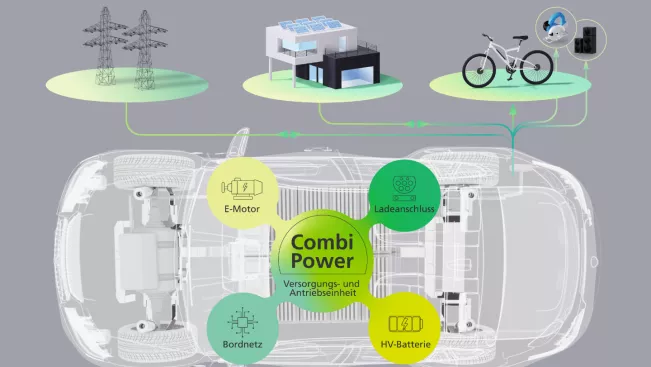
The aim of the CombiPower collaborative project is to develop a modular, cost-effective and multifunctional charging and drive unit for electric vehicles. By combining the charging and drive units in a single housing, it is ideally possible to reduce the overall size whilst simultaneously increasing efficiency. This approach leads to a reduction in the number of components and a reduction in volume. The use of modern SiC-based power semiconductors and active filters reduces the volume and weight of the filter components. The bidirectional power flow between the electricity grid and the vehicle battery enables the provision of system services and grid-stabilising functions. With regard to the future energy supply, which will continue to depend on stable grids for grid-connected loads and generators, a bidirectional charging and propulsion unit with grid-forming control design contributes to the stability and meshing of grid-forming systems. These grid-forming properties enable this technology to be used for Vehicle-to-X functionalities. This means that not only can the electricity grid be stabilised or restored (Vehicle-to-Grid+), but households can also be operated in island mode without an active grid connection in the event of an emergency (Vehicle-to-Home+). At the same time, a Vehicle-to-Device functionality is automatically established.
The H-BRS is focusing on the development of an active filter to ensure compliance with international EMC directives; to this end, a comprehensive study of active filters is being carried out, covering topology, efficiency and modelling. Another set of tasks for the H-BRS is to contribute to the development of an optimal design and to the topological research of combined, multifunctional converters, as well as to the identification of safety requirements in the electric vehicle operating environment. Furthermore, another focus of H-BRS will be the optimisation of the hardware design of the multifunctional converter.


Cooperation partners




Sponsors