PVCharge – Multifunctional power electronics for PV car parks: Genuine PV charging and grid-supporting functions through optimised hardware and intelligent control
Research project at a glance
Departments and Instituts
Funding type
Period
01.04.2025 to 31.03.2028

Project Description
Charging electric vehicles (EVs) using a photovoltaic (PV) system is a forward-looking concept that offers both environmental and economic benefits. In times of rising energy costs and growing environmental awareness, the use of renewable energy is becoming increasingly important. The combination of electric vehicles and a PV system makes it possible to use the solar power generated directly and efficiently to charge the vehicles. Current technologies rely on AC coupling between PV systems and charging points (Fig. 1a). To achieve this, the direct current from the PV system must first pass through the Maximum Power Point (MPP) tracker; it is then fed into the general AC grid via an inverter, rectified again by the charging point and finally adapted to the vehicle’s battery voltage by a DC/DC converter.
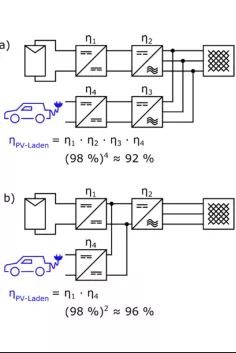
By connecting a bidirectional charging point directly to the DC terminals of the PV system downstream of the MPP tracker (Fig. 1b), three key advantages could be realised:
- By bypassing the inverter and rectifier stages in PV-driven DC charging, two conversion steps – and the associated losses – are eliminated. Together, these can easily amount to 3–5 per cent of the PV rated power, thereby making a significant contribution to energy and system costs.
- Direct DC coupling eliminates the need to use the public AC grid, which can avoid grid charges where applicable and reduce the grid load at the connection point. This therefore has a positive impact on costs for end users as well as on the stability of the (AC) power system.
- Connecting an entire PV charging string via an AC grid connection with an additional grid-forming function can have a positive impact on grid stability due to the combined energy output of the PV generator and the bidirectional charging systems, by providing inherent positive/negative control energy and reactive power.
However, this dynamic PV-controlled charging requires an intelligent control system that determines the available solar power in real time and transmits this information to the electric vehicle’s charger. This ensures that self-generated solar power is utilised optimally and that the draw on the grid is minimised. This not only leads to a reduction in energy costs but also to a reduction in CO₂ emissions.
As part of this project, H-BRS is developing the MPPT converter, which acts as an MPP tracker whilst also ensuring stable operation of the DC distribution system. Furthermore, this converter is being further developed into a DC matching stage, as part of an RCP system. This is intended to replicate the behaviour of electric vehicles. This enables the simulation of various usage profiles and the investigation of their impact on the distribution system.


Cooperation partners







Sponsors
Contact

Marco Jung
Professorship for Electromobility and Electrical Infrastructure with a focus on Power Electronics
Research fields
Location
Sankt Augustin
Room
B213
Address
Grantham-Allee 20
53757 Sankt Augustin
Telephone
+ 49 2241 865 316Location
Sankt Augustin
Room
B213
Address
Grantham-Allee 20
53757 Sankt Augustin
Telephone
+ 49 2241 865 316