Department of Engineering and Communication
Sustainable Engineering (MEng)
Study Facts
Degree
Master's degree
Standard period of study
Three Semester
Lecture language
German
Campus
Sankt Augustin
Start of study
Summer and Winter term
Type of study
Full-time
Admission requirements
Admission to the Master’s programme in Sustainable Engineering requires a first professional degree comprising 210 ECTS in Electrical Engineering, Mechatronics, Mechanical Engineering or Sustainable Engineering
For the Master’s programme, evidence of a total of at least 15 credit points from at least two of the following subject areas is required if the previous degree was not obtained in a programme in Sustainable Engineering:
- Life cycle assessments, sustainability analyses
- Environmental science, environmental engineering
- Renewable energy systems
Further information on admission requirements and documents.
Admission type and application deadline
If you meet all the entry requirements, you can apply within the deadline. You can apply from 15 November to 15 March to start your studies in the summer term, and from 15 May to 15 September to start your studies in the winter term.
Language skills
The programme is German. Elective modules may also be in English. German language skills at level C1 (CEFR) are required, demonstrated by a German university entrance qualification or the following German language certificates: German language certificates.
Costs
Only the current semester fee is payable for this degree programme: Semester fees and Administrative fees.
Programme content and qualification objective
Course structure
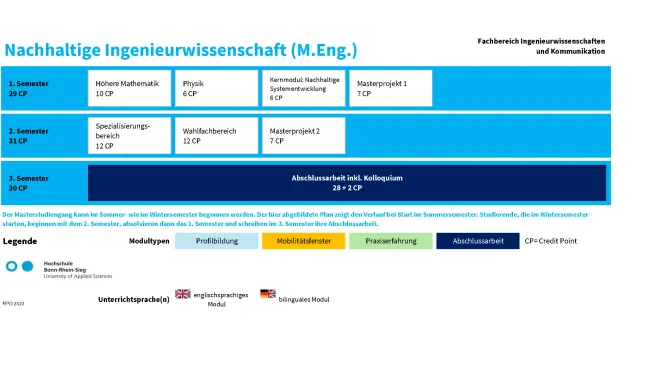
The programme comprises 90 CP over three semesters (starting in the summer or winter semester). You will study Advanced Mathematics and Physics/Technical Electrodynamics, as well as the core module ‘Sustainable Systems Development’. In the specialisation area, you will gain in-depth knowledge of, amongst other things, selected topics in sustainable technologies (including LCA and sector coupling), electrical energy systems, and the environment and transport. In addition, you will select subject areas from the extensive range of options that you wish to explore in greater depth. Most modules take place over two to three days, meaning the Master’s programme can be studied whilst working.
A distinctive feature of the programme is the two Master’s projects, in which you will work on a research or development topic for two days a week. The Master’s projects may be carried out within a department, an institute, a university facility or at an external organisation. Where possible, the two Master’s projects should be designed as project modules that build on one another thematically and are supervised on an individual basis. In the third semester, the Master’s thesis usually follows on from Master’s Project 2 and demonstrates the student’s acquired ability to carry out independent academic work.
Career prospects and job opportunities
You will be qualified for roles at the interface between technology and sustainability – for example, in the energy sector, in industry, in consultancy, in public planning or in research. Typical roles include development and systems engineer, sustainability engineer, sustainability manager, analyst specialising in energy systems or sector coupling, expert in LCA and life-cycle assessment, or R&D engineer. You are particularly distinguished by your ability to quantify sustainability in its environmental, economic and social dimensions, to optimise it using multi-criteria analysis, and to evaluate technical solutions on a scientifically sound basis.
Practical relevance and teaching formats
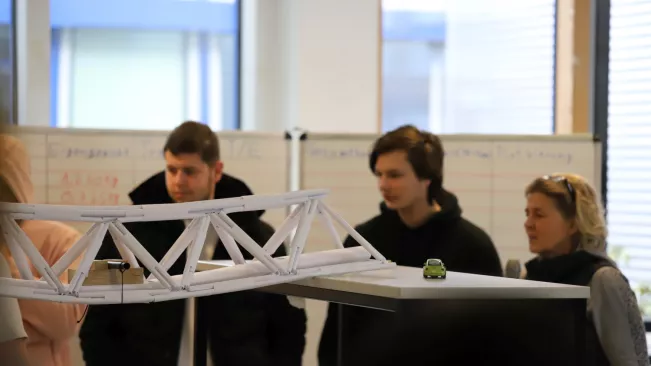
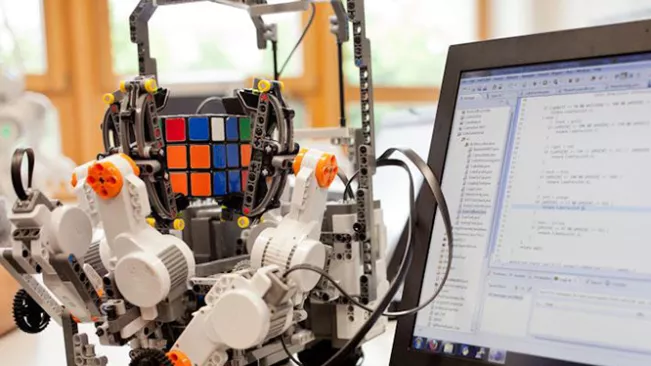
The specialist modules provide a logically structured deepening and broadening of knowledge at Master’s level. Studying in small groups and the pedagogical integration of lectures, tutorials and seminar-style teaching foster a deeper understanding of the subject matter and encourage a discursive and reflective engagement with the course content. This is further supported by a variety of project-based assessment formats. The Master’s programme in Sustainable Engineering (M.Eng.) combines theory with application-oriented system analysis and modelling: in sustainable system development, you will work with quantification, optimisation and simulation-based methods, amongst other things. Practical and research-based approaches are central to the Master’s projects and the Master’s thesis, in which you will work independently on a current topic, from research through planning and implementation to documentation and presentation. The specialisation modules offer practical in-depth study with laboratory or simulation components.
Study location and learning environment
The town of Sankt Augustin, home to the university campus, borders the urban area of Bonn to the north-east. The state university is easily accessible by public transport from Cologne, Bonn, Düsseldorf or Koblenz. The campus is modern, and the teaching rooms, laboratories, workshops and library are excellently equipped. Small study groups encourage good interaction with fellow students and lecturers. The university has a strong network and cooperates with around 90 foreign universities in more than 40 countries.
Study plan
Research, Knowledge Transfer and Start-ups

27. November 2026
18. January 2027
Consultation day for prospective students: "Your path to university"
22. January 2027
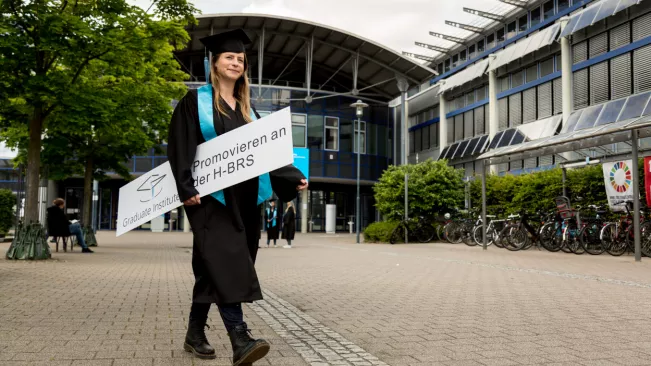
Master’s degree at H-BRS: Career, Research, Networking

Accreditation
Contact
Course guidance service Master Sustainable Engineering
Campus
Sankt Augustin
Room
B251
Opening hours
We look forward to hearing from you.
Contact to the Student Services
Opening hours
Telephone consultation hours: Monday - Friday: 10:00 - 12:00
Personal consultations by appointment only
Contact Student Advice Centre
Campus
Sankt Augustin
Room
E029, E031, E034, E035, E041
Opening hours
Telephone hours without appointment
Telephone hours: Monday, Wednesday and Thursday: 10:00-12:00
and Tuesday: 13:00-14:00
International Office - Sankt Augustin
Campus
Sankt Augustin
Room
E 056 - E 061
Opening hours
Please contact us by phone or email for an appointment