Department of Engineering and Communication
Mechanical Engineering (M.Eng.)

Study Facts
Degree
Master's degree
Standard period of study
Three semesters
Lecture language
German
Campus
Sankt Augustin
Start of study
Summer and winter semester
Type of study
Full-time
Admission requirements
Admission to the Master’s programme in Mechanical Engineering requires a first professional degree comprising 210 ECTS in Mechanical Engineering, Electrical Engineering, Mechatronics or Sustainable Engineering.
For the Master’s in Mechanical Engineering with a specialisation in Mechatronics, evidence of a total of at least 15 credit points from at least two of the following subject areas is required if the previous degree was not obtained in a programme in Mechanical Engineering or Mechatronics:
- Measurement and Control Engineering
- Mechatronics, Electric Drives
- Sensor Technology, Microprocessors
For the Master’s in Mechanical Engineering with a specialisation in Virtual Product Development, evidence of a total of at least 15 credit points from at least two of the following subject areas is required if the previous higher education qualification was not obtained in a Mechanical Engineering degree programme:
- Modelling/simulation
- Product development/design
- Technical Mechanics, Finite Element Method (FEM)
Further requirements and information on applications and admission.
Admission type and application deadline
This degree programme has no entry requirements. If you meet all the entry requirements, you can apply within the application period. You can apply from 15 November to 15 March to start your studies in the summer semester, and from 15 May to 15 September to start your studies in the winter semester.
Language skills
The language of instruction is German. Optional modules may also be taught in English. A knowledge of German at C1 level (CEFR) is required. A German-language university entrance qualification or the following German language certificates are accepted as proof: German language certificates.
Costs
For this degree programme, only the current term’s tuition fee is payable: Semester fees and administrative fees.
Course content and learning outcomes
Course structure
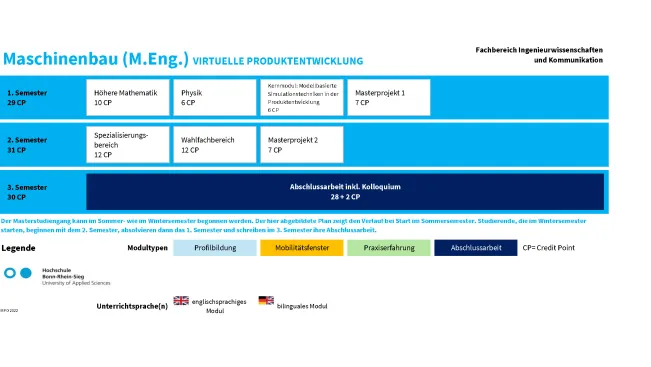
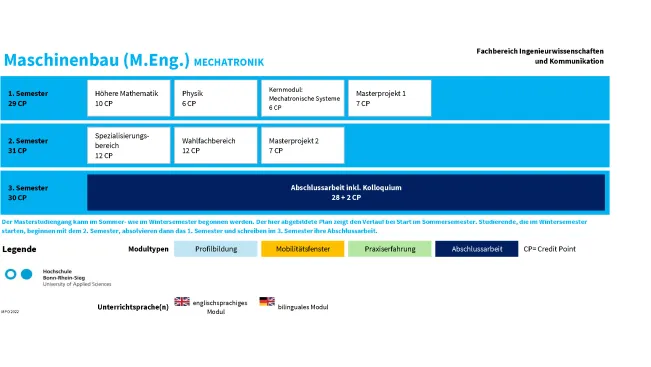
The programme comprises 90 CP over three semesters (starting in the summer or winter semester). You choose the specialisation Mechatronics or Virtual Product Development. In addition, you will select subject areas from the extensive range of electives that you wish to explore in greater depth. Most modules take place over two to three days, meaning the Master’s programme can be studied whilst working.
A distinctive feature of the programme is the two Master’s projects, in which students work on a research or development topic for two days a week. The Master’s projects can be carried out within a department, an institute, a university facility or at an external organisation. Where possible, the two Master’s projects should be designed as project modules that build on one another thematically and are supervised on an individual basis. In the third semester, the Master’s thesis usually follows on from Master’s Project 2 and demonstrates the student’s acquired ability to carry out independent academic work.
Career prospects and job opportunities
The Master’s in Mechanical Engineering (M.Eng.) qualifies you for roles in research and development within the automotive and supplier industries, mechanical and plant engineering, robotics/automation, and energy and medical technology. Typical roles include development engineer, calculation/simulation engineer (FEM/multiphysics), mechatronics/controls engineer, systems engineer or technical project manager. You will be particularly distinguished by your modelling, simulation and systems expertise, as well as your scientifically sound approach to project work.
Practical relevance and teaching formats
The specialist modules provide a logical progression in the deepening and broadening of knowledge at Master’s level. Studying in small groups and the pedagogical integration of lectures, tutorials and seminar-style teaching foster a deeper understanding of the subject matter and encourage a discursive and reflective engagement with the course content. This is further supported by a variety of project-based assessment formats.
In particular, the Master’s project enables students to learn how to transfer and apply what they have learnt to practical contexts and concrete problem-solving scenarios, which is essential for a successful professional career. In the final Master’s thesis, students once again demonstrate the practical and academic application of the knowledge and skills acquired during their studies.&
The Master’s programme in Mechanical Engineering (M.Eng.) thus combines theory with applications from current fields of mechatronics and product development and allows for individual specialisations.
Study location and learning environment
The town of Sankt Augustin, home to the university’s campus, borders the urban area of Bonn to the north-east. The state university is easily accessible by public transport from Cologne, Bonn, Düsseldorf or Koblenz. The campus is modern, and the study rooms, laboratories, workshops and library are excellently equipped. Small study groups encourage good relationships with fellow students and lecturers. The university has a strong network and cooperates with around 90 foreign universities in more than 40 countries.
Study plan Virtual Product Development
Study plan for Mechatronics


Research, Knowledge Transfer and Start-ups

12. November 2026
21. November 2026
27. November 2026
Master’s degree at H-BRS: Career, Research, Networking



Accreditation
Contact
Course guidance service Master Mechanical Engineering
Campus
Sankt Augustin
Room
B251
Opening hours
We look forward to hearing from you.
Contact to the Student Services
Opening hours
Telephone consultation hours: Monday - Friday: 10:00 - 12:00
Personal consultations by appointment only
Contact Student Advice Centre
Campus
Sankt Augustin
Room
E029, E031, E034, E035, E041
Opening hours
Telephone hours without appointment
Telephone hours: Monday, Wednesday and Thursday: 10:00-12:00
and Tuesday: 13:00-14:00
International Office - Sankt Augustin
Campus
Sankt Augustin
Room
E 056 - E 061
Opening hours
Please contact us by phone or email for an appointment