International Centre for Sustainable Development (IZNE)
E-Certificate for Sustainable Land Management in Africa: Interview with Monalisa Shingirayi Maremba

IZNE: What has been your role in developing and delivering the e-certificate “Research & Innovation for Sustainable Land Management in Africa” under the INTERFACES project?
Monalisa Shingirayi Maremba:The e-certificate was developed by the IZNE in collaboration with the University of Environment and Sustainable Development (UESD) in Ghana and the Forum for Agricultural Research in Africa (FARA). My role in developing and delivering the e-certificate has focused particularly on supporting the development and management of the E-Learning content and its implementation in the digital learning environment. This meant understanding the platforms of delivery and integrating the best practises, accessibility standards and virtual learning design principles. With a total of three cohorts and 140 registered participants from 19 African countries to this date, an important part of my work has also been supporting the operational delivery of the three cohorts. This has included supporting participant enrolment and communication, administration of the digital learning environment, supporting the weekly live sessions with learners and moderators, and assisting participants in solving technical and organisational problems. In addition, I have been supporting the evaluation and analysis of the course and learning assessments.
„The most rewarding aspect of my work with the e-certificate is working together with a multicultural team that brings diverse perspectives to the table. What remains remarkable is how the Directorate has been intentional about fostering transdisciplinary research across North-South collaborations. The e-certificate project has drawn inclusive, active and equal participation from all partners across the board which has enabled richness in research outputs.”
Monalisa Shingirayi Maremba - research associate at IZNE
IZNE: How do you think your own academic and professional experience has helped in this kind of role?
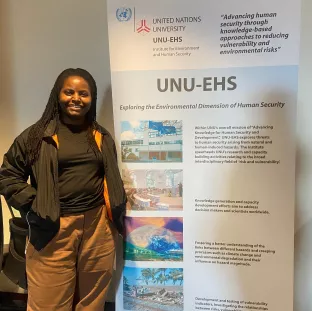
Monalisa Shingirayi Maremba: My academic and professional experience as a Geographer was beneficial in so far that sustainable development, land management, climate change mitigation and adaptation, resilience and transformation and social justice were already key topics in my academic journey. Having knowledge, practical and lived experiences of growing up in Africa has greatly helped in critically approaching discussions in this course. In addition to my professional background, having worked in Learning Experience Management roles before, enabled me to settle into my role perfectly. Coupled with my expertise in land systems from my bachelor’s degree in Geographical Information Science and Earth Observations, I was able to fully understand some of the issues that intersect between land management and sustainable development in most African countries. My exposure to an international group with 14 nationalities represented in my Masters’ studies and hundreds of experts from the larger United Nations organisations coming in to coordinate some classes, taught me important skills beyond the classroom of inclusivity, empathy and excellent communication which were a plus in this role.
„I find it exciting to explore digital platforms curated to translate research data into usable digital content. Working with the software has been a fun opportunity to explore different possibilities for designing the course and creating engaging content that can effectively evaluate the ESD competencies.”
Monalisa Shingirayi Maremba - research associate at IZNE
IZNE: What challenges did you face in developing this e-certificate and how did you deal with it?
Monalisa Shingirayi Maremba: I would say the main challenges were communication, coordination and meeting project timelines, mostly when working with over 20 content developers, including researchers and lecturers from different countries and time zones. This required exceptional communication and high organisational skills. I dealt with these challenges by being flexible, providing continuous support, and maintaining close communication with the content developers. This was integral to enabling the producers to continually review their content and restructure it to fit the digital platforms.
IZNE: How did your collaboration with the partners in Ghana in the development of the course look like?
Monalisa Shingirayi Maremba: The collaboration was a co-creation process, with each partner bringing in their own expertise and well-defined roles, making the delivery of the e-certificate especially efficient and rich in outputs. The IZNE coordinated content contributions from African and German researchers and ensured alignment with the guidelines and ESD principles. Additionally, it primarily coordinated the course enrolment and learning period. The FARA provided the continent-wide hosting platform, and the UESD as the local implementor in Ghana facilitated implementation and learner support through moderated live sessions and certification. UESD was also responsible for advertising the course to the students and practitioners in their network. For me, it was fulfilling to see how every voice and narrative mattered and was backed by scientific evidence, instead of being siloed or dominated by one-sided views.
IZNE: How did you make the E-Learning accessible and scientifically suitable for the diverse target group?
Monalisa Shingirayi Maremba: Our partner FARA enabled the use of a digital platform that was familiar to the intended users. The course content was developed following the African Union’s Guidelines for the Development of Curricula on Land Governance in Africa and established sustainability competency frameworks. Six modules covering the evolution of land governance, rural land management, environment and climate change, land information systems, gender in land management, and research and innovation were developed. It was ensured that the content touched explicitly on the African context with local examples from ongoing practical research outputs, flexible learning formats and creative ways of developing interactive and accessible activities. Access was further enabled by making the E-Learning user friendly for all forms of devices including mobile devices, desktops and web-access. The preliminary feedback from learners indicated that the course content was perceived as relevant and clearly structured and that the research-based content was appreciated by the multidisciplinary respondents.
IZNE: What distinguishes the e-certificate from a conventional online course?
Monalisa Shingirayi Maremba: Unique features of the e-certificate are its focused participation and feedback through individual follow-ups, as well as its continuous support from real people who are available to help. Practical and familiar examples enable the learners to engage further and even suggest project ideas. To some extend the course also motivated participants for implementing activities suggested by the course in their own contexts, such as a mapping exercise around the campus. Also, the weekly discussion live sessions were a distinct part of the e-certificate.
Following the certificate’s innovative approach to ESD and the Sustainable Development Goals the IZNE was awarded the “National Award - Education for Sustainable Development” by the Federal Ministry of Education, Family Affairs, Senior Citizens, Women and Youth (BMBSFJ) and the German Commission for UNESCO. This was an outstanding recognition for its distinction and uniqueness.
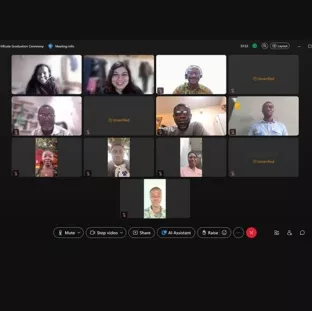
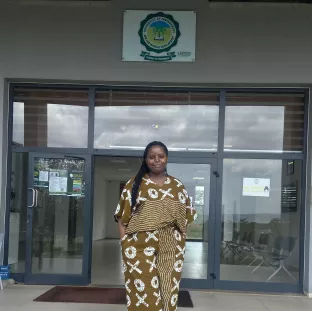
„Visiting the UESD I Ghana was a fulfilling experience to meet some of the participants from the 1st cohort and get to exchange beyond the few live sessions. Also being exposed to their daily realities, helped understanding the real challenges that online learning still presents for some students with limited connectivity.”
Monalisa Shingirayi Maremba - research associate at IZNE
IZNE: What advice would you give other institutions looking to build a similar cross-continental E-Learning programme?
Monalisa Shingirayi Maremba: My main advice would be to ensure full involvement and enthusiasm starting from the curriculum development process. Conceptualising cross-continental E-Learning programmes together with partner institutions ensures that important aspects are considered from the beginning and that there is a clear and shared structure. In this case the IZNE and the UESD cooperated from the start and integrated the African Union curriculum guidelines and UNESCO ESD competencies in the programme.
I would also advise institutions to consider constraints that can affect programme delivery, especially when partners are coming from different countries and cultural contexts. Communication styles differ between cultures and having a clear orientation will ensure smoothness as the project progresses. If rotations or mirroring can be done, that will help for continuation beyond the funded project periods. As ensuring continuity of e-certificate programs after the ending of funding periods usually presents a challenge, my advice would be to develop a detailed and feasible plan for institutional capacities early on.
IZNE: We really appreciate you sharing about your contribution and insights into the E-Certificate, one of the major milestones of the INTERFACES Project - Supporting Development Pathways for Sustainable Land Management in Africa.
interview conducted by Paula Semrau
About Monalisa Shingirayi Maremba

Contact

Wiltrud Terlau
Professor of Economics, Resilient and Sustainable Development, Director of the International Centre for Sustainable Development (IZNE), Department of Economics
Research fields
Location
Rheinbach
Room
B 111
Address
von-Liebig-Straße 20
53359, Rheinbach
Telephone
+49 2241 865 410Location
Sankt Augustin
Room
Raum F 305
Address
Grantham-Allee 20,
53757, Sankt Augustin