Institute for Safety and Security Research (ISF)
H-BRS showcases the HiLeit project during a federal communications exercise
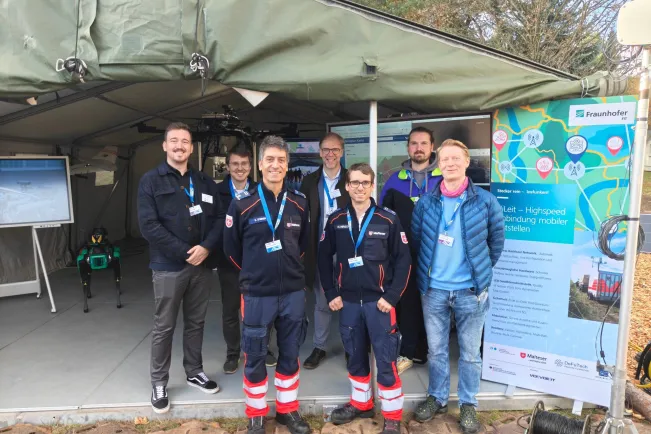
H-BRS showcases the HiLeit project at a federal communications exercise
Hochschule Bonn-Rhein-Sieg (H-BRS) took part in MURE26 (“Mutuality/Reciprocity 2026”) in Upper Lusatia, a federal communications exercise involving over 1,100 emergency and rescue personnel from fire brigades, ambulance services, the police, the Federal Police, the Federal Agency for Technical Relief (THW) and the German Armed Forces. Prof. Dr Michael Rademacher’s research group from the Institute of Safety and Security Research (ISF) presented the HiLeit research project there on 28 and 29 October with a demonstration.
At MURE26, the emergency services practised how to communicate with one another across organisational boundaries in the event of a major incident. On the day of the visit, new solutions for broadband operational communications were also presented. HiLeit was one of them. The event was organised by the Federal Agency for Public Safety Digital Radio for Authorities and Organisations with Security Responsibilities (BDBOS). The project partners from the Fraunhofer Institute for Applied Information Technology (FIT) and the Malteser Hilfsdienst were present with the H-BRS. MURE26 was organised by the Federal Ministry of the Interior and the Federal Ministry of Defence, in collaboration with the Free State of Saxony and the district of Görlitz.
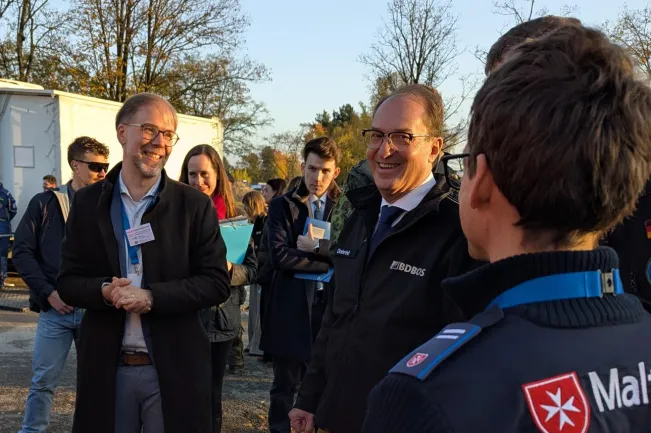
The project team set up the demonstrator on the evening of 28 October and presented the project results to BDBOS President Dr Christoph Hübner. The following day, many visitors from government agencies, the German Armed Forces and aid organisations visited the stand. Federal Minister of the Interior Alexander Dobrindt also attended to learn about the project.
„MURE26 was a very exciting experience for us. At the training site, we had direct contact with a large number of emergency services personnel. These conversations will help us make significant progress in our ongoing research and development of practical solutions.”
Prof. Dr Michael Rademacher

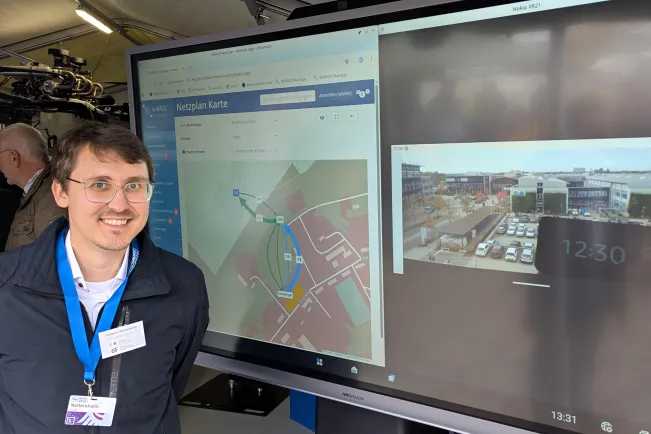
A dedicated network for emergency operations
When mobile and landline networks fail during a disaster – as happened during the 2021 flooding on the River Ahr – emergency services are left without a means of transmitting data, such as situational overviews or videos. Digital radio is designed for voice communication, which is why its bandwidth is often unsatisfactory for such purposes. With HiLeit, a completely self-sufficient communications network can be set up in such situations, one that is independent of other networks. The system is designed so that emergency services can set it up and put it into operation with minimal effort. In the operational area, connections are then established via radio or, if necessary, via field cables. The connection to the internet is provided via satellites in low Earth orbit (LEO).
H-BRS was responsible for network access within the project. Wi-Fi and 5G use the same SIM card registration, enabling emergency services to connect securely and easily without having to enter passwords. The general public also receives secure Wi-Fi access, which is separate from the emergency services’ network. Those affected can then use the remaining bandwidth to contact their families and friends. The satellite connection is protected by a VPN whose key exchange is based on post-quantum cryptography (PQC). These methods are designed to withstand attacks from future quantum computers. This ensures that data confidentiality is maintained in the future as well.
About HiLeit
HiLeit stands for ‘High-speed connection of mobile control centres via LEO satellites and 5G’. The project consortium comprised the Fraunhofer Institute for Applied Information Technology FIT (coordination), Hochschule Bonn-Rhein-Sieg, Malteser Hilfsdienst e.V. and DeFuTech UG. The project ran from 1 October 2024 to 31 July 2026 and was funded by the BDBOS. H-BRS was responsible for the security concept and the radio access nodes for 5G and Wi-Fi. Prior to MURE26, the demonstrator had already been tested at the 2nd BDBOS Innovation Forum at Schönhagen Airfield and in a field trial in the Ostalbkreis district.