Graduate Institute
It's all in the mix: Julian Rech completed his doctorate on the development of durable plastic composites
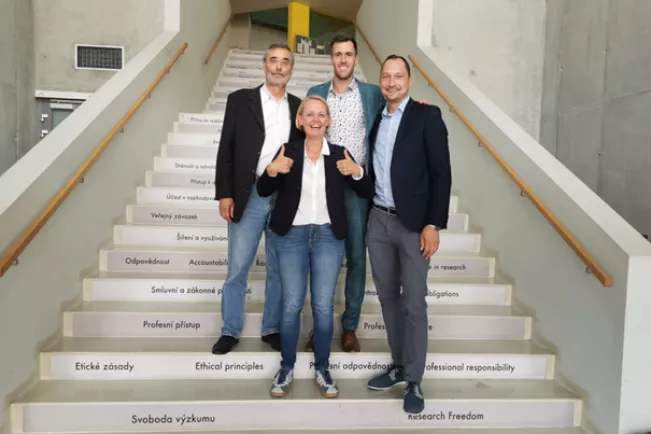
Julian Rech successfully defended his doctorate at the Faculty of Technology of Tomas Bata University in Zlín (Czech Republic) on Friday, 22 August 2025. The topic of his dissertation: "Reinforcing mechanisms of polymer matrix composites: evaluation and modelling of matrix/dispersed phase interrelationship".
Rech is a home-grown talent of H-BRS: As a former student of "Chemistry with Materials Science", he has been a research assistant in the Department of Applied Natural Sciences and a member of the Polymers working group (headed by Prof. Mandy Gieler-Großgarten and Prof. Johannes Steinhaus, formerly Prof. Bernhard Möginger) for several years.
Julian Rech was supervised by Prof. Bernhard Möginger (H-BRS) and Prof. Berenika Hausnerová at the Centre of Polymer Systems at TBU. After Johannes Steinhaus, Thomas Haenel, Esther Ramakers-van Dorp and Michael Meurer, Julian is the fifth H-BRS scientist to successfully complete a doctorate at TBU in Zlin.
The newly qualified doctor on his doctorate and his future plans:
What was your doctorate about?
The topic of the doctorate deals with plastic composites, i.e. materials in which plastics are mixed with small particles or fibres to make them more stable and versatile. The work primarily investigates how well plastic and filler bond together - because adhesion at the interface between the plastic matrix and filler determines the mechanical properties and therefore the applicability and durability. To this end, existing mathematical material models were reinterpreted and tested with experiments in order to better predict the behaviour of such materials. The focus here was on the elastic and viscoelastic (time-dependent) material properties. The aim was to develop a methodology to develop materials faster, more reliably and more cost-effectively for technical applications.
What were the main results of your research?
Adhesion plays a key role
How well the plastic matrix and filler bond determines the mechanical properties. An "adhesion coefficient" was introduced for this purpose, which varies greatly depending on the material combination (e.g. higher for polar plastics such as PA66/PBT, lower for non-polar plastics such as PE/PP) and thus enables customisation.
New model for prediction
The advanced "Elementary Volume Concept" makes it possible to predict the stiffness and also the time-dependent creep behaviour of composite materials - taking into account the filler content, alignment and adhesion.
Limits of the prediction
The models work well up to a filler content of around 20 vol-%. For fibre-reinforced plastics, the fibre orientation also had to be taken into account; otherwise the values are underestimated.
Experimental confirmation
Various test methods were compared. The Impulse Excitation Technique (IET) in particular proved to be a fast, reliable and non-destructive method for determining the elastic properties, with good agreement with classic tests.
What are your professional plans for the near future?
I will remain at the university, with a particular focus on teaching, but will also continue to hold my own in research and industrial services😊.
„My tip for our current doctoral students: Just do it - only what is there can be improved! Because in the end everything will be fine anyway and, most importantly, don't take everything too seriously. Having fun is still the best way to work!”
Julian Rech, PhD 2025 at H-BRS Department of Applied Natural Sciences
Kontakt

Location
Rheinbach
Room
I 206
Address
von-Liebig Str. 20
53359, Rheinbach
Telephone
+49 2241 865 766
Bernhard Möginger
Professor for Polymer Testing (emeritus), Founding director – Institute of Technology, Resource and Energy efficient Engineering, Senior professor since September 1st, 2022
Contact Points
Graduierteninstitut: Contact
Campus
Sankt Augustin
Room
F 427 , F 425, F 423
Opening hours
Mon-Fr 9.00 am-1.00 pm call us, send an e-mail or make an appointment for individual counselingfor