Institute of Visual Computing (IVC)

Dr Karl Kirschner
Research Scientist/Mentor and Teacher/International Chair (2017-'19)
Unit
Institute of Technology, Resource and Energy-efficient Engineering (TREE), Institute of Visual Computing (IVC)
Research fields
- Computational Chemistry
Location
Sankt Augustin
Room
A022.1
Address
Grantham-Allee 20
53754, Sankt Augustin
Profile
I am a computational chemist specializing in the development and application of molecular simulation tools to understand the fundamental behaviors of molecular systems. My research includes force fields (such as GLYCAM) development, optimization tools, and the use of molecular dynamics (MD) and quantum mechanics (QM) to predict molecular properties and interactions.
Research areas
- Force-field Optimization: Advancing parameter optimization techniques to improve the accuracy of conformational modeling and nonbonded forces.
- Small Molecules: Utilizing QM calculations to explore the conformational space and properties (e.g., vibrational frequencies, relative Gibbs free energies) of small molecules and nonbonded complexes.
- Proteins: Employing MD simulations to improve our understanding of the functional dynamics of the membrane proteins embedded in lipid bilayers and small molecule modulators bound to proteins.
- Carbohydrates: Employing MD simulations to explore the dynamics of glycans and their interactions with proteins, as well as carbohydrate (e.g., cyclodextrin) and closely related biopolymer (e.g., lignins) systems.
- Atmospheric Molecules: Applying QM calculations to explore water clusters and other atmospheric complexes.
- Visual Computing of Computational Chemistry Data: Creating tools and approaches for visualizing data created within the above research, including virtual reality (VR), Python notebooks and workflows, and a science-based video game for public outreach (GitHub: ion_pore_game).
Curriculum vitae
Short CV
- 1999 PhD in physical chemistry at the University of Georgia (USA)
- 65+ Peer-reviewed Publications in ca. 22 different journals, 2 book chapters
- 2 U.S. patents for a pharmacologically active agent that inhibits breast cancer in mice models
- Research supervision: ca. 45 undergraduate students, 5 master students, 2 doctoral students, and 3 postdocs
- Taught courses: Scientific Programming in Python, Scientific Writing, Physical Chemistry, Molecular Modeling, Advanced Research Strategies and Dissemination, Literature Seminar, Technical Journalism, and The History of America's Adirondack Park
Research Projects
The German Research Foundation funded research cluster "CytoTransport" combines expertise in biomedicine, computational modelling, structural biology, chemistry and materials science to investigate cellular transport mechanisms in health and disease. To this end, 9 working groups from two university research focuses are working together, represented by the two research institutes IFGA and TREE. An overarching goal is to bundle the institutes' overlapping interests and expertise in the long term.
Project management at the H-BRS
Prof. Dr Mike Althaus Dr Karl Kirschner Prof. Dr Matthias Preller Prof. Dr Dirk Reith Prof. Dr Jörn Oliver Sass Prof. Dr Margit Schulze Prof. Dr Christopher Volk Prof. Dr Steffen Witzleben Dr Katrin Richter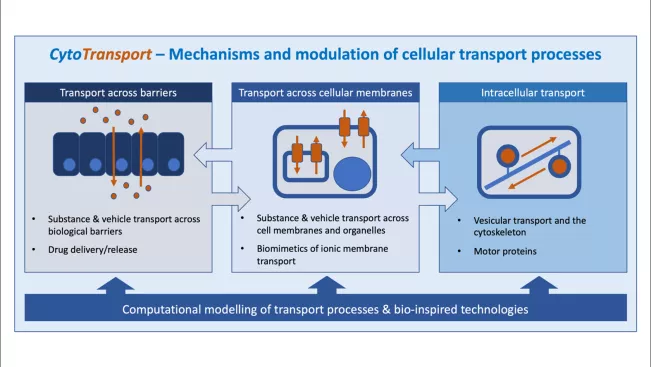
Bio-chemical research is increasingly dependent on accurate computer modelling and analysis. This field of research is by its very nature highly interdisciplinary, as basic physical laws must be implemented algorithmically in order to make relevant contributions in life science applications. The project and the associated initiative UMMBAS bundles the strong cross-disciplinary expertise at the H-BRS in method development, visualisation and the application of computer-based procedures for deciphering material science and biochemical issues.
Project management at the H-BRS
Prof. Dr Matthias Preller
Publications
Publications since 2015 (70+ total since 1993)
- M Mobasher, AJ Hone, M Pilzecker, D Bozic, A Hecker, JM McIntosh, KN Kirschner, V Grau, RL Papke, H Andleeb, and K Richter, "Putative α7-selective ligands interact with α9-containing nicotinic acetylcholine receptors and modulate immune functions of human mononuclear phagocytes". Front. Immunol. 17 (2026) 1773637 https://doi.org/10.3389/fimmu.2026.1773637
- KN Kirschner. “Gas-Phase Benzene-Methanol Dimer Configurations: Geometries, Relative Stabilities, and Interaction Energies”. J. Phys. Chem. A 129 (2025), 8110–8119 https://doi.org/10.1021/acs.jpca.5c03923
- R Strickstrock, A Hagg, D Reith, and KN Kirschner. “Speed up Multi-Scale Force-Field Parameter Optimization by Substituting Molecular Dynamics Calculations with a Machine Learning Surrogate Model”. ChemPhysChem 26 (2025), e202500353 https://doi.org/10.1002/cphc.202500353
- R Strickstrock, A Hagg, M Hülsmann, KN Kirschner, and D Reith, “Fine-tuning property domain weighting factors and the objective function in force-field parameter optimization”. Journal of Molecular Graphics and Modelling 139 (2025), 109035 https://www.sciencedirect.com/science/article/pii/S1093326325000956
- A Hagg and KN Kirschner. “Open-Source Machine Learning in Computational Chemistry”. Journal of Chemical Information and Modeling 63 (2023), 4505–4532 https://doi.org/10.1021/acs.jcim.3c00643
- M Müller, A Hagg, R Strickstrock, M Hülsmann, A Asteroth, KN Kirschner, & D Reith. “Determining Lennard-Jones Parameters Using Multiscale Target Data through Presampling-Enhanced, Surrogate-Assisted Global Optimization”. Journal of Chemical Information and Modeling 63 (2023), 1872–1881 https://doi.org/10.1021/acs.jcim.2c01231
- W Fiedler, F Freisleben, J Wellbrock, & Kirschner, Karl N. “Mebendazole’s Conformational Space and Its Predicted Binding to Human Heat-Shock Protein 90”. Journal of Chemical Information and Modeling 62 (2022), 3604–3617 https://doi.org/10.3390/ijms221910670
- R Strickstrock, M Hülsmann, D Reith, and KN Kirschner. “Optimizing Lennard-Jones parameters by coupling single molecule and ensemble target data”. Computer Physics Communications 274 (2022), 108285 https://doi.org/10.1016/j.cpc.2022.108285
- F. Freisleben, F. Modemann, J. Muschhammer, H. Stamm, F. Brauneck, A. Krispien, C. Bokemeyer, K.N. Kirschner, J. Wellbrock, & W. Fiedler. "Mebendazole Mediates Proteasomal Degradation of GLI Transcription Factors in Acute Myeloid Leukemia," International Journal of Molecular Sciences, 2021, 22, 10670 https://doi.org/10.3390/ijms221910670
- Cesari, A.; Uccello Barretta, G.; Kirschner, K.N.; Pappalardo, M.; Basile, L.; Guccione, S.; Russotto, C.; Lauro, M. R.; Cavaliere, F. & Balzano, F. “Interaction of natural flavonoid eriocitrin with β-cyclodextrin and hydroxypropyl-β-cyclodextrin: an NMR and molecular dynamics investigation,” New J. Chem., The Royal Society of Chemistry, 2020, 44, 16431-16441 https://pubs.rsc.org/en/content/articlelanding/2020/nj/d0nj02022b#!divAbstract
- K.N. Kirschner, S. Keil, K. Seuser, and C. Siefer, “Teaching Technical Journalism with an Engineering Foundation,” in 2020 IEEE Global Engineering Education Conference (EDUCON), Porto, Portugal, 2020, pp. 808-813 https://ieeexplore.ieee.org/document/9125242 (Won Best Paper.)
- K.N. Kirschner, D. Reith, and W. Heiden, “The performance of Dunning, Jensen, and Karlsruhe basis sets on computing relative energies and geometries,” Soft Materials, 2020, 18, 200-214 https://www.tandfonline.com/doi/full/10.1080/1539445X.2020.1714656
- Schenk, M.R.; Köddermann, T.; Kirschner, K.N.; Knauer, S. & Reith, D. “Molecular Dynamics in the Energy Sector: Experiment and Modeling of the CO2/CH4 Mixture,” Journal of Chemical & Engineering Data, 2020, 65, 1117-1123 https://pubs.acs.org/doi/10.1021/acs.jced.9b00503
- Krämer, A.; Pickard, F.; Huang, J.; Venable, R.; Reith, D.; Kirschner, K.; Pastor, R. & Brooks, B. “Interactions of Water and Alkanes: Modifying Additive Force Fields to Account for Polarization Effects,” J. Chem. Theory Comput., 2019, 15 (6), 3854-3867 https://pubs.acs.org/doi/10.1021/acs.jctc.9b00016
- Mitchell, S. R.; Larkin, K.; Grieselhuber, N. R.; Lai, T.-H.; Cannon, M.; Orwick, S.; Sharma, P.; Asemelash, Y.; Zhang, P.; Goettl, V. M.; Beaver, L.; Mims, A.; Puduvalli, V. K.; Blachly, J. S.; Lehman, A.; Harrington, B.; Henderson, S.; Breitbach, J. T.; Williams, K. E.; Dong, S.; Baloglu, E.; Senapedis, W.; Kirschner, K.; Sampath, D.; Lapalombella, R. & Byrd, J. C. “Selective targeting of NAMPT by KPT-9274 in acute myeloid leukemia, Blood Advances, American Society of Hematology, 2019, 3, 242-255 https://www.bloodadvances.org/content/3/3/242
- A. Bernardi, R. Faller, D. Reith, and K.N. Kirschner, “ACPYPE update for nonuniform 1-4 scale factors: Conversion of the GLYCAM06 force field from AMBER to GROMACS,” SoftwareX, 2019, 10, 100241 https://www.sciencedirect.com/science/article/pii/S2352711018300736
- K. Kirschner, J. Bode, and D. Reith, “The International Chair - Concept and Benefits of a New Interdisciplinary Faculty Position,” in 2019 IEEE Global Engineering Education Conference (EDUCON), 2019, 775-780 https://ieeexplore.ieee.org/document/8725255
- K. N. Kirschner, W. Heiden, and D. Reith. “Small alcohols revisited: CCSD(T) relative potential energies for the minima, first- and second-order saddle points, and torsion-coupled surfaces,” ACS Omega, 3(1):419–432, 2018 https://pubs.acs.org/doi/abs/10.1021/acsomega.7b01367
- A. Bernardi, K.N. Kirschner, and R. Faller. “Structural analysis of human glycoprotein butyrylcholinesterase using atomistic molecular dynamics: The importance of glycosylation site ASN241,” PLOS ONE, 12(11):1–17, 11 2017 https://journals.plos.org/plosone/article?id=10.1371/journal.pone.0187994
- T. Köddermann, M.R. Schenk, M. Hülsmann, A. Krämer, K.N. Kirschner, and D. Reith. “Molecular dynamics simulation of membrane free energy profiles using accurate force field for ionic liquids.” In Scientific Computing and Algorithms in Industrial Simulations. Springer, Cham, 2017 https://link.springer.com/chapter/10.1007/978-3-319-62458-7_14
- K. N. Kirschner, W. Heiden, and D. Reith. “Relative electronic and free energies of octane’s unique conformations. Molecular Physics, 115(9-12):1155–1165, 2017 https://www.tandfonline.com/doi/abs/10.1080/00268976.2016.1262076
- R. Elfgen, M. Hülsmann A. Krämer, T. Köddermann, K.N. Kirschner, and D. Reith. “Optimized atomistic force fields for aqueous solutions of magnesium and calcium chloride: Analysis, achievements and limitations,” The European Physical Journal Special Topics, 225(8):1391–1409, 2016 https://link.springer.com/article/10.1140/epjst/e2016-60112-7
- M. Hülsmann, K.N. Kirschner, A. Krämer, D.D. Heinrich, O. Krämer-Fuhrmann, and D. Reith. “Optimizing molecular models through force-field parameterization via the efficient combination of modular program packages. In Q. R. Snurr, S. C. Adjiman, and A. D. Kofke, editors, Foundations of Molecular Modeling and Simulation: Select Papers from FOMMS 2015, pages 53–77. Springer Singapore, Singapore, 2016 https://link.springer.com/chapter/10.1007/978-981-10-1128-3_4
- K.N. Kirschner, D. Reith, O. Jato, and A. Hinkenjann. “Visualizing potential energy curves and conformations on ultra high-resolution display walls,” Journal of Molecular Graphics and Modelling, 62:174–180, 2015 https://www.sciencedirect.com/science/article/pii/S1093326315300577
Further Information