Autonomous Systems (MSc)
MAS Hall of Fame
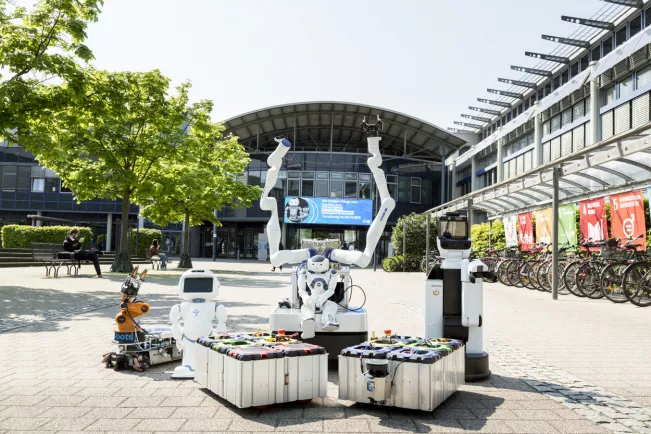
MAS projects and theses
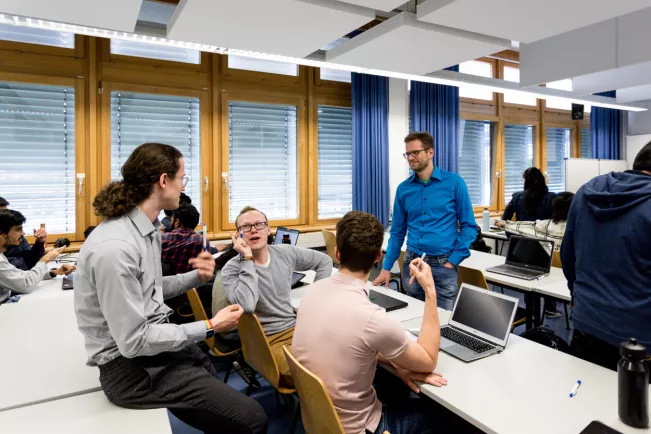
We connect students with leading research and industry. Strong ties to Fraunhofer IAIS and IPA, as well as partnerships with companies such as KUKA, Infineon, GPS, BGIA and Bertrand, provide access to state‑of‑the‑art topics, platforms, and mentorship. International exchange with our partner universitiesadds global perspectives and methods. Students build up an outstanding portfolio and industry-ready skills. Companies gain access to motivated talent and the opportunity to test concepts for new technologies.
Would you like to offer an R&D project for our students?
Here you can find the successful projects and final dissertations of our students on the Master's degree programme in Autonomous Systems.
Awarded / Published
Natalia Quiroga wins the first AFCEA Prize in 2024
1st and 2nd place in the 2023 AFCEA Student Award
Sushant Vijay Chavan took second place with his master's thesis ‘Coins Map – Composable ontology-based indoor semantic map’.
2026
Master’s Thesis Defence 2026
- Deep Learning-based Approach for 3D Reconstruction of Single-Shot Photometric Stereo Images at Close Range
- FunAkt3D: 3D Functional Element and Affordance Detection for Robotic Interaction
- Deadlock Detection and Resolution in CV.Singulate System
- Event-Based Computer Vision for Acquisition, Tracking and Communication
- Exploration of Multi-lingual Vocabulary for Context Biasing in SpeechLLM
R&D Project Defence 2026
- Post-hoc correction of 3D voxel-based semantic grids via contextual learning models
- Biometric Forgery Detection via 3D Face Structure Analysis
- Enhanced Human Skin Detection with Time-of-Flight and BRDF
2025
Master’s Thesis Defence 2025
- Advancing Indoor Spatial Perception: Leveraging 3D Scene Graphs and Sensor Fusion for Localisation and Mapping in Robotics
- Forklift and Human Pose Estimation for Safety and Risk Analysis in Industrial Environments
- Evaluating Visual SLAM Algorithms for a Micro-Rover in Lunar Environments with Constrained Resources
- Deep Learning-Based Denoising for Heartbeat Audio Enhancement
- Neural Reconstruction for Higher Accuracy in Lidar-Based SLAM
- Textual Representation of Visual Programs
- Reliable Deep Surface Normal Estimation through Probabilistic Quantification of Aleatoric Uncertainty from Monocular Images
- On using conversational AI for automated planning goal specification
- Deep Learning Models for Time Series Forecasting in a Concentrated Solar Power Plant
- Fusion of Optical and Synthetic Aperture Radar Data on UAVs for Object Detection and Classification in Disaster Areas
R&D Project Defence 2025
- Evaluation of Semantic Segmentation using Artificial Training Data
- Learning Locomotion for Quadruped Robots
- Multi-Input Conditional Object Detection
- Exploration of the Adaptation of XAI Methods for Automatic Speech Recognition
- Image-Based Machine Learning Methods for Bolting Tool Selection
- Explaining Models for Predicting Student Exam Performance based on Longitudinal Data
- Evaluation of Few-Shot Transfer of Vision-Language Foundation Models to Learn Lightweight Models for Robotic Vision Tasks
- Testing Fatigue Detection in Driver Status Monitoring (DSM) Systems
- Comparative evaluation of mobile manipulation technologies
- Development of a framework for the localisation of radioactive sources and evaluation methods
- Season-Invariant Feature Recognition for Image Matching in Forest Ground Using Deep Learning Algorithms
2024
Master’s Thesis Defence 2024
- Robust Robot Task Execution with Monitoring and Recovery in Anomalous Conditions
- Fuzzing Strategy for Enhancing Error Detection in Machine Learning Models
- A Study on the Effect of Calibration Quality on Multi-Modal Perception Tasks for Autonomous Driving
- Efficacy of Foundation-Model-Based Distillation for Image Classification
- Development of an AI-based method for the pre-evaluation of electrical distribution grids for state-estimation-based congestion handling
- CAPerMoMa: Coupled Active Perception for Mobile Manipulation in Unknown Environments
- Graph Optimisation for View Motion Planner
- Physically Informed 6D Object Pose Estimation
- Harnessing Large Language Models for Clinical Entity Extraction and Medical Coding in German Clinical Text
- Enhancing Synthetic Images for 3D Object Detection in Autonomous Vehicles
- Joint Speaker Diarisation and Recognition through Iterative Refinement
- Multimodal Deep Anomaly Detection for Robot Pouring Task
- Exploiting Contacts for Workspace Alignment with a Dual-Arm Mobile Robot
- Graph CNN-Based Warpage Forecasting for Improved Quality in Electric Battery Case Manufacturing
- Uncertainty Estimation for Keypoint Detection and its Application in Robot Grasping
- Knowledge-based Adaptation of Robotic Control and Estimation Architectures in the Presence of Uncertainty
- Sensor Fusion-based SLAM leveraging Hierarchical Representation
- Online Terrain Traversability Estimation for Wheel-Legged Rover Exploration
- Towards Enhancing Industrial Process Fault Diagnosis: A Fusion of Logic Rules and Neural Networks
- Outdoor Navigation in Uneven Terrain using Learning Methods
- Investigating Surrogate Modelling Techniques for Quality Diversity Optimisation of High-Dimensional Discrete Problems
- A Model-Based Approach for Fault Detection and Diagnosis in Robotics using Inductive Logic Programming
- Natural Language Processing and Topic Modelling for Exploring Trends in Human-Robot Interaction
- Multimodal Emotion-Aware Conversational Agent
- Context-Aware Product Recommendation Engine for Automated Tender Processing
- Differentiable Physics for Few-shot Contact Dynamics Learning
- Deep Learning-Based Super-Resolution of Urban Digital Surface Models
- Experience-Based Path Planning Framework for Real-Time Learning from Demonstration
- Robustness and Fairness Evaluation for the German Question Answering Task
- Quantitative Comparison of Deep Learning Classifiers and Human Attention in Assessing Rare Disorders
- Increasing the Efficiency of Monte Carlo Tree Search via Bayesian Optimisation
R&D Project Defence 2024
- Motion Control in Multi-rotor Aerial Robots Using Deep Reinforcement Learning
- The Effect of the Randomness Underlying Image Cropping in Contrastive Learning: A Comparative Study
- Effect of Keypoint Confidence Maps on Visual Odometry
- A Comparative Study of Image Augmentations in Contrastive Learning
- System Transparency Specification for Assistive Robots
- Development of an RTK GPS-enabled
mobile soil moisture sensor - Exploring strategies and the impact of pre-trained embeddings for sound event detection
- Knowledge-enabled adaptation and relaxation of robot motion control
- Improving Robotic Perception through Kinematics and Dynamics Feed-forward
- Black-box optimisation of the ground interaction model for legged robots
- Interpretability Analysis of Speaker Embeddings in DNNs for a Robust Speaker Recognition System
- Explainability Analysis for Skill Execution
- Exploratory Analysis: Leveraging BERT Models for Adverse Event Detection in Clinical Text
- Enabling Intuitive Human-Robot Interaction during Continuous Navigation and Manipulation in a VR-Based Teleoperation Setting
- A Comparative Study of Visual Anomaly Detection Methods in Industrial Inspection
- Cyber Threats and Risk Mitigation in Autonomous Vehicles
- Object detection in adverse weather conditions using tightly-coupled data-driven multimodal sensor fusion
- Learning-Based Individual Plant Detection for Vegetation Monitoring of Post-Harvest Forest Floor Using Aerial Imagery
- Combining Multi-speaker Recognition and Diarisation
- A Study on the Multi-classification Problem of fNIRS Data Using Right-hand Fingers
- Exploiting contact constraints in robotic manipulation tasks
2023
Master’s Thesis Defence 2023
- Towards Building a Tomato Crop Localisation Map using GPS, IMU, and Visual Odometry
- 3-D Molecular Conformation Generation Using Machine Learning
- An Investigation into the Impact of Multimodality on Named Entity Recognition
- Multimodal Deep Learning-Based Adaptation of Robot Behaviour for Assistive Robotics
- Applying the Principles of the YOLO Object Detector to Time-Series Subsequence Search
- Pedestrian Activity Monitoring using DeepSORT under Partial Occlusions
- Multi-modal Emotion Categorisation in Oral History Interviews
- Timetable optimisation using reinforcement learning
- Time series forecasting models for a simulation-accelerating surrogate model
- Vehicular in-cabin depth estimation using sparse training data
- Deepfakes in style: Improving Face-swapping Autoencoder with StyleGAN Components
- Continual Learning in Object Detection
- Benchmark for Few-Shot 6D Pose Estimation Methods
- On the Explainability of Neural Network Models for Classifying Rare Genetic Syndromes from Frontal Facial Images
- Vision-Based Automation System to Prepare Harvested Lettuces for Packaging
- Comparative Evaluation of Feature Extraction Methods for Time Series Classification
- Property-Based Testing: Formalised Robotic Testing for Standard Compliance
- Multi-View Temporal Fusion in Semantic Segmentation
- Computer-assisted short-answer marking with rubrics using active learning
- Comparative analysis of the use of different granularity levels on word embeddings for literature-based knowledge discovery
- End-to-End Prediction of Driving Commands Using 3D Lane Detection as an Auxiliary Task
- Continuous Control of Under-Actuated Autonomous Vehicles using Reinforcement Learning Methods
- Navigation of Bulky Robots in Confined Indoor Spaces
R&D Project Defence 2023
- Integrating Anomaly Detection with Fault Diagnosis for Long-Horizon Tasks
- Automatic LiDAR - Camera Extrinsic Calibration Based on Natural Features in the Environment
- From Motion Specifications to Robot Control Architectures: Design and Implementation of a DSL for Robot Manipulation
- Semantic mapping for enhanced localisation in indoor environments
- 3D object detection for autonomous driving using stereo vision
- Difference annotation for car crash software reports
- Safe and Fault-aware Child-Robot Natural Language Interaction
- Automated Grading System for Plot Grading
- Similarity Calculation and Textual Entailment Identification for Short Answers
- Interval-based anomaly isolation in friction stir welding using machine learning
- Model-based time series synthesis for stress wave classification
- Learning efficient knife-handling skills in semi-structured environments on a dual-arm robot
- Developing a Framework to Compare 2D and 3D Few-shot Object Detection Algorithms
- Evaluation of Visual SLAM Approaches for UAVs in Indoor Environments
- Uncertainty Estimation for Quantised Deep Learning Models: Comparative Study
- Language Modelling for Conversational Speech Recognition
- Benchmarking Uncertainty Estimation of Deep Learning Models Using a Synthetic Dataset
- Development and implementation of a self-learning control approach for contact-rich object manipulation
- Evaluation and comparison of real-time robot perception capabilities in a 24/7 supermarket
- Anomaly detection using acoustic data in friction stir welding
- A Method for Creating a Forest Surface Temperature Model
- Tree Stump Detection Using Learning-Based Methods with Data Fusion
- Ontology for Integrating Failure Mode and Effect Analysis and Issue Reporting in Robotics
- ROS-based provenance for robotic applications
- Uncertainty Estimation for Key-point Detection Task: Robustness Study
- Similarity in Convolutional Neural Networks
- Real-Time Body Movement Analysis of Fitness Exercises for People with Paralysis Using Sensors
2022
Master’s Thesis Defence 2022
- Lifelong Action Learning for Socially Assistive Robots
- Multi-Person Tracking using Generative Models
- A Neuromorphic Approach to Obstacle Avoidance in Robot Manipulation
- Composing Software Architectures for Smart Manipulation Tasks based on the Popov-Vereshchagin Hybrid Dynamics Solver
- Specifying and Generating Simulated Environments for Verifying Autonomous Mobile Robot Scenarios
- Uncertainty in Explanation Methods for Neural Networks
- COINS Map: Composable ontology-based indoor semantic map
- Out-of-distribution detection in 3D semantic segmentation
- Empirical evaluation of multi-modal communication between a visually impaired person and an autonomous navigation aid
- Continual learning in semantic segmentation
- Learning simulation for plastic sheet extrusion in a blow moulding machine
- Novelty detection in semantic segmentation
- Benchmarking out-of-distribution detection methods in 2D object detection
- DExT: Detector Explanation Toolkit for Explaining Multiple Detections Using Saliency Methods
- Primitive detection on RGB-D data for a compact hybrid scene representation
- Multisensor data fusion techniques for mass imbalance detection in wind turbine blades
- Image-based quality control in thermoplastic composite production using deep transfer learning
- Improving the traceability of hazardous scenarios for multi-robot systems using a knowledge graph
- LiDAR-based indoor localisation with optimal particle filters using surface normal constraints
- Auto-encoding of semantic models of the mobile robot’s environment based on ontology for localisation and navigation
- Self-supervised learning for sonar images: enhancing multimodal perception for underwater applications
- Evaluation of Drift Detection Techniques for Automated Machine Learning Pipelines
- Object Detection in Dense Volume Data
R&D Project Defence 2022
- Evaluation of Visual Object Tracking Methods on Multimedia Datasets
- Automatic Consistency Check of Table & text in financial documents
- Semantic Video Keyframe Extraction
- Automatic Consistency Check of Tables & text in financial documents
- 3D Molecular Representation Using Machine Learning Models
- Traffic Sign Data Augmentation using Cycle-Consistent Generative Adversarial Networks (CycleGAN)
- Investigating topic segmentation for online news classification
- Tangible Programming in Open Roberta Lab
- Analysis of Active Learning Mechanisms Applied to Language Models for Computer-Assisted Short-Answer Marking
- Learning human gestures by imitation for robots
- Personalised Behaviour Models for Child-Robot Interaction
- Hard/soft logic inference using machine learning approaches in ODIN-II
- Benchmarking object placement algorithms for mobile robotic manipulators
- Uncertainty estimation in time-series prediction
- An intelligent approach to detecting valid measurement sequences for driving dynamics
- Testbench for UAVs
- Assurance Cases for Learning-Enabled Components
- Implementing an Enhanced Fruit Tracking System for Precision Agriculture
- Design of semantic parsers for knowledge representation using existing computer vision outputs
- Speech Emotion Recognition from German Oral History Interviews
- Automatic Scenario Detection for ADAS using Dynamic Time Warping
- Evolving Deep Neural Network Architectures for Time Series Classification
- Interactive Learning Loop for Modelling Valid Measurement Data in Driving Dynamics Evaluation
- Anomaly Detection in Time Series Data
2021
Master’s Thesis Defence 2021
- Context-based navigation using composed behaviours
- Humanoid Robot Grasp Suggestion
- Visuomotor policy learning for predictive manipulation
- Resilience of Edge-optimised CNNs to Adversarial Attacks
- A Benchmark for Out-of-Distribution Detection in Deep Reinforcement Learning
- Effective Neighbourhood Feature Exploitation in Graph CNNs for Point Cloud Object-Part Segmentation
- CoLe-VIO: Supervised Complementary Learning of Keyframe Detection and Visual-Inertial Odometry
- Improving PySpark Performance with Cross-Language Optimisation
- Design and Realisation of Smart Non-prehensile Manipulation Strategies for Robots
- Automatic Formative Assessment for Students’ Short Text Answers through Feature Extraction
- Intelligent Neural Network Design for Robotic Embedded Vision
- Automatic Question and Answer Generation from Domain-Specific Text for Exams
- Improving Accessibility and Transparency of Large-Scale Robot Experience Data using a Natural Language Interface
- Visuomotor Policy Learning using Dense Descriptors for Robot Manipulation
- Enhancing Model Predictive Control to Improve the Navigation of a Quasi-Omni-Directional Mobile Robot
- Vision-based safe robot motion for human-robot collaboration
- Image-based object detection for autonomous parking using convolutional neural networks
- Identifying object grasps for manipulation
- Deep Reinforcement Learning for Continuous Control Docking of Autonomous Underwater Vehicles: A Benchmarking Study
- Efficient architectures for object pose estimation
- Improving Uncertainty Estimates in Deep Learning Models using Knowledge Distillation
R&D Project Defence 2021
- Classification of the Degree of Destruction of Laminated Safety Glass by Texture Analysis
- Design of a Cost-Effective, Lightweight Robotic Running Coach
- Deep Learning for Livestock Detection
- UAV path planning in a 3D unstructured environment
- Development of a UAV 3D terrain mapping system for forestry applications
- Design and feasibility of a UAV-based seeding mechanism
- Comparative evaluation of adversarial attacks and their defence mechanisms on deep neural networks
- Comparative Analysis of Explanations for Multivariate Time Series Classification
- Imbalance Problems in Vision-based Object Detection and Learning from Negative Examples
- Generic Object Segmentation in Dense Volume Data
- Comparative evaluation of unsupervised methods for video anomaly detection
- Estimation of water content in agricultural land via UAV-based sensing
- Model-driven engineering support for ROS 2 through meta-models and tooling
- Benchmarking Uncertainty Estimation Methods in Deep Learning for Regression
- Explaining Deep Learning Models for Detecting Anomalies in Time Series Data
- Registering and visualising point cloud data with existing 3D CityGML models
- Clustering Techniques in Computer-Assisted Short Answer Grading
- Automated Test Generation for Robot Self-Examination
- Survey on Video-based Anticipation for Anomaly Detection
- Comparative Evaluation of Generative Models for Future Frame Prediction
- Feature Extraction for Motion Data
- Environmental Sound Classification Using Deep Learning
- Acoustic Quality Checking of Gearboxes using Machine Learning
- Comparison between Fixed-weight Neural Network and Bayesian Neural Network for 3D Object Detection in Autonomous Driving
2020
Master’s Thesis Defence 2020
- PillarFPN: A Feature Pyramid Extension to PointPillars for 3D Object Detection.
- Knowledge-Enabled Specification of Composable Robot Motion Control Architectures
- Efficient and Context-aware Pedestrian Trajectory Prediction
- An investigation of regression as a means of determining the precision-runtime trade-off for object segmentation.
- Evaluating Uncertainty Estimation Methods on 3D Semantic Segmentation of Point Clouds
- Development of a New Quality Prediction Approach and Aggregation of a Quality Prediction Pipeline
- Multi-robot task allocation with temporal constraints and uncertain durations
- Feature Extraction for Time Series Classification
- Generative machine learning model obfuscation
- Compositional Machine Learning Models for Robotic Manipulation Behaviours
- Estimating Confidence in Spatio-Temporal Models
- Explainable Assistive Short Answer Grading
- A Comprehensive Evaluation of Uncertainty Quantification Methods in Deep Learning
- Black-Box Optimisation of Object Detector Hyperparameters.
- Compliant Manipulation with Reinforcement Learning Guided by Task Specification
- Skeleton-Based Action Recognition: Enhancing the Co-occurrence Explorer with a View-Adaptive Network
- Lazy Robot Control by Relaxation of Motion and Force Constraints
- Immersive Telepresence Through 360° Video Streaming: Potential and Limitations Today
- Evaluation of Deep Learning Techniques for Impulse Sound Classification in 2D Representation
- Comparative Evaluation of Image Data Selection Methods for Human Pose Estimation
R&D Project Defence 2020
- NEPO Framework based on the Blockly Library
- Automatic Question Generation for Exams
- Identification of Reliable Observations in Car-Crash Analysis
- Localisation of Objects Using Unsupervised Representation Learning and Object Proposal Techniques
- Generative Models for the Analysis of Dynamical Systems with Applications
- Evaluation of Change Point Detection Algorithms for Time-Zero Estimation in Vehicle Crash Tests
- Intelligent Identification of Valid Measurement Data for Driving Dynamics Evaluation
- Detection of Occluded Pedestrians Using Deep Learning Techniques
- Comparative Study of 3D Object Detection Frameworks Based on LiDAR Data and Sensor Fusion Technologies
- Implementation of weightless neural networks on a GPU for background subtraction
- Comparing reinforcement learning generalisation across physics engines
- Simulation of realistic traffic flows using genetic algorithms
- Dynamic Modelling and Identification of the Neobotix MPO-700 Mobile Robot
- Whole-Body Contact Sensing in Human–Robot Interaction: A Comprehensive Literature Survey with Preliminary Implementations
- Fusing 3D Range Measures with Video Data for Robust Obstacle Detection and Avoidance
- Comparative evaluation of mobile LiDAR-based 3D mapping systems for robot navigation in large-scale environments
- Comparative evaluation of transfer learning models in semantic text similarity
- Embedded Deep Learning for Image-Based Grasp Verification
- A Comprehensive Classification and Evaluation of Deep Learning Techniques for Object Detection in Videos
- Multimodal machine learning techniques for evaluating task performance in robots
- A Comparative Study of Sparsity Methods in Deep Neural Networks for Faster Inference
- Interactive Learned Models to Aid Human Decision-Making
- Retrieval-based Geo-Localisation from Aerial Images Using CNN Features
- Towards smart coupling in multiphysics simulation
- Evaluation of language interoperability issues in PySpark
2019
Master’s Thesis Defence 2019
- Vision-based human fall detection
- Automated gait and pose analysis for lameness detection in cows
- Real-time deep learning for multispectral human detection
- Multi-agent system for warehouse material flow control
- Point cloud classification of real objects using CNNs
- Semantic localisation and navigation for indoor robots using OpenStreetMap
- A mediator system for querying heterogeneous data in robotic applications
- An Evaluation of Deep Learning Object Detection Pipelines for Maritime Applications
R&D Project Defence 2019
- Comparative Study of Uncertainty Estimation Methods in Deep Learning-based Classification Models
- SqueezeBox: Real-Time CPU Face Detector
- Incorporating Contextual Knowledge Into Human-Robot Collaborative Task Execution
- Comparative analysis of experience-based path planning frameworks for multi-robot systems
- Assessing service robots’ experience data with conversational interfaces
- Neural Scrutiny: A comparative study of neural network architecture generation techniques
- On Using Convolutional Neural Networks for Human Activity Recognition with Accelerometer Data
- Singularity detection in the Vereshchagin hybrid dynamics solver
- Extending the Vereshchagin hybrid dynamics solver to mobile robots
- Safe Reinforcement Learning – Comparative Evaluation and Experimentation
The list is constantly being updated. We’d be delighted to receive any additions, particularly from earlier years.
Would you like to find out more about a specific project? Please get in touch and we’ll try to put you in contact with the students.
Further information for MAS students
Contact

Sebastian Houben
Professor for Robot Vision and Machine Learning, International Affairs Representative, Head of Examination Board Master Autonomous Systems
Location
Sankt Augustin
Room
C230
Address
Grantham-Allee 20
53757, Sankt Augustin
Telephone
+49 2241 865 293
Kristin Pöllmann
Coordinator of the Master's programme in Autonomous Systems
Location
Sankt Augustin
Room
C226
Address
Grantham-Allee 20
53757 Sankt Augustin
Contact hours
Monday - Thursday
Telephone
+49 2241 865 9830Points of contact
Course guidance service Master Autonomous Systems
Campus
Sankt Augustin
Room
C 226
Opening hours
We look forward to hearing from you.