Communications and Marketing
25 years of transfer: Udo Scheuer retires
H-BRS: Can you still remember your first day at work in 1997?
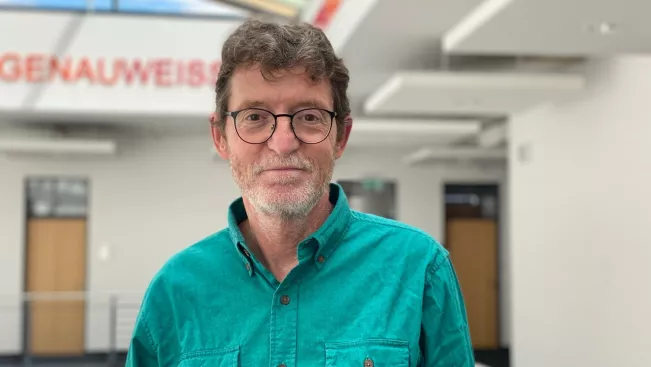
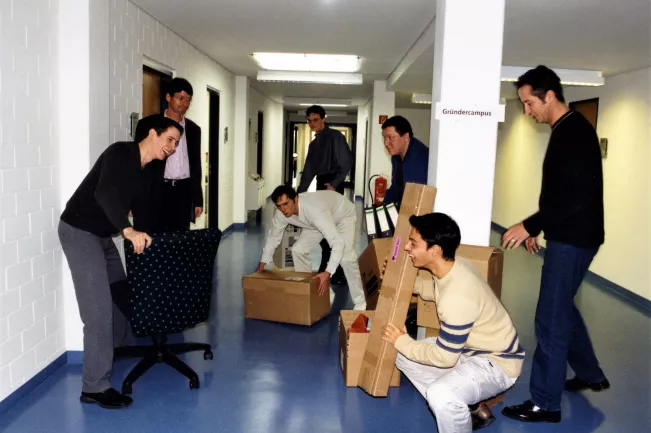
Udo Scheuer: Of course. The day before, I got a call from the Press and Public Relations department, which had formed a mini-team with the new Transfer department - consisting of press officer Eva Tritschler and a joint secretary. They asked me if I could give a presentation about the university at an event on the evening of my first working day. That's what I did - after spending the first day unpacking and storing a delivery of exhibition stand walls.
H-BRS: That sounds like a pretty shirt-sleeved start.
Scheuer: That was typical of the pioneering phase of the university, which had only been in existence for two years when I joined. People didn't ask about responsibilities. There weren't any yet. It was more a question of who still had a hand free and who could lend a hand where. However, we were able to develop and achieve a lot in this environment. When the first founders emerged from the university, even before we had our first graduates, we founded the Gründercampus at the turn of the millennium, the forerunner of today's ecosystem for start-ups in the region.
H-BRS: Today, the university is considered to be strong in research and successful in transfer. How can we imagine transfer at the end of the 1990s, when there was no research?
Scheuer: First of all, it was about raising awareness of the university - among politicians, the general public and, of course, prospective students. Back then, new degree programmes were created every year and they had to be advertised. We went to every event that would let us in: Regional conferences, university fairs, public festivals and so on. We even designed the posters ourselves to advertise degree programmes. When the Technical Journalism degree programme was launched, the slogan was "Do you understand the station when it comes to technology?". We showed a large picture of a locomotive next to it.
Innovation began with an old circular saw
H-BRS: When did the research really get going?
Scheuer: One or two years after I started. During this start-up phase, many new professors came to the university in a relatively short space of time, and they brought a number of ideas and approaches with them. From around 1999, we successfully submitted our first research proposals. A few years later, the first pioneering inventions and patents came from the ranks of the university - such as Norbert Jung's work in the fields of occupational safety and biometrics. I remember that we caused a stir at the Hannover Messe with an old circular saw. We had managed to make it safe using laser sensors: When someone held their hand to it, a safety guard immediately folded down. A few weeks later, all the German manufacturers of circular saws came to us wanting to know more about the technology. This resulted in contract projects, but also - as a late consequence - in strategic cooperation with the Federal Office for Information Security, with whom we launched the Biometrics Evaluation Centre last year. Above all, however, we were able to make it clear through patents on various topics that we have the relevant experts at the university.
H-BRS: What role did transfer play in this? Was it the launch pad for research projects?
Scheuer: The transfer has opened many doors. We have written many successful applications in which we not only formally explained the research question correctly, but also emphasised the transfer idea: What happens after the end of the research project, what benefits will it have in the long term? How do we want to utilise our results? I think we were more agile and more active than some of our academic competitors right from the start, we took up relevant topics at an early stage and we built up people who wanted to carry out practical research. That was always the secret of our success. With the founding of the Centre for Science and Technology Transfer in 2011, we have given transfer more visibility alongside research funding and put it on a new footing.
H-BRS: How did you identify the relevant topics?
Scheuer: In dialogue with our academics. And, of course, through close contact with industry, for example in the form of company visits. We specifically asked about future topics in the individual sectors, many of which later became the subject of practical research. We practised network management very early on, at a time when this term was not even used. We established a number of formats that were well received, such as the Company Day or the President's Dinner at the Bundeskunsthalle. Bringing science and business together at a Lagerfeld exhibition was an interesting experience - fortunately, it worked very well. All these developments have enabled us to shed the image of a university of applied sciences and showcase our strengths in research. With the "Campus to World" project, we have been able to further sharpen our profile in recent years.
"Campus to World" as a highlight
H-BRS: Looking back, was "Campus to World" as part of the federal-state initiative "Innovative University" the greatest success of your time in office?
Scheuer: Yes, it was a very important project. It enabled us to expand various fields of activity in terms of biometrics and security research, the expansion of transfer structures and the topics of ethics and responsibility. However, we have also developed new topics for us, such as citizen science, by seeking dialogue on everyday topics that are as concrete as possible - such as home gardens in terms of sustainability. The question was: How can we translate citizens' questions into scientific answers? Unfortunately, "Campus To World" ends at the end of the year and our application did not make it to the second round of funding. We had to realise that the focus there was on new universities. However, the university will certainly take up the key elements from the application and implement them in other ways. Especially in relation to the major topic of sustainability, which the university takes seriously. With the new sustainability strategy and the creation of the necessary structures, the university will be in a position to systematically roll out projects and initiatives.
H-BRS: Do you regret not being able to experience this new chapter in office?
Scheuer: I have to admit that there are some things that would have appealed to me. The initiatives around the topic of sustainability are one of them, but also the transfer agency DATI planned by the federal government, which is intended to bring research and business together. In that sense, it's a bad time to stop. But retirement doesn't come as a surprise, and the university has the necessary tailwind to tackle these issues.
H-BRS: What will you miss?
Scheuer: The diversity of the university and the interaction with so many people with different backgrounds. When the phone rang, you never knew beforehand whether it was about robotics, genetic engineering or business start-ups. It was exciting, and many collegial and friendly relationships were formed that I will certainly miss. But I'm sure that I won't be bored in retirement. Family, voluntary work, sport, playing the guitar, travelling - there's plenty to do.
Interview: Dominik Pieper
Contact us

Location
Sankt Augustin
Room
E 239
Address
Grantham-Allee 20
53757, Sankt Augustin
Telephone
+49 2241 865 9652