Department of Engineering and Communication
Felix Bünning is the new Professor of Artificial Intelligence in Engineering
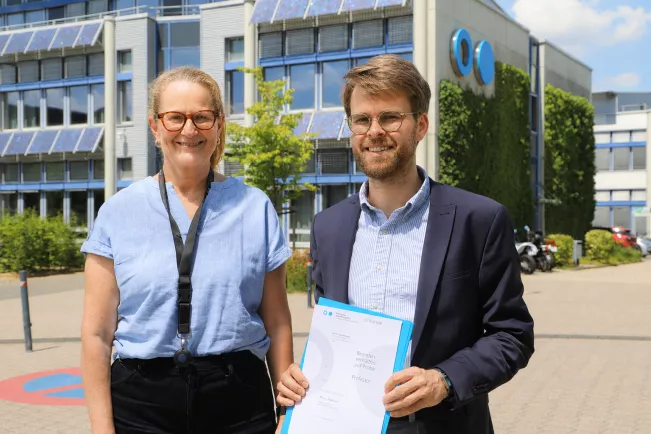
Bünning studied mechanical engineering at RWTH Aachen University and subsequently energy engineering, specialising in renewable energy. At the Lawrence Berkeley National Laboratory in California, he conducted research into the control of district heating systems. He moved to Zurich to complete his PhD, working concurrently at the Institute of Control Science at ETH Zurich and the Urban Energy Systems Laboratory at Empa. There, he developed control algorithms that combine data-driven methods with model-predictive control, and tested them in the NEST research building. He was awarded the ETH Medal for his doctoral thesis.
In 2021, he co-founded the company viboo in Zurich, which offers the methods researched during his PhD as a cloud service for heating systems and currently controls over 100 buildings across several European countries. He gained teaching experience at ETH Zurich, where he taught the ‘Building Control and Automation’ course and was the supervisor for around 15 final-year theses. At the H-BRS, he aims to bring both worlds together: “I have seen first-hand everything that needs to happen between a scientific publication and a product that works in the real world,” says Bünning. “I want to pass this experience on to the students, as they will be the ones implementing such solutions later on.”
At H-BRS, he aims to further develop his research. He considers it largely established from a methodological perspective – and proven in practice – that energy systems can be efficiently controlled using AI; the challenge now lies elsewhere. “The technology works. Yet it is still not widely used,” says Bünning. Systems whose decisions people cannot understand are often switched off or overruled.
At the university, he therefore intends to investigate how such systems can be made more comprehensible – for example, through AI that derives specific recommendations from individual consumption patterns, or through methods that reveal why an automated control system makes a particular decision rather than another. In doing so, he is joining colleagues at the H-BRS who are working on related issues: at the Institute for Artificial Intelligence and Autonomous Systems, for example, on explainable AI; and at the Institute for Technology, resource and energy efficiency, on sustainable energy systems.
Contact

Location
Location
Sankt Augustin
Address
Grantham-Allee 20
53757 Sankt Augustin