Communications and Marketing
H-BRS bulletin: "The digitalisation of public space is a key issue for the future"

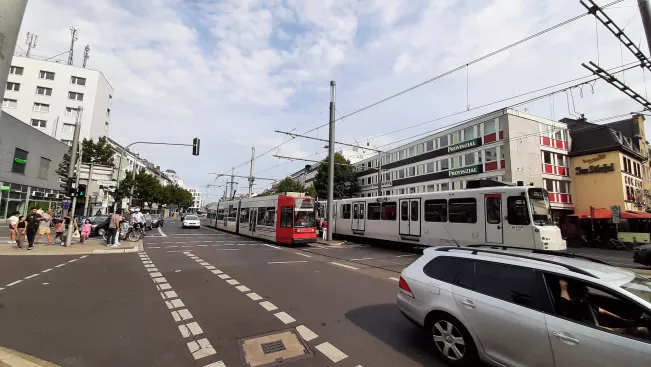
H-BRS: Professor Rademacher, in Hürth, the city has installed rubbish bins that send a request to empty them when they are more than half full. In Bonn, trees have been fitted with sensors that measure the moisture content in the soil and send the data to the Office for the Environment and Urban Greenery. Other cities have street lamps that only light up at full power at night when they recognise cyclists or pedestrians. Are these technical gimmicks, or is there more to it than that?
Michael Rademacher: Not at all. The digitalisation of public spaces, i.e. the concept of a so-called "smart city", is a key topic for the future. We have already made significant progress in our private and professional lives. When we interact with VR glasses or a language model such as ChatGPT, for example, the lag in public spaces is particularly noticeable. If properly thought through, networked technical systems can offer real added value and increase both quality of life and economic growth.
H-BRS: How far are we on the way to becoming a smart city?
Rademacher: We are still at the beginning in Germany. However, increasing electrification, for example through e-mobility or decentralised energy generation, is forcing us to move faster. In administration, we are seeing initial progress thanks to the Online Access Act, which describes the legal framework for the path to digital citizen services. We are lagging behind in many other areas. We now need to lay the right foundations.
„Networked technical systems, if properly thought through, can offer real added value and increase both quality of life and economic growth.”
Michael Rademacher - Professor of Embedded Systems and Networks at the Department of Computer Science

H-BRS: If sensors and cameras are installed everywhere in the city, won't that bring us much closer to a surveillance state?
Rademacher: This concern is understandable and justified. I myself think that cameras are the wrong way to go; there are other types of sensors that are better suited to the application. In general, however, we have it in our own hands. There are promising approaches to anonymising and pseudonymising data. Implementation is complex, but it is a mandatory prerequisite for successful digitalisation.
H-BRS: What do cities need to pay attention to so that, on the one hand, the potential can be exploited and, on the other, security and privacy are preserved? Data protection is often viewed negatively, and that needs to change. At the same time, local authorities should remain open to technology and define high IT security requirements from the outset. This may mean that not every application request can be implemented immediately, but the resulting pressure will lead to better solutions on the market.
H-BRS: In your research, you focus on secure communication networks. What can research and the university contribute to progress in digitalisation?
Rademacher: All systems that collect or process data are networked, usually wirelessly. Secure networks and protected data transfer are therefore the basis of all digitalisation. Our research group focuses on two key issues: firstly, the secure transmission of data and secondly, the availability of wireless networks. Data must be protected from manipulation and interception en route, and a sensor is only useful if the network offers stable coverage. Our aim is always to translate the research work into prototypes that can be demonstrated in order to show direct added value. This is currently working very well.
About Professor Michael Rademacher
Press photos for download

Contact

Michael Rademacher
Professorship of Computer Science, in particular Embedded Systems and Networks, Research Group Leader Fraunhofer FKIE
Location
Sankt Augustin
Room
F313 (entrance via car park behind the F-building)
Address
Grantham-Allee 2-8
53757 Sankt Augustin
Contact hours
Please enquire about consultation hours via e-mail
Telephone
+49 2241 865 151
Location
Sankt Augustin
Room
E 240
Address
Grantham-Allee 20
53757, Sankt Augustin
Telephone
+49 2241 865 9560