Communications and Marketing
Exhibition "ZOOM! Microscopic images between science and art"
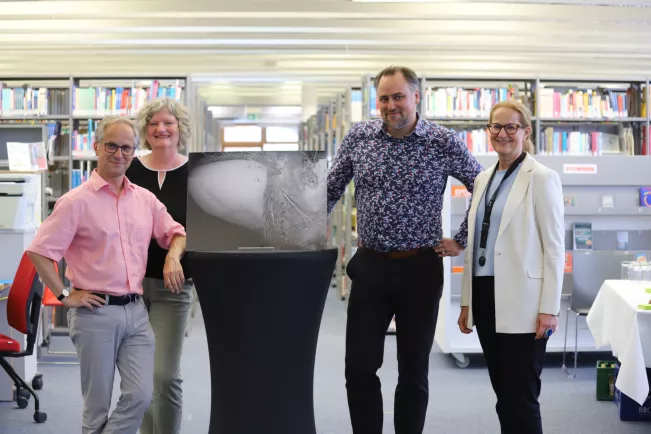
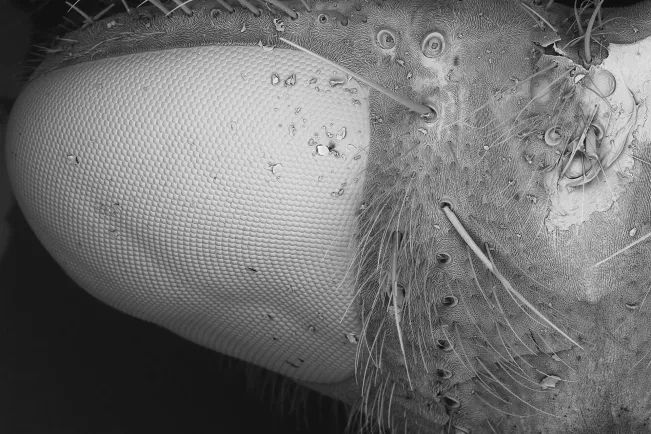
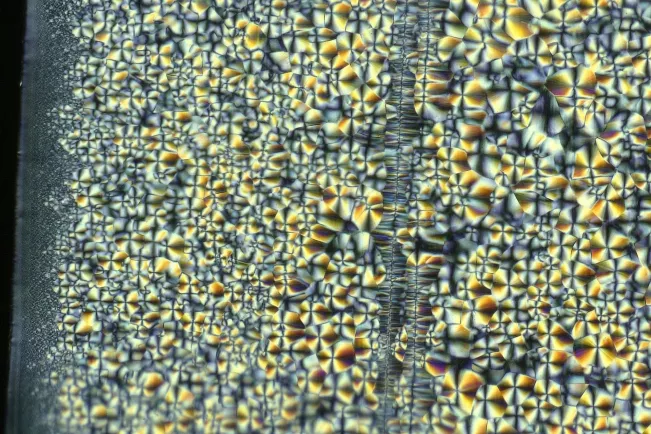
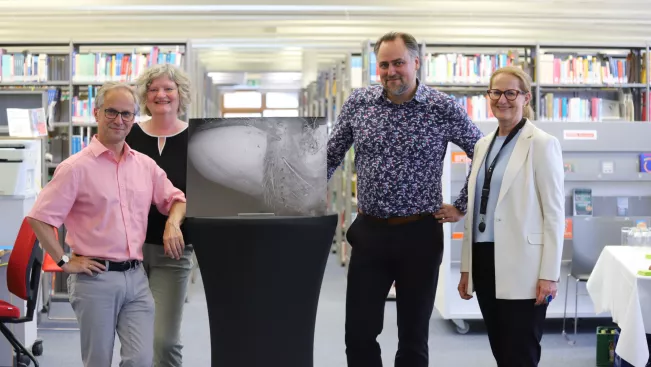
The Hochschule Bonn-Rhein-Sieg offers around 40 degree programmes. Artistic subjects are not among them. And yet studies and research sometimes produce results that are characterised by a special aesthetic. In the exhibition at the Rheinbach campus, 23 exhibits provide fascinating insights into the microscopic world of nature and materials. Sometimes a picture is reminiscent of a church window flooded with sunlight, sometimes endless spaces seem to open up. Anyone who engages with the works will find numerous associations. In fact, the images conceal concrete motifs from the environment. What you see here is a fly's eye, the crystal structure of a hoover's cable reel or the structure of silk - each in extreme magnification, captured by researchers and students from the fields of materials science, biology and forensics
The idea for the exhibition came from Vice President Research and Transfer, Professor Johannes Steinhaus, and Professor Emeritus of Chemistry, Gerd Knupp. "Science can change the way we look at the things around us and provide exciting new insights into micro- and nanoscopic worlds," explained Steinhaus at the opening of the exhibition. The exhibition allows scientists to look over their shoulders as they work, so to speak, and the images also have an artistic quality. "It's fascinating to suddenly recognise things in nature and materials that remain completely hidden without a microscope," he said. Science creates transparency and makes complex relationships visible.
Part of "Kunst findet Stadt!" in Rheinbach
The exhibition is part of the "Kunst findet Stadt!" project in the city of Rheinbach, which is based on the guiding principle of democracy. "Democracy thrives on openness and dialogue," said university president Marion Halfmann. This event fits in perfectly with the library, which is a place of discovery and wonder, as well as with the theme of society and democracy, she said.
Because scientific knowledge plays an important role in society, as the Dean of the Department of Natural Sciences, Professor Richard Jäger, demonstrated in a keynote speech. He chose a local example: the Rheinbach witches' tower, which symbolises irrationality and the belief in supernatural causes such as magic or witchcraft and represents a dark chapter in the town's history. "Today there is a primary school next to it - which is somewhat ironic," said Jäger. At the time of the witch trials at the transition to modern times, most of the laws of nature had not even been discovered and knowledge was very incomplete, unlike today. But something else was just as crucial: "Education was by no means a common good at that time," said the Dean. Teaching the natural sciences was no less important than scientific research itself. Both are closely linked to technological progress and rationality, which today underpin our prosperity and our society.
Counteracting irrational tendencies even today
Even today, it is still important to counteract irrational tendencies. "The teaching of scientific principles and methods is an ongoing task and represents an extremely important social achievement of schools and universities, through which enlightened rationality is anchored in our coexistence," said Jäger. The exhibition "ZOOM! Microscopic images between science and art" makes a contribution to this. "Microscopy is a technique with which even the inexperienced can easily penetrate into the realm of the hidden and thus gain initial access to the foundations of our reality," he emphasised, also with a view to simple devices that are also suitable for children and young people.
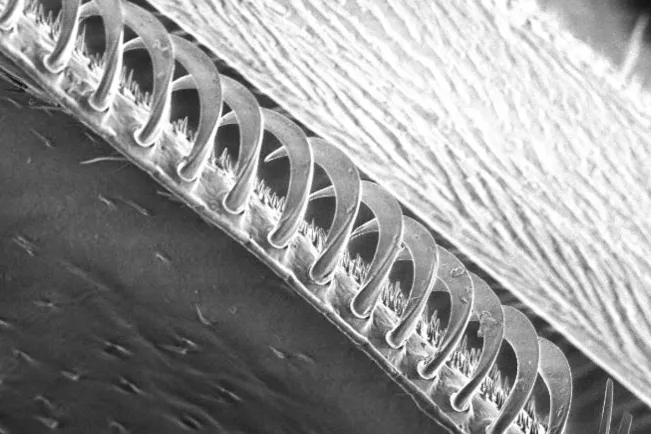
The images in the exhibition are taken with high-performance microscopes and not only offer an insight into the natural sciences, but are also aesthetic. What the motifs are all about is explained in detail. For example, the scanning electron microscope can be used to visualise the hamuli, sickle-shaped hooks on the wing edge of a bumblebee. They serve to couple the front and rear pairs of wings and are essential for the bumblebee's ability to fly. In addition to the very vivid black and white images from scanning electron microscopes, colour images from light microscopes are also presented.
The "Zoom" exhibition
Press photo for download
Contact us

Johannes Steinhaus
Vice-President Research and Transfer, Professor of Materials Science
Location
Sankt Augustin
Room
E 234
Address
Granthamallee 20
53757 Sankt Augustin
Telephone
+49 2241 865 602Location
Rheinbach
Room
I 207
Address
von-Liebig-Str. 20
53359, Rheinbach
Telephone
+49 2241 865 458
Daniela Greulich
Deputy Head of executive department Communications and Marketing/Press and Public Relations, Press Officer
Location
Sankt Augustin
Room
E 237
Address
Grantham-Allee 20
53757, Sankt Augustin
Telephone
+49 2241 865 641