Communications and Marketing
Resilience of critical infrastructure: funding for high-tech research at the H-BRS
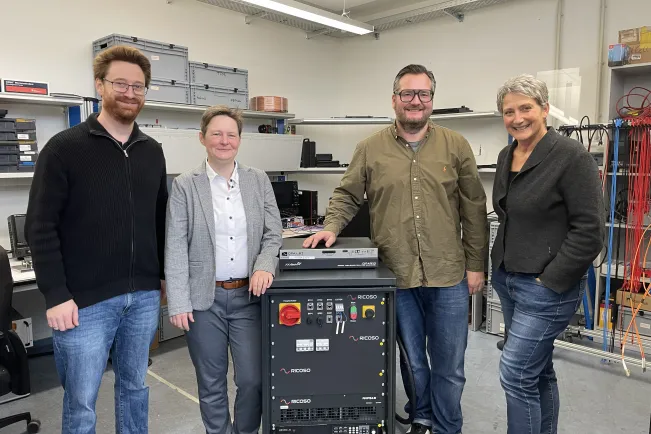
“As the world becomes more turbulent – whether due to extreme weather events or (cyber) attacks – the resilience of critical infrastructure must increase significantly. We aim to contribute to this with our research project,” says Professor Tanja Clees, who heads the “AI-supported resilience analysis for coupled critical infrastructures” (KRAFT) project at H-BRS. As the energy transition and digitalisation progress, the interconnection of electricity, natural gas, hydrogen and communications networks is increasing. At the same time, new interdependencies are emerging, meaning that extreme weather, technical failures, targeted sabotage or cyber-attacks can affect several sectors simultaneously. Until now, these systems have predominantly been analysed in isolation. The researchers are now developing methods and research frameworks to examine the systems holistically and enhance their resilience.
Physical and virtual levels
To this end, from next year onwards they will be establishing a permanent, interdisciplinary innovation space at the university in Sankt Augustin. This will take place on two levels: a physical one and a virtual one. Physical test facilities, real-time simulations, communication and cyber-security test environments, as well as AI-supported digital twins, will be integrated into a shared research infrastructure. “The focus is on developing AI-supported methods,” says Clees. These are intended to analyse resilience, detect anomalies, investigate cross-network effects and test technical and organisational defence measures.
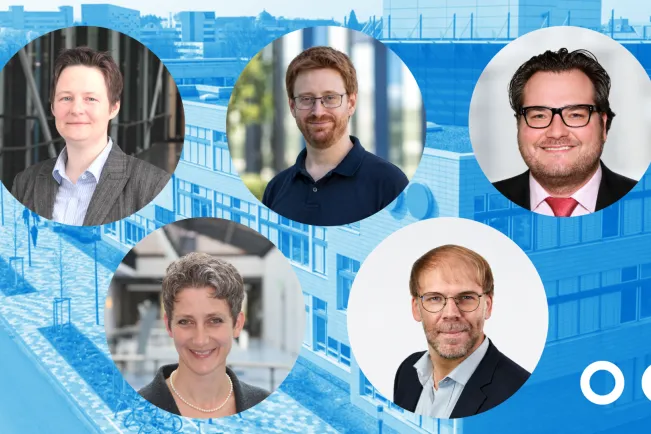
The innovation space created in this way is available to researchers and application partners from academia, industry and public authorities as a joint research and knowledge transfer platform. Access is governed by a role-based security concept. “Here, specific use cases – such as the impact of cyber-attacks on system stability – can be investigated,” explains Clees, who represents the areas of natural gas, hydrogen and sector coupling within the project. Alongside her, four other researchers from the departments of Engineering and Communication as well as Computer Science at H-BRS are involved: Professor Jörn Hees (AI and Data Science), Professor Marco Jung (Electricity and P-HiL), Professor Stefanie Meilinger (Sustainable Technologies) and Professor Michael Rademacher (Communication Networks).
Key technology: Artificial Intelligence
The KRAFT project combines the key technologies of artificial intelligence and climate-neutral energy systems with the research fields of security and sustainability from the High-Tech Agenda for Germany (HTAD). The federal and state governments have selected the project this week for funding under the new HAW-OpenSpace programme. According to the Joint Science Conference (GWK), the aim of this funding scheme is to support the establishment of open innovation spaces for inter- and transdisciplinary research relating to the HTAD’s key technologies, thereby strengthening application-oriented research at universities of applied sciences (HAW). A total of 31 projects across Germany are receiving funding; the programme has a budget of around 61 million euros.
Practice-oriented research at the H-BRS
The Hochschule Bonn-Rhein-Sieg University of Applied Sciences (H-BRS), founded on 1 January 1995, is a dynamic university with a strong research focus. It offers around 9,000 students ideal opportunities for learning and research, supported by more than 1,100 staff members, including 150 professors. The H-BRS has campuses in Sankt Augustin, Rheinbach and Hennef. The university offers a total of around 40 Bachelor’s and Master’s degree programmes. As a university of applied sciences, the H-BRS is heavily involved in practice-oriented research. A total of 17 institutes cover a wide range of subjects, from life sciences and health, sustainable development, resource conservation and security research to visual computing. The H-BRS collaborates with the regional and national business community and has established the Centre for Applied Research for this purpose. Since 2022, the H-BRS has also held independent doctoral degree-awarding powers through the NRW Doctoral College.
Press images available for download

Contact

Tanja Clees
Engineering, particularly Informatics for Engineers, Modeling and Simulation, TREE - Member of Executive Board, Research Professorship
Research fields
Location
Sankt Augustin
Room
B 245
Address
Grantham-Allee 20
53757 Sankt Augustin
Telephone
+49 (2241) 865-9854Fraunhofer SCAI
Location
Sankt Augustin
Address
Schloss Birlinghoven
53757 Sankt Augustin
Telephone
+49 (2241) 14-4074
Jörn Hees
Computer Science, Professor for Data Science, Chairman of the Computer Science Faculty Council
Research fields
Location
Sankt Augustin
Room
F 312
Address
Grantham-Allee 20
53757 Sankt Augustin

Marco Jung
Professorship for Electromobility and Electrical Infrastructure with a focus on Power Electronics
Research fields
Location
Sankt Augustin
Room
B213
Address
Grantham-Allee 20
53757 Sankt Augustin
Telephone
+ 49 2241 865 316Location
Sankt Augustin
Room
B213
Address
Grantham-Allee 20
53757 Sankt Augustin
Telephone
+ 49 2241 865 316
Stefanie Meilinger
Professor for Sustainable Technologies, esp. Energy Efficiency and Renewable Energies, Director of the International Centre for Sustainable Development (IZNE), Department Engineering and Communication (IWK)
Research fields
Location
Sankt Augustin
Room
F 321
Address
Grantham-Allee 20
53757 Sankt Augustin
Telephone
+49 2241 865 718
Michael Rademacher
Professorship of Computer Science, in particular Embedded Systems and Networks, Research Group Leader Fraunhofer FKIE
Location
Sankt Augustin
Room
F313 (entrance via car park behind the F-building)
Address
Grantham-Allee 2-8
53757 Sankt Augustin
Contact hours
Please enquire about consultation hours via e-mail
Telephone
+49 2241 865 151
Daniela Greulich
Deputy Head of executive department Communications and Marketing/Press and Public Relations, Press Officer
Location
Sankt Augustin
Room
E 237
Address
Grantham-Allee 20
53757, Sankt Augustin
Telephone
+49 2241 865 641