Communications and Marketing
Tubers with potato cancer have a special odour - H-BRS study
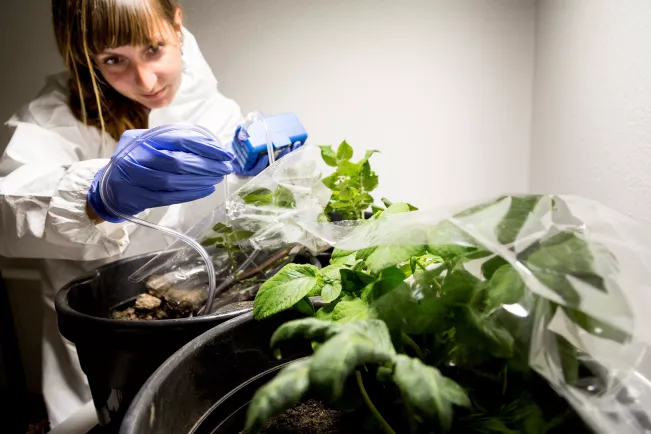
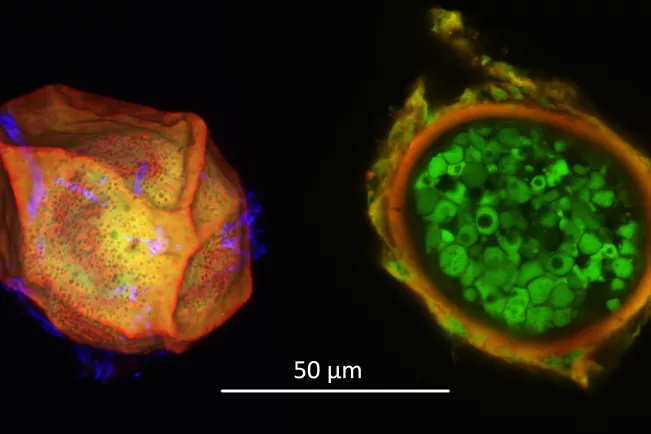
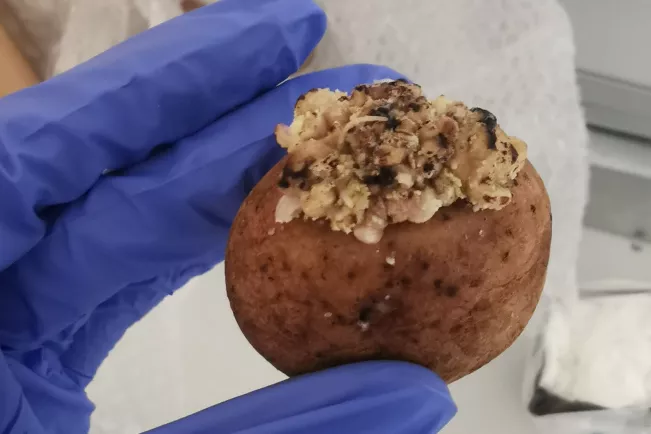
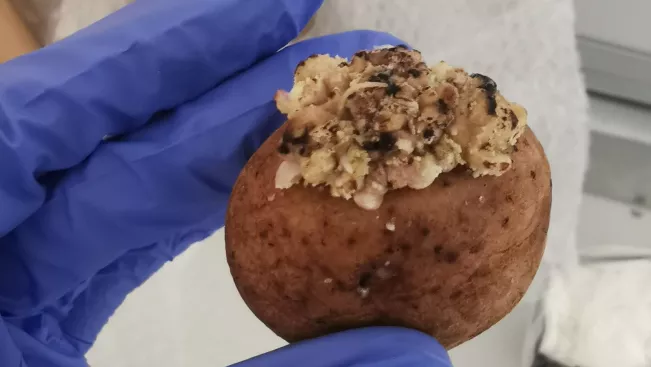
When potatoes are attacked by the fungus Synchytrium endobioticum, this has serious consequences for farmers. Although the fungus is harmless to humans, it causes what is known as potato wart, which removes all nutrients from the tubers. The fungus is a danger even before the typical cauliflower-like growths that give the plant disease its name develop on infected tubers. This is because it spreads via spores that are formed in so-called "permanent spores". These encapsulated spores can remain germinable in the soil for more than 40 years. This is why potato wart disease must be reported and infested fields are closed to potato cultivation for decades. According to the Julius Kühn Institute, the Federal Research Institute for Cultivated Plants, there have been several confirmed cases of potato wart disease in Bavaria in recent years, as well as findings in Lower Saxony and Baden-Württemberg.
Characteristic volatile organic compounds (VOCs)
PhD student Sarah Vermeeren has now developed a method to detect potato wart disease using characteristic volatile organic compounds (VOCs) as part of the joint project "SYNergie" at Hochschule Bonn-Rhein-Sieg. "With the help of gas chromatography-mass spectrometry and mathematical-statistical analyses of the chemical data, a specific infection pattern of infected potato tubers can be detected based on the fragrances, which enables reliable differentiation from healthy samples," says the researcher. Put simply, infected tubers smell different to healthy tubers - but not to the human nose, only to the measuring devices.
The starting point was a very large amount of data. Vermeeren took around 200 measurements on infested and healthy tubers in a specially prepared quarantine room at the H-BRS site in Rheinbach, collecting 7,000 data points of volatile organic compounds for each measurement. "The challenge was data reduction," says Vermeeren. She succeeded in filtering out the relevant organic compounds using a self-written programme based on machine learning, a branch of artificial intelligence. The result: "If seven substances occur in combination, this is a strong indication of infestation with potato cancer," says the PhD student from the Department of Natural Sciences. These substances are 1-methoxy-3-methylbutane, 3-methyl-1-butanol, 2-methyl-1-butanol, 2,3-butanediol, prenyl ethyl ether, styrene and solavetivone. This is the first detailed description of the VOC profiles in potato cancer. The study was published in the "Journal of Plant Diseases and Protection".
Potato wart: insidious plant disease
Potato wart is an insidious plant disease in more ways than one. The potato tubers grow below the surface of the soil so that an infestation is not immediately recognisable. In addition, the pathogen can not only remain inactive and infectious in the soil for years and spread through the soil, but it is also very resistant. Neither heat or cold nor chemicals can render it harmless. "This is why we are looking for quick methods to detect the fungus and prevent it from spreading," says Professor Peter Kaul, explaining the background to the "SYNergie" research project to detect Synchytrium endobioticum, which he led at the Institute of Safety and Security Research (ISF) at Hochschule Bonn-Rhein-Sieg (H-BRS). "SYNergie" was a joint project between H-BRS, the Julius Kühn Institute (JKI), the University of Osnabrück and the company Inopur. It was funded by the Federal Ministry of Agriculture, Food and Home Affairs (BMELH).
Kaul: Potential of non-invasive diagnostic methods
"The results show the potential of non-invasive diagnostic methods for plant protection and quarantine monitoring," says Kaul. The next step could now be the development of a rapid potato cancer test with a mobile system for the field. Kaul is convinced that other bacterial and fungal pathogens in potatoes, as well as in other plants such as maize, ginger, turmeric or beans, can also be detected in the future with the help of volatile organic compounds. H-BRS is currently continuing to focus its research on potatoes. The new "PoC-DiKa" project is focussing on four bacterial and two fungal pathogens in potatoes. The joint project with the Julius Kühn Institute, TU Braunschweig, the Association for the Promotion of Plant Innovation and the companies Lionex and Airsense Analytics is once again being funded by the BMELH.
Publication
Press images for download
Contact

Location
Rheinbach
Room
K210 R
Address
Heisenbergstr. 16
53359, Rheinbach
Telephone
+ 49 2241 865 9835
Location
Rheinbach
Room
G 133
Address
von-Liebig-Str. 20
53359, Rheinbach
Telephone
+49 2241 865 515
Daniela Greulich
Deputy Head of executive department Communications and Marketing/Press and Public Relations, Press Officer
Location
Sankt Augustin
Room
E 237
Address
Grantham-Allee 20
53757, Sankt Augustin
Telephone
+49 2241 865 641