30 years Hochschule Bonn-Rhein-Sieg
Exhibition Visionary Female Researchers: Rahel Hirsch
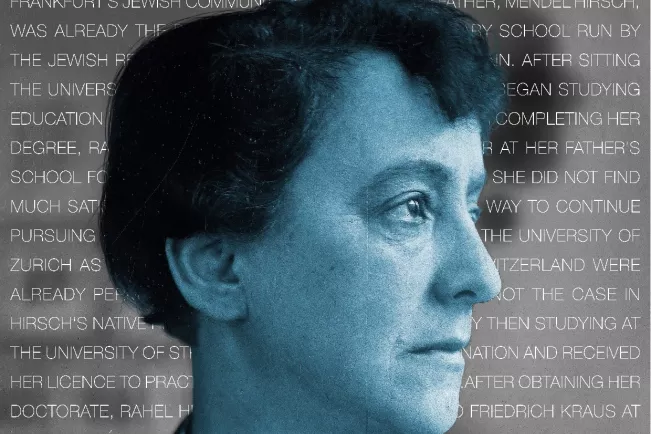
Biography Rahel Hirsch (1870-1953)
Rahel Hirsch is born on 15 September 1870 in Frankfurt am Main to Johanna Juedel. She is the sixth of eleven children in a respected family of the Jewish community in Frankfurt. Her father, Mendel Hirsch, is already director of the secondary school for girls of the Israelite Religious Community in Frankfurt am Main at this time. After graduating from high school in 1885, Hirsch begins studying education in Wiesbaden, graduating in 1889. Due to a lack of career alternatives for women, Rahel Hirsch initially works as a teacher at her father's school after graduating but finds this unsatisfying. She eventually finds a way to pursue her interest in medicine by enrolling to study medicine at the University of Zurich. Unlike in her Prussian homeland, women are allowed to study medicine in Switzerland since 1898. In 1903, Hirsch, now at the University of Strasbourg, passes her state examination and receives her licence to practise medicine in the same month.
After completing her doctorate, Rahel Hirsch becomes Friedrich Kraus' assistant at Berlin's Charité hospital. She is the second female doctor in the clinic's history after Helene Friederike Stelzner. In this position, she devotes herself entirely to research. She is particularly interested in the intestinal mucosa and the effect she observes in experiments of large-bodied food particles, such as starch grains, passing from the intestinal tract into the urinary tract. In November 1907, she is the first woman to be invited to present her findings at the conference of the Society of Chief Physicians at the Charité. However, her colleagues reject the process she described and initially do not consider her theory to be valid. Despite these negative reactions, Hirsch is not discouraged but remains steadfast in her conviction and continues her research with unbroken enthusiasm. Later, the development proves her right.
Under the tutelage of Friedrich Kraus, she takes over as head of the polyclinic at the Charité's Second Medical Clinic in 1908 and, in 1913, becomes the first female physician in Prussia and the third woman in the German Empire to be awarded the title of professor. However, her colleagues do not allow her to take on a lectureship or her own chair, and the Charité refuses to pay her a salary. In 1919, Hirsch finally feels compelled to leave the Charité and concentrate on working as a private practitioner to earn a living. In 1928, she opens an internal medicine practice with an X-ray institute on Kurfürstendamm in Berlin.
When the Nazi regime comes to power, the Jewish doctor loses her licence to practise medicine and is no longer allowed to treat ‘non-Jews’. In October 1938, she gives up her practice and flees to London. However, as her licence is not recognised by the British authorities, she initially works as a laboratory assistant and later as a translator.
However, the experience of fleeing her homeland, giving up her profession and the death of two of her sisters in concentration camps are almost too hard to bear for Rahel Hirsch and shape the last phase of her life. Suffering from severe depression and delusions, Rahel Hirsch spends her twilight years in a mental hospital on the outskirts of London, where she dies on 6 October 1953 at the age of 83.
Even though her male colleagues deny her recognition for her most significant scientific discovery during her lifetime, she is posthumously awarded a special honour four years after her death: In 1957, Gerhard Volkheimer, assistant to Rahel Hirsch's former colleague Theodor Brugsch at the Charité hospital, revisits Hirsch's findings on the permeability of the renal wall in his postdoctoral thesis and confirms them. In memory of the discoverer, he names the proven process the ‘Hirsch effect’.
Kreissparkasse Köln has sponsored the portrait of Rahel Hirsch and supported the exhibition Visionary female researchers with a donation of €3,000.
As a financial services provider, Kreissparkasse Köln has been rooted in the region for over 170 years. Private, corporate and municipal customers alike appreciate its comprehensive range of services and its business model, which is based above all on regional anchoring, trust and proximity.
For students, Kreissparkasse Köln offers a free current account and other tailor-made products. Here, Kreissparkasse Köln's young ‘Team Finance’ advises customers between the ages of 18 and 30 on their banking transactions in a way that suits their lives: by video, chat, telephone or in person – always approachable and always on an equal footing.
Kreissparkasse Köln also supports young talent through internships, working student positions and trainee programmes, enabling them to gain practical experience in banking. With flexible working models and an open corporate culture, Kreissparkasse Köln is an attractive employer for the next generation of financial experts.
Contact points
Centre for Science and Technology Transfer (ZWT)
Campus
Sankt Augustin