30 years Hochschule Bonn-Rhein-Sieg
Exhibition Visionary Female Researchers: Rosalind Franklin
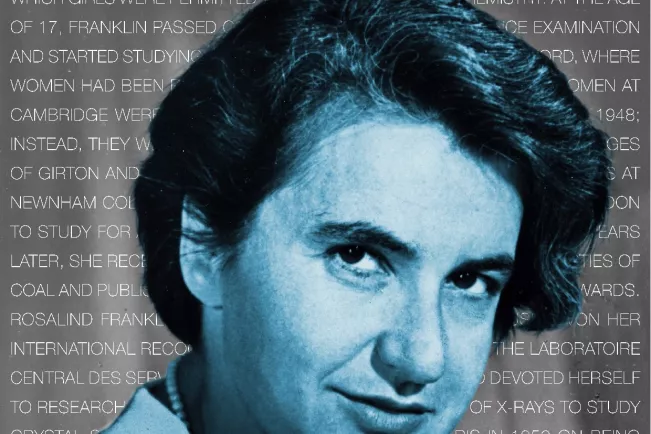
Biography Rosalind Franklin (1920-1958)
Rosalind Franklin is born on 25 July 1920 in London to Muriel Franklin, who herself comes from a family of intellectuals and academics. Rosalind's father is the Jewish banker Ellis Franklin. Her parents place great importance on their daughter receiving a solid education at St. Paul's Girls School in London, one of the few schools at that time where girls are also allowed to study physics and chemistry.
At the age of 17, Franklin passed the entrance examination at Cambridge University and began studying natural sciences. Unlike Oxford, where women had been allowed to obtain academic degrees since 1921, women at Cambridge are not considered full students until 1948, but merely as pupils of Girton and Newnham Colleges. In 1941, Franklin completes her studies at Newnham College, Cambridge.
At the age of 22, she obtains a position as a doctoral student in physical chemistry in London. Three years later, she completes her doctorate on the properties of carbon and immediately publishes her first scientific paper. Rosalind Franklin's research on carbon and viruses attracts international attention.
In 1947, Franklin joins the Laboratoire Central des Services Chemiques de l'Etat in Paris and devotes himself to the field of X-ray crystallography, the study of crystal structures using X-rays.
In 1950, Rosalind Franklin leaves Paris on a research scholarship and moves to the renowned King's College London. The fellowship comes with the task of setting up an X-ray diffraction facility and conducting research into DNA. At this point, a fierce international competition has already broken out to crack the code of DNA. Against this backdrop, a research programme led by biophysicist Maurice H. F. Wilkins is initiated at King's College even before Franklin arrives. However, working with Wilkins would prove extremely difficult from the outset. Wilkins initially assumes that Franklin is merely assigned to him as an assistant and not as a largely equal colleague. This misunderstanding can be cleared up but remains indicative of the relationship between the two. Wilkins has great difficulty accepting Franklin, whereas she takes an unambiguous stance. After the tense situation between the two poisons the atmosphere in the research laboratory and threatens to affect the work, the head of the laboratory, John Turton Randall, finally feels compelled to clearly delineate the areas of responsibility of Franklin and Wilkins.
Together with her doctoral student Raymond Gosling, Franklin succeeds in producing revealing X-ray images of DNA in 1951. She correctly interprets the images as evidence of a spiral structure of DNA, but hesitates to publish her findings at this early stage of the discovery. Nevertheless, she discusses her findings with biochemists Francis H. C. Crick and James D. Watson, who are working on deciphering the structure of DNA at Cambridge at the same time.
In 1953, Franklin's colleague and rival Maurice Wilkins passes on her latest X-ray images to Crick and Watson without her knowledge. This enables them to reconstruct the structure of DNA based on Rosalind Franklin's data and develop a model of the double helix, which they publish in the journal Nature.
Rosalind Franklin leaves Cambridge that same year and moves to the Birkbeck Laboratory in London, where she conducts research on the tobacco mosaic virus and live poliovirus until her death.
After years of working with X-rays, Rosalind Franklin dies of ovarian cancer on 16 April 1958 at the age of only 37.
Watson, Crick and Wilkins are awarded the Nobel Prize in Physiology or Medicine in 1962 for ‘the discovery of the molecular structure of nucleic acids and its significance for information transfer in living organisms’. It is now undisputed that Franklin's work provided an essential basis for determining the structure of DNA and that the discovery would have taken considerably longer without her X-ray diffraction patterns and the analyses based on them. Rosalind Franklin should therefore have been considered for this Nobel Prize.
However, it must also be taken into account that Rosalind Franklin was deprived of her well-deserved Nobel Prize not only by her male colleagues, but also by her early death, as the Nobel Committee does not award honours posthumously.
Contact points
Centre for Science and Technology Transfer (ZWT)
Campus
Sankt Augustin