30 years Hochschule Bonn-Rhein-Sieg
Exhibition Visionary Women Researchers: Maria Goeppert-Mayer
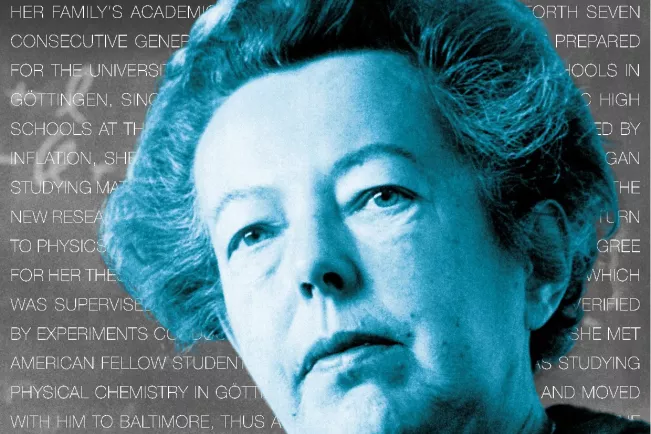
Biography Maria Goeppert-Mayer (1906-1972)
Maria Goeppert-Mayer is born on 28 June 1906 in Katowice, Upper Silesia, to Maria Wolff-Göppert, a language and music teacher. Her father, Friedrich Goeppert, a university professor of paediatrics (child medicine), moves with his family to Göttingen in 1910.
From an early age, Maria's parents encourage her to continue the academic tradition of her family, which had produced seven consecutive generations of university teachers. In Göttingen, she attended private schools that prepare her for her Abitur (A-levels), as girls are not allowed to attend public secondary schools at that time. Although school operations are interrupted by German inflation, she passes her Abitur in 1924 and begins studying mathematics in Göttingen. However, she soon turns to physics, as she is enthusiastic about the young field of quantum mechanics.
In 1930, Goeppert-Mayer earns her doctorate under Max Born with a thesis on double photon processes, a quantum physical effect. Her calculations, made at that time, are experimentally confirmed in the 1960s. During her studies, she meets her American fellow student Joseph Edward Mayer, who is studying physical chemistry in Göttingen. She marries him in 1930 and moves with him to Baltimore, thus escaping possible persecution by the National Socialists before 1933 due to her Jewish ancestry.
Her husband teaches at Johns Hopkins University, but for Maria Goeppert-Mayer, who is equally qualified, job opportunities are poor during the Great Depression. She finds employment as a German correspondent and is allowed to use her workplace for her own research. She also trains female students and publishes her own articles on physics. In 1940 and 1943, Goeppert-Mayer gives birth to two children, Peter and Nicole, who later also pursue careers in the natural sciences. At the same time as the challenging baby and toddler phase, she writes and publishes the textbook ‘Statistical Mechanics’ with her husband in 1940, which becomes a standard work.
In 1941, the situation changes when the United States declare war on Japan. Maria Goeppert-Mayer, who initially works as a science teacher at Sarah Lawrence College in Bronxville, is recruited by Columbia University. Here, she conducts research into separating highly fissile uranium-235 from the more stable uranium-238.
In 1946, Maria Goeppert-Mayer and her husband move to Chicago. She initially works as an unpaid member of the institute but quickly earns a professorship and subsequently conducts research at both the Institute for Nuclear Physics and the new Argonne National Laboratory, a national laboratory of the American Atomic Energy Authority.
Two years later, Goeppert-Mayer begins her research in the field of atomic nuclei and her work on magic numbers, postulating the ‘shell model’. Maria Goeppert-Mayer feels vindicated in her research by the findings of Hans Jensen (1907-1973) from Heidelberg, which had been published shortly before. The two then decide to continue their research together and write a book entitled ‘Elementary Theory of Nuclear Shell Structure’. In 1963, they jointly receive the Nobel Prize in Physics for their discoveries on the shell structure of the nucleus.
Despite suffering a stroke, Maria Goeppert-Mayer remains faithful to physics, teaching, researching and publishing until she dies in 1972 at the age of 65 as a result of a heart attack.
Contact points
Centre for Science and Technology Transfer (ZWT)
Campus
Sankt Augustin