30 years Hochschule Bonn-Rhein-Sieg
Exhibition Visionary Female Researchers: Wangari Maathai
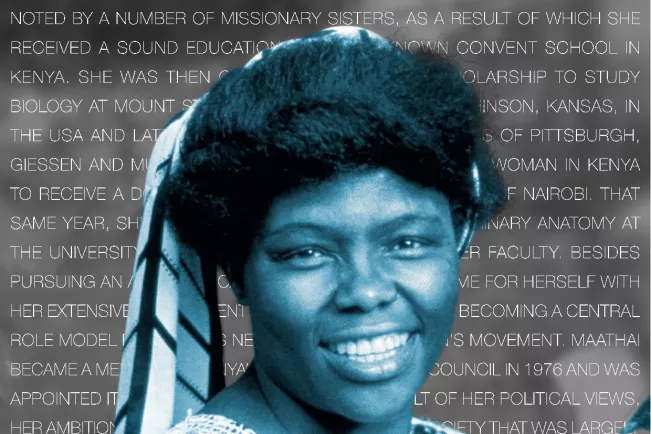
Biography Wangari Maathai (1940-2011)
Wangari Muta Maathai is born on 1 April 1940 in the village of Ihithe in the Nyeri District of Kenya to Teresa Nyokabi. Her parents are farmers. As a schoolgirl, her talent is noticed by some missionary sisters, enabling her to receive a solid education at a well-known convent school in Kenya. Her parents support her education, which was by no means a given in rural areas at that time. Thanks to her outstanding talent, she is selected for a scholarship to study biology in the United States at Mount St. Scholastica College in Atchinson, Kansas. She begins her studies at Mount St. Scholastica College in Atchinson, Kansas, and later continues her academic career at the universities of Pittsburgh, Giessen and Munich. In 1971, she becomes the first woman in Kenya to earn a doctorate from the University of Nairobi, where she is also appointed the first professor of veterinary anatomy. She later takes over as dean of her department.
In addition to her academic career, Maathai is passionate about socio-political issues and becomes a central figure in the emerging women's movement in Kenya. From 1976 onwards, Maathai is involved in the National Council of Women of Kenya, which she leads until 1987. During these years, she also gives birth to three children.
However, Maathai not only has to contend with considerable resistance on a political and professional level, but also in her private life. Her husband divorces her in 1979. In court, he cites as grounds that she is ‘too educated, too strong, too successful, too opinionated and too difficult to control’.
In her role as president of the National Women's Council, the scientist founded the Green Belt Movement in 1977, which combats poverty and preserves forests in East Africa through reforestation. Maathai initiated this project to protect the environment and improve the living conditions of women in rural areas. For this groundbreaking commitment, she was awarded the Alternative Nobel Prize in 1984.
In the 1990s, Maathai, whose commitment to environmental protection and women's rights repeatedly brings her into opposition with then-head of state Daniel arap Moi, is imprisoned and mistreated several times, but she never wavers in her resistance to oppression.
In 1997, Wangari Maathai ran for parliament and the presidency with unwavering courage. Although her candidacy was unsuccessful, it demonstrated her determination to drive political change in Kenya. In 2002, she is elected to the Kenyan parliament as a member of the National Rainbow Coalition (NARC). The NARC replaces Daniel arap Moi's government, and the newly elected President Mwai Kibaki appoints Maathai as Deputy Minister for Environmental Protection.
In 2004, Wangari Maathai becomes the first African woman to be awarded the Nobel Peace Prize – for her tireless work for ‘sustainable development, peace and democracy’, as stated by the committee in Oslo.
In the same year, the Heinrich Böll Foundation awards Wangari Mathaai the Petra Kelly Prize for her unreserved commitment to human rights, women's rights and emancipation, non-violence, ecological sustainability and the democratisation of Kenya.
In her final years, Mathaai devotes herself to establishing an institute for peace and environmental research at the University of Nairobi, which she realises together with the Heinrich Böll Foundation. The institute is later named after her and remains a testament to her life's work.
Wangari Maathai dies on 25 September 2011 in Nairobi because of cancer. Her tireless work for environmental protection, women's rights and social justice leaves behind a legacy.
Contact points
Centre for Science and Technology Transfer (ZWT)
Campus
Sankt Augustin