Department of Computer Science
Georg-Kerschensteiner-Berufskolleg visits the Computer Science Department at Hochschule Bonn-Rhein-Sieg
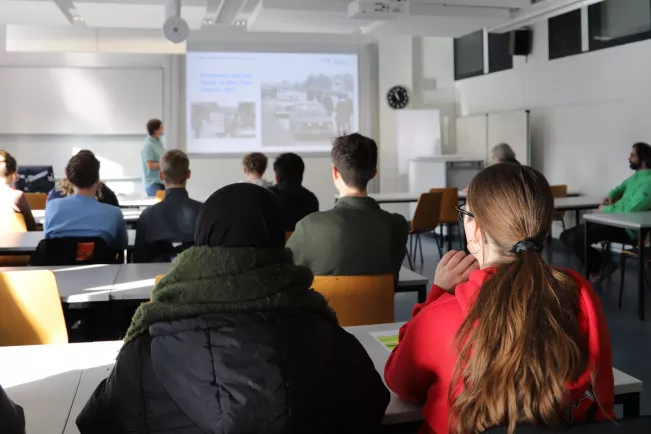
The students of the two-year Health and Social Care course (classes HS25A, HS25B and HS25C) were given an insight into the breadth of topics covered by computer science, both as an academic discipline and in its diverse fields of application, during their own visit day. More than ten employees from the department were involved in organising the technical aspects of the visit.
Science meets application
The school classes were introduced to various academic formats: scientific presentations, lectures, exercises and practical laboratory work.
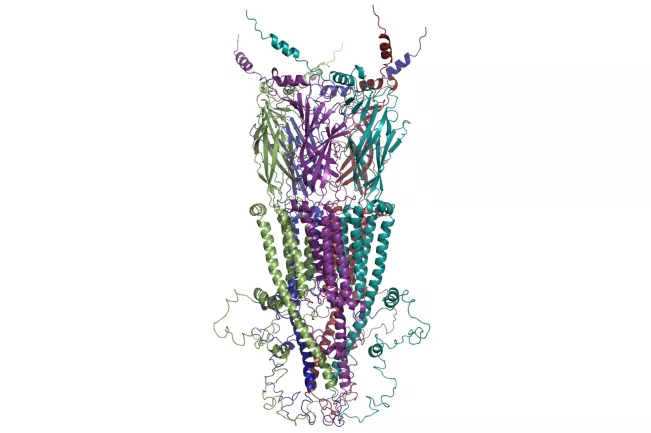
The event kicked off with an English-language lecture entitled ‘Scientific Programming: Data Visualisation and Interpretation Using the Example of Molecular Programming’ by Dr Karl Kirschner on the connection between natural sciences and computer science. He explained scientific objectives and model types and used mathematical methods and the Python programming language to demonstrate how molecules are modelled using computers. Using the example of a protein ion pore, embedded in current research from the DFG project ‘CytoTransport’, participants gained practical insight into modern computer-assisted research and were able to improve their English skills at the same time.
Afterwards, the students were able to take a close look at PC hardware and gained practical insights into data modelling and character encoding from Robert Hartmann. Among other things, they discussed the ICD-10 code for classifying diseases and its significance for medical documentation and billing.
Modern AI architectures were also discussed: using Microsoft Copilot as an example, a system architecture for connecting large language models (LLM) and retrieval-augmented generation (RAG) was outlined. The possibilities, but also the risks, of networked access to emails, files and chats via Microsoft Graph fascinated the students and gave them food for thought.
Data protection, information security and social responsibility
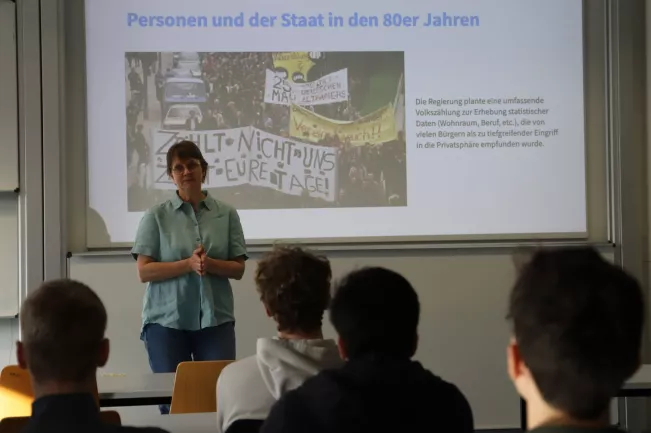
Prof. Dr. Petra Haferkorn gave a lecture on two days, and Ivonne Zimmermann-Fabricius gave a lecture on the third day on the topic of ‘To err is human: A practical introduction to data protection and data security’. The development of data protection in Germany was explained in historical context and compared with international perspectives. This highlighted the differences in how government and economic actors around the world handle personal data and the consequences this can have for users.
Markus Stuhm conducted an image-based exercise on information security management, focusing on process and data security using the example of a fictional medical practice. Based on a real data protection incident from the activity report of a state data protection officer, particularly fast working groups developed additional protective measures for a fictional scenario involving a pizza delivery service.
Robotics, visual computing and server technology
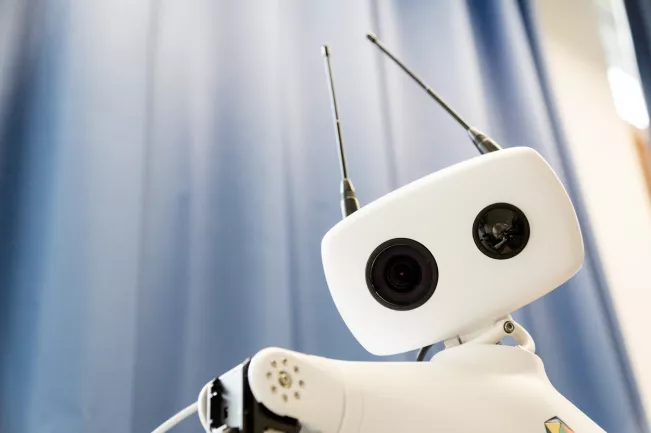
In the Robotics Lab, the classes interacted with robot systems under the supervision of Mohamad Wasil, Ritwik Sinha and Jordan Schneider. Congratulations were also conveyed to the winning team of the 2025 RoboCup World Championship.
Under the expert guidance of Philipp Löschner, the pupils gained insights into the Institute for Visual Computing, while Pia Funk gave them a tour of the Biometrics Evaluation Centre at the Institute for Security Research.
In small groups, they also visited the server room, where Javed Razzaq explained the basics of parallel computing and clearly demonstrated that ‘cloud’ data is always stored on physically existing servers. The importance of encrypting sensitive data was particularly emphasised.
In the hypermedia lab, the students immersed themselves in virtual anatomical models using VR glasses and were able to experience a virtualised knee examination. Bernd-Siegfried Klein explained the technology and the lab's current research activities.
Hands-on theoretical computer science
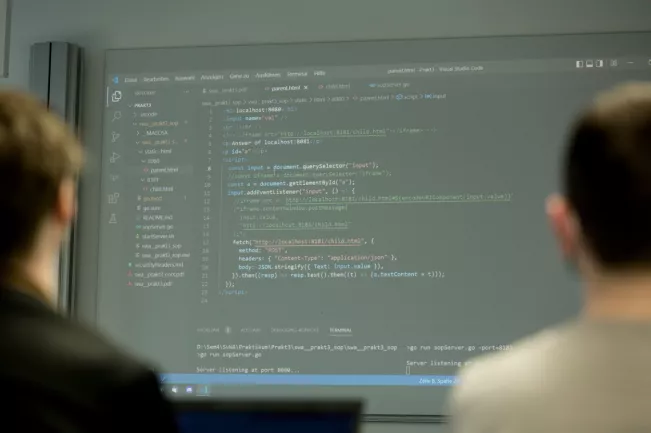
Hannah Freudenberger and Oliver Lanzerath concluded the event with an introduction to the concept of finite automata. Working individually and in groups, the participants developed a deterministic automaton that was simulated in a Jupyter notebook.
The enthusiasm was so great that two learners voluntarily invested an additional hour to further deepen their understanding of automata theory. In doing so, they independently discovered that the framework used to simulate deterministic automata is not readily suitable for modelling non-deterministic automata – an impressive example of discovery learning.
Getting a taste of university life in the main lecture hall
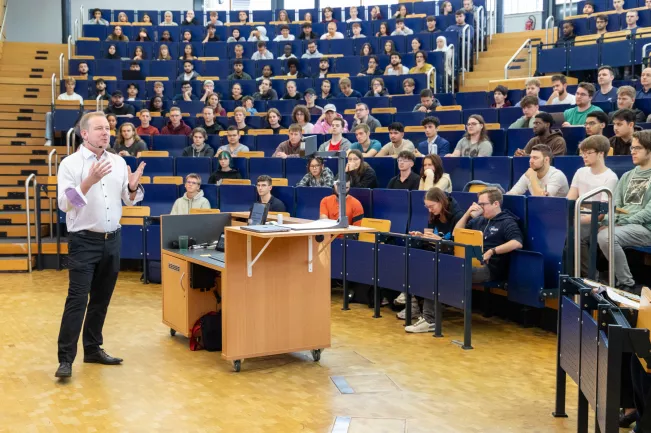
During the visit, there was also an opportunity to explore the campus's main lecture hall. For some, this was their first chance to sit in a large lecture theatre. Others realised how challenging it can be to speak in front of a large audience – especially in bright sunlight, when the back rows are barely visible.
The visit impressively demonstrated how diverse, interdisciplinary and socially relevant computer science is and how closely it is linked to topics such as health, biology, security and ethics.
Kontakt

Robert Hartmann
Dipl.-Inf., Research associate, VMWare IT Academy (Programm Coordinator), Technical Editor: ISSN 1869-5272, Raumplanung (FB02)
Location
Sankt Augustin
Room
C 184
Address
Grantham-Allee 20
53757, Sankt Augustin
Telephone
+49 2241 865 291