Graduate Institute
More accurate molecular simulations through intelligent optimisation: Robin Strickstrock successfully defends his PhD thesis
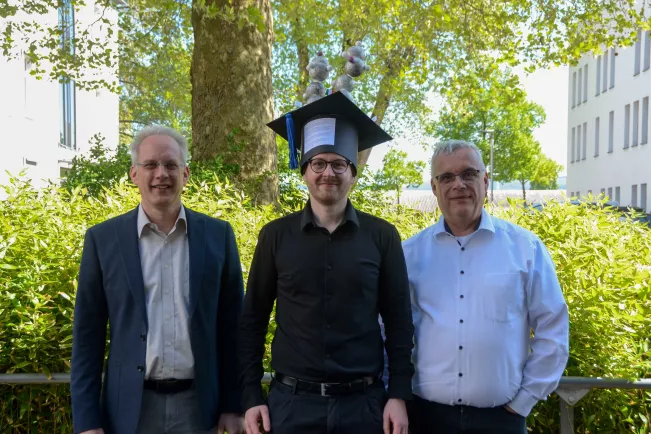
On 22 April 2026, Robin Strickstrock successfully defended his doctoral thesis at the University of Koblenz. The defence took place at the University of Koblenz.
The examination committee comprised his primary supervisor Dirk Reith (H-BRS) and Professors Wolfgang Imhof and Robert Rockenfeller (University of Koblenz). In addition to colleagues from the Sankt Augustin research group, other members of the University of Koblenz also attended the defence.
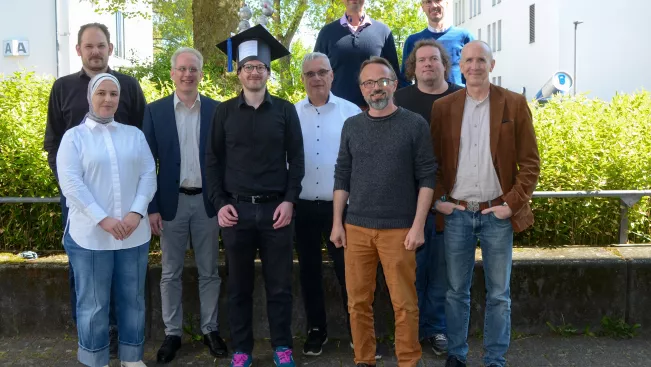
Dr Robin Strickstrock with the examination board and members of the working group
How can molecules be simulated on a computer as realistically as possible? Robin Strickstrock addressed this question in his doctoral thesis. Such simulations play an important role today – for example, in the development of new materials, more efficient energy storage systems, innovative fuels, or in chemical processes in industry and research. Crucial to the accuracy of these simulations are so-called force fields, which describe how molecules interact with one another. However, their parameterisation is considered a highly complex optimisation problem.
As part of his PhD research, Robin Strickstrock developed an automated, multi-scale optimisation workflow for force field parameters. This modular approach makes it possible to optimise a wide variety of parameters flexibly and to easily integrate new optimisation algorithms or objective functions. The result is a versatile tool for computer-aided materials and molecular research.
Among other things, the work demonstrates that optimising the Lennard-Jones parameters for n-octane can extend the scope of application of existing force fields. At the same time, Strickstrock specifically investigated conflicting objectives between different material properties and reduced these by fine-tuning the workflow. Furthermore, the use of machine learning surrogate models significantly increased the efficiency of the optimisation. Finally, the workflow was successfully applied to 1-bromobutane and 2-bromobutane, with significant improvements to the simulation models already achieved.
Professionally, too, Robin Strickstrock is now setting his sights on new challenges. He is particularly interested in the fields of embedded software development, renewable energy, and energy generation and supply, as well as the development of mechatronic systems.
The Graduate Institute at Bonn-Rhein-Sieg University of Applied Sciences warmly congratulates Robin Strickstrock on successfully completing his PhD and wishes him every success in his future career.
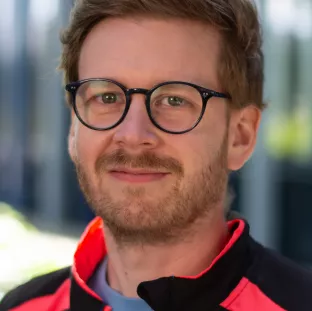
„Speaking from personal experience, my advice is not to be discouraged by unexpected experimental results that appear to contradict your hypothesis. Such cases either indicate that something went wrong in the experiment, or they open up a host of new and exciting questions that research can explore.”
Dr. Robin Strickstrock - PhD Engineering 2026
Anlaufstellen
Graduierteninstitut: Contact
Campus
Sankt Augustin
Room
F 427 , F 425, F 423
Opening hours
Mon-Fr 9.00 am-1.00 pm call us, send an e-mail or make an appointment for individual counselingfor