Communications and Marketing
DFG approves joint research training group of H-BRS, University of Bonn and UKB on the urban future
"For Hochschule Bonn-Rhein-Sieg, this research training group is a special milestone and a strong sign of the quality of our research," says University President Marion Halfmann. "Together with the University of Bonn, the UKB and IDOS as a non-university research institute, we are demonstrating how effective research can be when different scientific profiles work together in partnership. Young scientists are provided with optimal conditions for an excellent education."
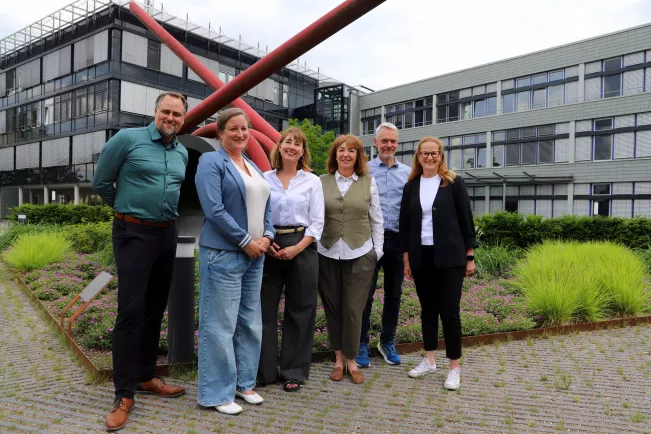
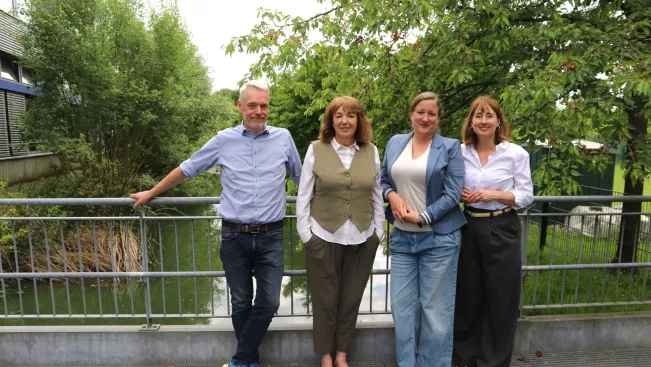
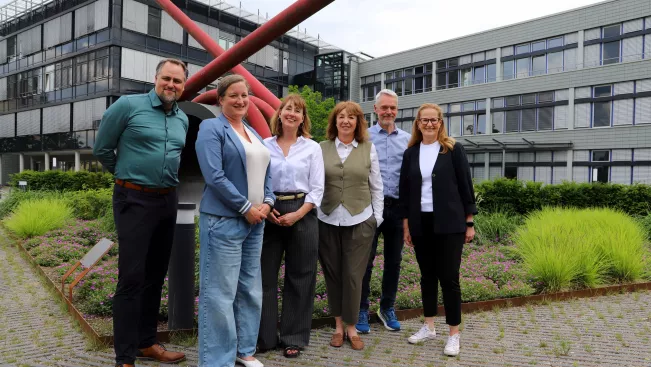
Four IZNE researchers
The DFG is supporting the Research Training Group of the University of Bonn, University Hospital Bonn (UKB) and H-BRS with around five million euros over the next five years. The International Centre for Sustainable Development (IZNE) with Professor Katja Bender (also deputy spokesperson of the research training group), Professor Wiltrud Terlau, Professor Martin Hamer and Professor Simona Helmsmüller is in charge at H-BRS. A total of ten new Research Training Groups will be funded throughout Germany from autumn 2026.
Blue cities in the global South are coming into focus
More and more people around the world are living in cities. Their design has a direct impact on both the health of their inhabitants and their ecological footprint. The rapidly growing and newly emerging cities of the global South in particular are facing major challenges in this regard. The so-called "blue cities", i.e. cities located by the sea or large rivers, are particularly vulnerable to climate change. On the other hand, transformations are likely to have a greater impact here. The new DFG research training group is focusing on blue cities in the global South for the first time.
Working with international partners
"The continuous changes associated with the transformation, expansion and development of cities require careful management in order to achieve sustainability, resilience and health as central goals," explains Professor Nico Mutters from the Institute of Hygiene and Public Health at the UKB, the spokesperson for the research training group. "Successful urban transformations and the design of integrated healthcare systems require innovative, inter- and transdisciplinary research approaches," says co-spokesperson Professor Katja Bender from H-BRS. Working with international partners is very important for the DFG Research Training Group. It builds on existing partnerships with universities and research institutes worldwide. The international partners are involved in the doctoral students' supervisory teams, will offer seminars as guest researchers and play a major role in the implementation of international data collection.
Multiple interconnected perspectives
In the Research Training Group, early career researchers will investigate how urban change can be shaped in such a way that both the health of residents and the sustainability and resilience of urban systems can be increased. The complex urban systems will be analysed from several interconnected perspectives - from land use, soil and water conservation and nutrition to pathogenic dynamics and disease vectors, political economies and biodiversity. An interdisciplinary and transdisciplinary approach is central to this, which will also be reflected in the future joint supervisory teams of H-BRS, the University of Bonn, UKB and the German Institute of Development and Sustainability (IDOS) as a non-university research institute.
Cooperation experience with the University of Bonn in the research training group "One Health"
H-BRS and the University of Bonn have many years of cooperation experience in this field. The DFG Research Training Group "Urban Future" builds on the "One Health" research training group funded by the state of North Rhine-Westphalia, a graduate school in which PhD students investigated various dimensions and transformations of urban systems and their effects on humans, animals, plants and the environment
Mehrere miteinander verbundene Blickwinkel
In dem Graduiertenkolleg sollen Nachwuchswissenschaftlerinnen und Nachwuchswissenschaftler erforschen, wie der Wandel von Städten so gestaltet werden kann, dass sowohl die Gesundheit der Bewohnerinnen und Bewohner als auch die Nachhaltigkeit und die Resilienz urbaner Systeme erhöht werden können. Dabei sollen die komplexen städtischen Systeme aus mehreren miteinander verbundenen Blickwinkeln betrachtet werden – von Landnutzung, Boden- und Wasserschutz und Ernährung über pathogene Dynamiken und Krankheitsvektoren bis hin zu politischen Ökonomien und Biodiversität. Zentral ist hierfür eine interdisziplinäre und transdisziplinäre Herangehensweise, die sich auch in den zukünftigen gemeinsamen Betreuungsteams von H-BRS, Uni Bonn, UKB und dem German Institute of Development and Sustainability (IDOS) als außeruniversitärem Forschungsinstitut widerspiegeln wird.
Kooperationserfahrung mit Uni Bonn im Kolleg "One Health"
Die H-BRS und die Uni Bonn verfügen über langjährige Kooperationserfahrungen in dem Bereich. Das DFG-Graduiertenkolleg „Urbane Zukunft“ knüpft an das vom Land NRW geförderte Forschungskolleg „One Health“ an, eine Graduiertenschule, in der Doktorandinnen und Doktoranden verschiedene Dimensionen und Transformationen der städtischen Systeme und deren Auswirkungen auf Menschen, Tiere, Pflanzen und Umwelt untersuchten.
Background:
The DFG Research Training Groups:
Contact us

Katja Bender
Professor of Economics, esp. Economic & Social Development, Vice Dean for Research, Transfer and Internationalization, Director International Center for Sustainable Development
Research fields
Location
Sankt Augustin
Room
F 306
Address
Grantham-Allee 20
53757, Sankt Augustin
Telephone
+49 2241 865 9660
Wiltrud Terlau
Professor of Economics, Resilient and Sustainable Development, Director of the International Centre for Sustainable Development (IZNE), Department of Economics
Research fields
Location
Rheinbach
Room
B 111
Address
von-Liebig-Straße 20
53359, Rheinbach
Telephone
+49 2241 865 410Location
Sankt Augustin
Room
Raum F 305
Address
Grantham-Allee 20,
53757, Sankt Augustin

Martin Hamer
Professor for soils and biomass, Director of the International Centre for Sustainable Development (IZNE), Department of Applied Natural Sciences
Research fields
Location
Sankt Augustin
Room
F 311
Address
Grantham-Allee 20
53757, Sankt Augustin
Telephone
+49 2241 865 774
Simona Helmsmüller
Professor for 'Economics of Social Protection', Director of the International Centre for Sustainable Development (IZNE), Academic Head MSc Social Protection
Research fields
Location
Sankt Augustin
Room
F 208
Address
Grantham-Allee 2-8
53757 Sankt Augustin
Telephone
+49 2241 865 9875
Daniela Greulich
Deputy Head of executive department Communications and Marketing/Press and Public Relations, Press Officer
Location
Sankt Augustin
Room
E 237
Address
Grantham-Allee 20
53757, Sankt Augustin
Telephone
+49 2241 865 641