Administrative unit 1: Facility Management, Building and Safety
AED: Automated external defibrillator
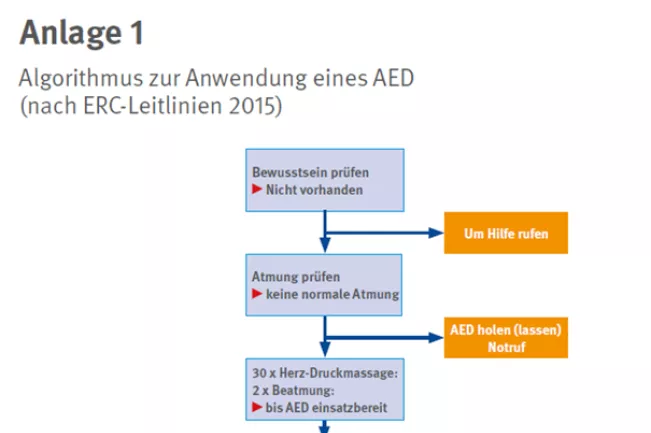
In the event of a serious emergency with loss of vital functions such as breathing and heartbeat, an automated external defibrillator (AED) can be used in addition to cardiopulmonary resuscitation through heart massage and ventilation. The device is retrieved by a second person. The first person remains with the patient. The adjacent flowchart illustrates which steps are to be taken in which order in the event of respiratory and cardiac arrest.
The use of the AED enables early treatment of ventricular fibrillation before the arrival of the emergency services. Defibrillation has been proven to increase the chances of survival in cases of "sudden cardiac death".
The automated external defibrillator (AED) is a medical device that can also be operated by laypersons until the arrival of the emergency services.
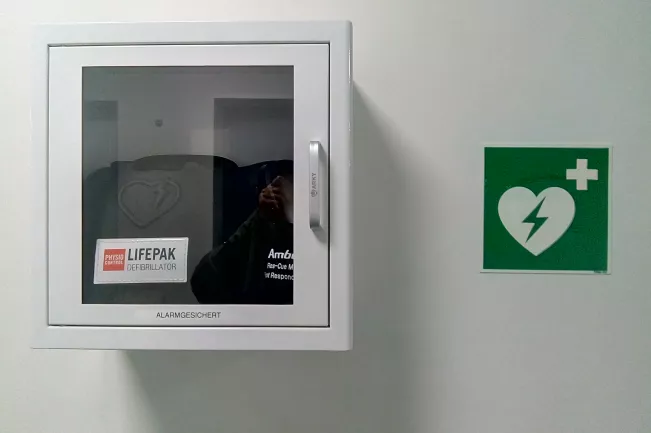
An electric shock is administered via two electrodes attached to the affected person's chest when the AED has reliably recognised ventricular fibrillation. All steps are communicated via voice control using an announcement and/or clearly visible text or pictogram instructions. After successful cardiopulmonary resuscitation, the heart beats regularly again.
As with any emergency, the emergency services must be called immediately before the AED is used so that advanced measures can be initiated at an early stage.
Trained and instructed first aiders carry out defibrillation with the AED
Documents
Links
Further links