Administrative unit 1: Facility Management, Building and Safety
Bird protection on glass
Every year, up to ten birds have an accident on a residential building. Around 18 million birds collide with glass panes and facades every year. Injured birds often fly away in panic and later die as a result. Killed birds become an unnoticed source of food for predators. During the breeding season, the death of an adult bird is fatal for the young birds.
Glass panes pose a danger to birds because they can see through them or only perceive the reflection of their surroundings in the glass. They collide with supposed images of the sky or structures on which they want to land. Any height is dangerous for the birds. They collide with the glass pane at full flight speed without braking. Each of us has certainly heard this dull impact at least once.
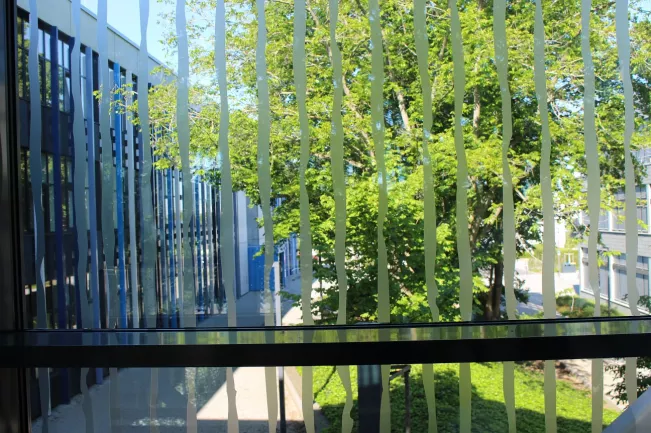
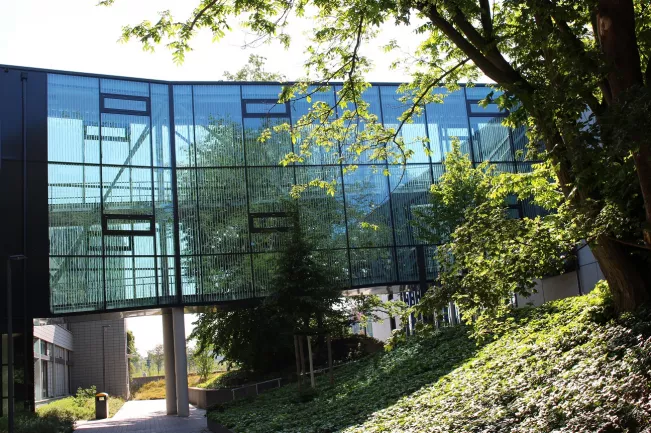
Corner glazing, green and glazed roof terraces, glass connecting walkways and tunnels and balcony glazing pose a particular risk. In order for the birds to recognise the obstacle, the glass must be made visible. The solution lies in the application of highly effective patterns or customised external cladding.
The highly effective pattern applied to the university's glass connecting corridor was selected in accordance with the Austrian standard ONR 191040, which defines the effectiveness of protective measures against bird strike on transparent and reflective surfaces in four effectiveness categories from ineffective to highly effective. The Hochschule Bonn-Rhein-Sieg sought advice on bird protection measures from BUND NRW, Dr Förster. Valuable tips are summarised in the brochure Bird Strike on Glass.
Cost-effective fly screens or string curtains can also provide a remedy in private areas. Painting windows decoratively with waterproof glass paint from the outside also helps. However, bird silhouettes or products based on ultraviolet markings are unsuitable. Not all bird species can see ultraviolet light.