Social Protection (MSc)
MSc Social Protection Insights: September 2025

September 2025: Social Protection Insights
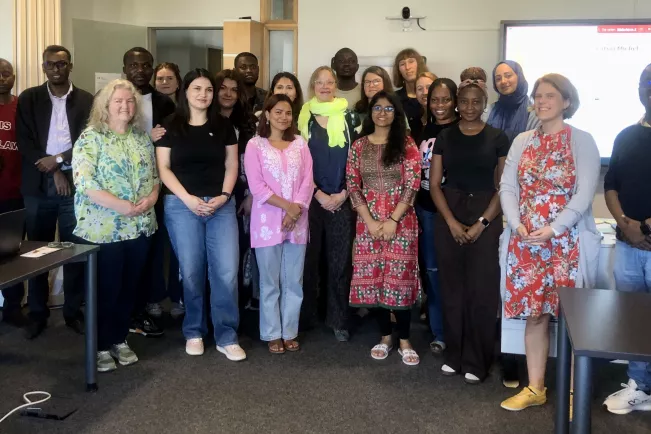
📢 A Warm Welcome to the MSc Social Protection, Batch of 2025!
This September, the Master's in Social Protection programme welcomes its new academic cohort for the year 2025. 🎉
This vibrant international cohort of 34 students, representing 18 countries, brings a wealth of diverse professional and academic expertise to the programme. As they embark on this new chapter, we look forward to accompanying them on their journey of learning and collaboration – and seeing the impact they will make in the field of social protection. 🌍✨
--------------------------------------------------------------------------------------------------------------------

📢 Orientation Day Programmes
During the first weeks of September, the students participated in three-day intensive orientation sessions and preparatory courses in Economics and Statistics. Special highlights of this year’s orientation included sessions on effective study planning, as well as workshops on intercultural communication by Eileen Küppers and academic writing by Eva Goletz. These sessions were designed to encourage students to embrace the diversity of their cohort while setting high academic standards for their upcoming work.
In addition to academic preparation, our international students were introduced to Germany’s integration system and its various actors. We were happy to welcome Ms. Sara Grunenberg-Bartmann (KIM Coordination Rhein-Sieg-Kreis) and Ms. Katrin Michel (KIM Case Management Sankt Augustin) to our orientation session, who made an interactive presentation on Communal Integration Management NRW (KIM). They explained its functions and the services it offers with a practical case example.
The orientation concluded with a cultural highlight: the International Dish Party on September 19, 2025. Students brought traditional dishes representing their home countries, creating a rich and diverse buffet. This warm and lively gathering brought together the new incoming students and those from previous batches, fostering community spirit across cohorts. 🥗
--------------------------------------------------------------------------------------------------------------------

📢 Prof. Dr Maria Klara Kuss joins as new professor
We extend a very warm welcome to Dr. Maria Klara Kuss , who is joining us as a new professor in the MSc Social Protection programme. Her work is interdisciplinary and spans politics, development sociology, and social anthropology. Dr. Kuss brings a unique blend of academic expertise and practical experience in Social Protection Systems, the Political Economy of Development, and Social & Gender Norms. Her professional background includes significant roles as an international consultant for UNICEF’s Social Protection Programme Division in New York, at UNICEF Innocenti, and with UN Women’s Data and Research Team, as well as serving as a Research Officer at the Institute of Development Studies (IDS) and as a Gender Advisor for Deutsche Gesellschaft für Internationale Zusammenarbeit (GIZ) GmbH .
Starting this Winter semester, she will teach the introductory modules on Social Protection Systems and Comparative Social Protection. She also welcomes enquiries for BA and MA thesis projects exploring the politics of social policy in developing countries, social justice and transformative processes, qualitative case studies, and discourse analyses. We are excited for our students to benefit from her insights and experience. Please join us in giving a warm welcome to Dr. Kuss! 🎉🎉
--------------------------------------------------------------------------------------------------------------------
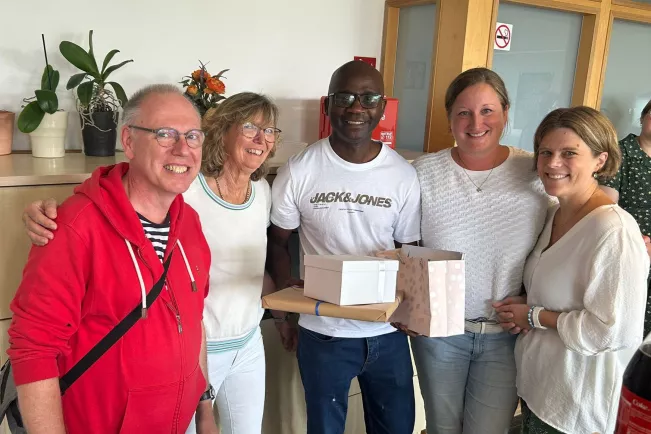
📢 Thank you, Professor Masauso Chirwa
After two years as a visiting professor, Prof. Dr. Masauso Chirwa is returning to Zambia. Prof. Chirwa has made a significant impact on the master's programme in Social Protection, sharing his expertise in social protection systems for vulnerable groups. He also led the 2024 alumni seminar in Ghana, taught specialised courses on disability, and supervised numerous theses. In the upcoming winter semester, Professor Chirwa will continue to be a part of our programme by teaching Module 2.3 on Public Finance.
--------------------------------------------------------------------------------------------------------------------
📢Our Partnership with UNRISD is Growing!
We are excited to announce that five of our Master’s students from the 2024/25 cohort have secured internships this winter semester with UNRISD. Congratulations to Ariba Khan Waheed, Collins Yao Losu, Madeline J Colley, Joy Namweke (Cpsp-K), and Samira Seidu on this outstanding achievement! 👏
With our students gaining experience at renowned regional, national, and international institutions, we are reminded that meaningful global impact is built on strong collaborations. If your organisation is seeking skilled and motivated talent in the field of social protection, we would be delighted to explore opportunities for internships, research collaborations, or strategic partnerships with you.
--------------------------------------------------------------------------------------------------------------------
📝 Current Courses: Preparatory courses, Module 1 & 2
The programme offers preparatory courses in economics and statistics, followed by the regular Modules 1 and 2, using a flipped classroom structure that encourages students to engage in both self-study and in-depth class discussions.
▶️▶️Preparatory Courses
The preparatory courses in Economics and Statistics are designed to build the foundational knowledge and skills that will prepare students for more advanced analysis throughout the programme.
▶️Economics// Natalie Bröse
With this introductory course, students will gain a basic understanding of economic thinking, learn key terms and concepts, and become familiar with simple micro- and macroeconomic models. They will develop the ability to use these models as a starting point for thinking about real-world policy questions and societal issues.
▶️Statistics // Pablo A. Herrera Gálvez
Students will build fundamental skills in handling and interpreting data, understand basic statistical concepts, and practice simple methods for describing and comparing data. They will also learn to use statistical tools to analyse how policies affect poverty and inequality.
▶️▶️Module 1: Comparative Analysis of Social Protection Systems
This module aims to provide students with a comprehensive understanding of the constitutive elements, actors, and typologies of social protection systems. Students will learn to analyse and compare different systems, explore the theoretical and political determinants of social protection, and assess how national, regional, and global factors shape policy design and implementation.
▶️M1.1 Social Protection Systems: Constitutive Elements | Prof. Dr Maria Klara Kuss
By the end of this submodule, students will be able to define social protection and distinguish between its key typologies and conceptual frameworks. They will gain an understanding of the system’s approach to social protection, identify core instruments and actors, and apply methods and indicators for comparative system analysis in different regional contexts.
▶️ M1.2 Social Protection Systems: Driving Factors | Prof. Dr Maria Klara Kuss
Students will be able to critically engage with welfare state theories and identify the determinants that shape social protection systems. They will also analyze the role of values, social justice norms, and political economy models in influencing the design and development of welfare policies.
▶️ M1.3 Comparative Social Protection Systems | Prof. Dr Maria Klara Kuss
By the end of this submodule, students will be able to select and apply appropriate indicators and comparative methods to analyse social protection systems. They will learn to use relevant databases for both quantitative and qualitative analysis while critically reflecting on the challenges of data comparability across different national contexts.
▶️ M1.4 International Social Protection Policy | Darleen Kolbe
Students will understand how global crises, migration, and international regulations influence national welfare states and social protection policies. They will be able to evaluate the role of global and regional coordination (e.g., EU frameworks) and assess how international support and norms interact with national policy design and implementation
▶️▶️Module 2: Economic Foundations
This module aims to equip students with the economic and financial knowledge to understand, evaluate, and design social protection interventions. Students will analyse how social protection responds to market failures, poverty, and risk, assess public finance sustainability, and apply economic and statistical tools to evaluate the impact of social protection policies.The submodules include,
▶️ M2.1 Economics of Social Protection | Prof. Dr Simona Helmsmüller
Students will be able to analyse the economic rationale for social protection, including the trade-offs between equity and efficiency. They will understand how social protection addresses market failures, asymmetric information, and public goods, as well as how it influences labour supply, intertemporal choices, and decision-making under uncertainty. Additionally, they will gain a foundational understanding of taxation and health economics as they relate to social protection interventions.
▶️ M2.2 Risk Assessment | Prof Dr Markus Loewe
Students will develop the ability to measure and interpret poverty, vulnerability, inequality, and risk using welfare indicators and poverty lines. They will analyse determinants and profiles of poverty and inequality and understand how these risk profiles inform the design and evaluation of social protection policies.
▶️ M2.3 Public Finance | Prof. Dr Masauso Chirwa
By the end of this submodule, students will be able to explain key elements of public finance theory and the financing of social protection programmes. They will learn to conduct cost-benefit analyses, interpret government finance statistics, and assess the combined redistributive effects of taxes and benefits, as well as evaluate the sustainability of public finances.
--------------------------------------------------------------------------------------------------------------------
Get to Know Our Students, Lecturers, and Alumni
Current student Spotlight
Jana Gueye
Meet Jana Gueye, from Germany, current student of batch 2023/24. Currently working as a programme manager at BORDA Bremen Overseas Research and Development, her passion lies in advancing and advocating decolonised development practices and fostering critical reflections on Eurocentric knowledge systems. Through her work, she aims to challenge conventional paradigms and advocate for more inclusive and equitable development approaches. Jana finds the programme specifically beneficial for advancing her career. In her words,
„More than anything, the program has helped me evolve from a practitioner executing project components to a strategic thinker and program designer, capable of understanding the broader ecosystem of social protection and contributing meaningfully to it. I am confident that the combination of work experience and academic learning has uniquely positioned me to contribute to building stronger, more inclusive, and resilient social protection systems worldwide”
Jana Gueye - Student, Batch 2023 Masters in Social Protection

Meet our Lecturers
Pablo A. Herrera Gálvez
Originally from Chile, Pablo is both a lecturer of the preparatory course in statistics and a third-semester student of the MSc Social Protection (Batch 2024). Pablo's expertise includes statistical analysis, impact evaluations, public management, and data-driven solutions for state modernisation. Prior to joining the program, he worked at the Ministry of Social Development, Chile, for four years, where he contributed to modernising and facilitating access to social protection services. During the pandemic (2020–21), his team also supported the delivery of the Emergency Family Income (IFE).About the programme he says,
„The master is well structured and also has a lot of support for international students. The courses and evaluations have an applied focus, which is very enriching for the professional future. There is also room for customisation; especially we enjoy the freedom to choose topics for many of the courses' assignments, as well as some elective courses.”
Pablo A. Herrera Gálvez - Pablo A Herrera Galvez, Batch 2024, Lecturer Statistics course

Resources, Events and Publications
Events
- Follow the second World Summit for Social Development (WSSD2) in Doha, from 4 to 6 November 2025. The summit will bring together global voices to advance universal social protection and build eco-social contracts, with several sessions available online.
- Register for the upcoming online event on "Social Protection and Climate Change in Protracted Crisis Contexts" on 23rd September 2025, hosted by the Institute of Development Studies.
- Join the event Strengthening Gender-Responsive and Inclusive Social Protection through Technical Assistance – Lessons Learnt and Future Practice on 25th September, organized by socialprotection.org
Resources
- Preventing Child-Family Separation Through Social Development, a chapter co-authored by Prof. Masauso Chirwa (Springer, 2024).
- Benchmarking the Performance of Healthcare Systems in the Provision of Childhood Immunisation Services in Sub-Saharan Africa (2016–2019), an article co-authored by Albert Opoku Frimpong (BMC Health Services Research, 2024).
- Subscribe to the World of Social Protection blog and insights curated by World Bank economist Ugo Gentilini.
- Apply for the Michael Cichon Graduate Award for outstanding master's thesis in social protection by the United Nations University by September 26th, 2025.
CONTACT US!
We are always interested in creating partnerships with those of you working in the field! We would love to hear from you if are interested in
- being a #ThesisSupervisor,
- providing #Internship opportunities to our students,
- publishing a paper in our #WorkingPaper series, or
- visiting our university as a #GuestSpeaker
Your feedback and suggestions to improve the newsletter are also very welcome.
📩 msc-socialprotection@h-brs.de
🌐 Master's of Science in Social Protection | Hochschule Bonn-Rhein-Sieg (H-BRS)