30 years Hochschule Bonn-Rhein-Sieg
Exhibition Visionary Female Researchers: Françoise Barré-Sinoussi
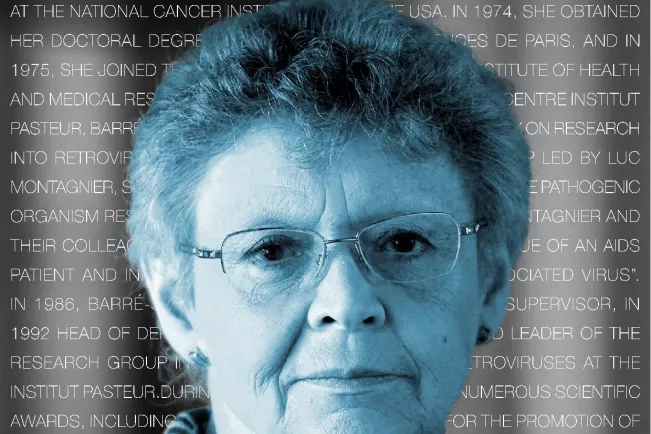
Biography Françoise Barré-Sinoussi (1947)
Françoise Barré-Sinoussi is born in Paris on 30 July 1947.
After graduating from Lycé Bergson, she studies biochemistry and virology in Paris. A scholarship takes her to the US National Cancer Institute (NCI). In 1974, she obtains her doctorate from the Faculté des Sciences de Paris and in 1975 takes up a position at the French Institute of Health and Medical Research (INSERM). At the Institut Pasteur basic research centre in Paris, Barré-Sinoussi begins to focus more closely on research into retroviruses. In 1983, working in Luc Montagnier's research group, she succeeds in identifying the HI virus as the cause of AIDS. Barré-Sinoussi, Luc Montagnier and their colleagues had isolated the virus from the tissue of an AIDS patient and initially named it ‘lymphadenopathy-associated virus’.
In 1986, Barré-Sinoussi becomes laboratory director, in 1992 department head, and in 1996 professor and head of the research group for retrovirus biology at the Institut Pasteur.
Throughout her career, she receives numerous scientific awards, including the Körber Foundation's European Science Award in 1986, the King Faisal Foundation's International Prize for Medicine in 1993, and the International AIDS Society's Honorary Award in 2001. In 2006, Françoise Barré-Sinoussi is appointed Officier, in 2013 Grand Officier, and in 2016 Grand Croix de la Légion d’Honneur.
Finally, in 2008, the jury of the Royal Swedish Academy of Sciences honours her with the Nobel Prize in Medicine. However, the award was preceded by a long-standing feud:
In the early 1980s, the Parisian virologists send their newly discovered pathogen to colleagues in America. They quickly recognise its significance – and protect it with patents. American researcher Robert Gallo later claims credit for the discovery of the HI virus. He therefore believes he is entitled to the exploitation rights for the discovery and a blood test for HIV. The dispute between the researchers is not settled at the highest level until 1987: then US President Ronald Reagan and French Prime Minister Jacques Chirac agree to a points split.
Twenty years later, however, the Nobel Committee remains unimpressed by this political decision and awards the prize – in accordance with its statute of always honouring the origin of a discovery – to the French, without taking Gallo into consideration.
Barré-Sinoussi and Montagnier share the Nobel Prize in Physiology and Medicine with the German Harald zur Hausen, who was able to show that cervical cancer is always the result of infection with certain papillomaviruses (wart viruses).
Françoise Barré-Sinoufi's commitment to the fight against AIDS goes far beyond her scientific work. As an advisor, she regularly participates in international conferences and anti-AIDS programmes organised by the World Health Organisation and the UN programme UNAIDS. She sees her role as a scientist in the fight against AIDS as extending to the political arena.
In 2009, Barré-Sinoussi and her colleagues write an open letter to the Vatican in which they describe a statement by the then Pope Benedict XVI on the alleged ineffectiveness of condoms in combating AIDS as ‘wrong’ and ‘fatal’.
As an alumna and former director of the ‘Regulation of Retroviral Infections’ research department at the Institut Pasteur, Barré-Sinoussi continues to conduct research on HIV infections even after her retirement in 2017.
In 2018, Françoise Barré-Sinoussi is elected to the National Academy of Medicine of the United States.
Contact points
Centre for Science and Technology Transfer (ZWT)
Campus
Sankt Augustin