30 years Hochschule Bonn-Rhein-Sieg
Exhibition Visionary Female Researchers: Hedwig Dohm
Biography Hedwig Dohm (1831-1919)
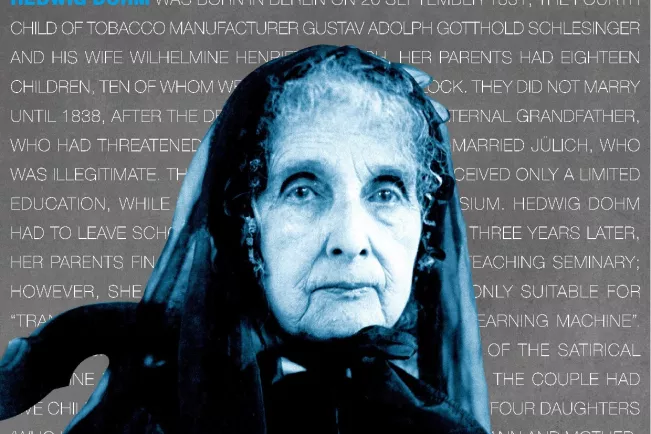
Hedwig Dohm is born in Berlin on 20 September 1831, the fourth child of tobacco manufacturer Gustav Adolph Gotthold Schlesinger and his wife Wilhelmine Henriette Jülich. The couple have eighteen children together, ten of whom are born out of wedlock. The parents did not marry until 1838, after the death of the paternal grandfather, who had threatened to disinherit his son if he married Jülich, who was born out of wedlock.
The daughters of the extended Jülich-Schlesinger family are only allowed a limited education, while the sons attend grammar school (Gymnasium). At the age of 15, Hedwig Dohm leaves school and must help in the family household instead. Three years later, she fights to attend a teacher training college, but finds it uninspiring, suited only to ‘turning a lively mind into a mechanical learning machine.’
In 1853, she marries Ernst Dohm, editor-in-chief of the satirical magazine Kladderadatsch. Between 1854 and 1860, Hedwig gives birth to five children, her only son dying at the age of eleven. Her four daughters (including Hedwig Pringsheim, mother of Katia Mann and mother-in-law of writer Thomas Mann) all receive a thorough school and vocational education.
Through her husband, Hedwig Dohm meets the intellectual elite of Berlin society. The list of personalities who frequent the Dohms' home is long and impressive, and the couple's house becomes a popular and well-known salon: Ferdinand Lassalle and Countess Hatzfeld are among the visitors, as are Alexander von Humboldt, Franz Liszt, Theodor Fontane, Fanny Lewald, Lily Braun and the publisher couple Lina and Franz Duncker.
In the first half of the 1870s, the first four feminist books by Hedwig Dohm are published, in which she advocates for complete legal, social and economic equality between women and men. She is one of the first women in Germany to demand voting rights for women. In the third volume of the series ‘Die wissenschaftliche Emanzipation der Frau’ (The Scientific Emancipation of Women), published in 1874, Hedwig Dohm calls for universities to be opened completely to women, a ‘radical’ demand at the time. These four essays make her famous overnight but also attract fierce criticism. In her writings, she attacks the oppression of women in all areas with humour and acumen: Dohm wants equal education and training for girls and the free choice of a profession that ensures women's economic independence. She demands the right to abortion, criticises marriage law and the mystification of motherhood, double standards and prostitution, inadequate sex education for young girls and the obsession with youth. At the end of the 1870s, Dohm publishes several comedies, all of which are performed at the Berlin Schauspielhaus.
In 1883, her husband Ernst Dohm dies after a long illness. After his death, Hedwig Dohm begins writing novellas and novels. As the progressive wing of the women's movement gains strength in the late 1880s, she devotes herself once again to political publications in newspapers and magazines. She co-founds several transformative associations, including the women's association ‘Reform’, which advocates for comprehensive educational reform and women's studies. She joins Minna Cauer's emancipatory association ‘Frauenwohl’ (Women's Welfare) and, at the age of 74, becomes a member of the founding assembly of Helene Stöcker's ‘Bund für Mutterschutz und Sexualreform’ (Association for Maternity Protection and Sexual Reform). Until her death in 1919, she publishes several volumes of essays and almost a hundred articles in newspapers and magazines, in which she participates in and takes a stand on current debates in literature and politics.
During the First World War, Dohm was one of the few intellectuals who speak out against the war from the outset and advocated uncompromising pacifism. She lives to see the introduction of women's suffrage in Germany in 1918, much to her delight.
Hedwig Dohm dies at the age of 87 on 1 June 1919. She is buried in the Old St. Matthew's Cemetery in Berlin-Schöneberg. In August 2018, the Berlin Senate decides to honour Hedwig Dohm as a personality of special significance for Berlin with a grave of honour.
Contact points
Centre for Science and Technology Transfer (ZWT)
Campus
Sankt Augustin