30 years Hochschule Bonn-Rhein-Sieg
Exhibition Visionary Female Researchers: Inge Lehmann
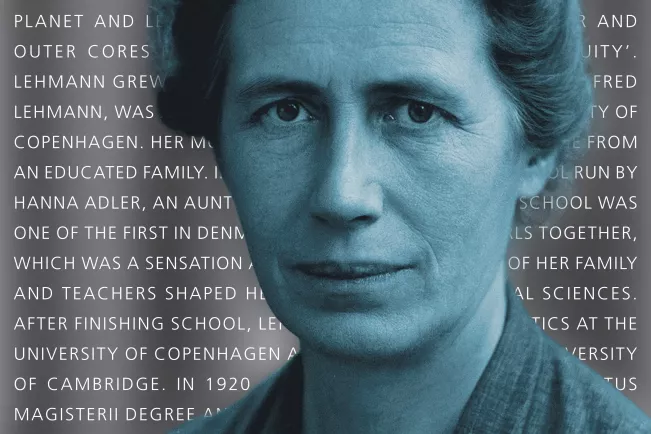
Biography Inge Lehmann (1888-1993)
Inge Lehmann was born on 13 May 1888 in Copenhagen, Denmark, and died on 21 February 1993 in her hometown. She was an outstanding Danish geodesist and seismologist known for her groundbreaking discoveries about the structure of the Earth. Of particular note is her discovery of the inner core of the Earth in 1936, which she made by analysing seismograms of earthquakes. This discovery revolutionised our understanding of the geophysical properties of our planet and led to the boundary between the inner and outer cores being named the ‘Lehmann discontinuity’.
Lehmann grew up in an academic family; her father, Alfred Lehmann, was a professor of psychology at the University of Copenhagen. Her mother, Ida Sophie Tørsleff, also came from an educated family. Inge attended a progressive school run by Hanna Adler, an aunt of physicist Niels Bohr. This school was one of the first in Denmark to teach boys and girls together, which was a sensation at the time. The influence of her family and teachers shaped her interest in the natural sciences.
After finishing school, Lehmann studied mathematics at the University of Copenhagen and Newnham College, University of Cambridge. In 1920, she graduated with a Candidatus magisterii degree and then worked for several years in the insurance sector, particularly for the insurance company Det gjensidige Forsikringsselskab ‘Danmark’. This experience helped her develop analytical skills that she would later use in her scientific career.
In 1925, Lehmann joined Den danske gradmåling, a government agency responsible for surveying Denmark. There she became assistant to geodesist Niels Erik Nørlund, who wanted to establish seismological observatories in Denmark and Greenland. In this role, she discovered her interest in seismology and began to study this field more intensively. To further her education in seismology, she completed study visits to the seismological stations in Darmstadt and Strasbourg in 1927. In 1928, she became the first Danish woman to pass her exam in geodesy and took over as head of the seismological department at the Geodetic Institute of the University of Copenhagen. In this role, she was responsible for the seismological stations in Denmark and Greenland.
Lehmann's most significant scientific contribution came in 1936, when she interpreted the P-wave signals in seismograms in an article simply titled ‘P’ and postulated the existence of a solid inner core. This discovery challenged the prevailing opinion that the entire Earth's core was liquid. She proved that the Earth has a solid inner core, while the outer shell is liquid. This fundamental insight revolutionised our understanding of the geophysical properties of our planet. The boundary between the inner and outer cores of the Earth that she discovered is often referred to in scientific literature as the ‘Lehmann discontinuity.’ On her 127th birthday, Google honoured the researcher with a Doodle that artistically depicts the Earth's core.
During the Second World War, Lehmann's work was restricted by the occupation of Denmark, but she continued her research even after her retirement in 1953. In the following decades, she published more than half of her total of 56 scientific papers. She worked closely with renowned scientists in the United States and Canada and discovered another seismic discontinuity, which was also named after her. Her scientific contributions were not only significant for seismology but also contributed to the understanding of the Earth's structure and geophysical processes.
As a woman in a male-dominated field, Lehmann often had a difficult time. She once complained: ‘You should know how many incompetent men I had to compete with – in vain.’ This quote illustrates the challenges she faced and her tireless struggle for recognition in science.
Lehmann received numerous awards for her scientific achievements, including the Emil Wiechert Medal (1964), the Gold Medal of the Royal Danish Academy of Sciences (1965) and the William Bowie Medal (1971). In 1997, the American Geophysical Union established the Inge Lehmann Medal to recognise outstanding achievements in geophysics. The asteroid (5632) Ingelehmann was also named in her honour.
After retiring in 1953, she moved to the United States, where she remained active in the scientific community. In 1964, she was awarded an honorary doctorate by Columbia University in New York, and four years later she received the same honour from the University of Copenhagen. Her lifetime achievements were recognised not only through academic awards, but also through the recognition of her contributions to science, which continue to have an impact today.
Inge Lehmann died on 21 February 1993 in Copenhagen at the age of 104. She was unmarried and had no children but left behind a significant legacy in science. Her discoveries not only revolutionised our understanding of the Earth's structure but also paved the way for future research in geophysics.
Overall, Inge Lehmann is considered one of the most important seismologists in history. Her life's work and achievements are a significant legacy in science and continue to inspire generations of scientists. Her discovery of the inner core of the Earth and the associated findings are fundamental building blocks of modern geophysical knowledge and underscore the importance of her work for understanding our planet.
Sponsoring
CPA ReDev GmbH (Dr. Averdung) has sponsored the portrait of Inge Lehmann and supported the exhibition Visionary female researchers with a donation of €3,000.
CPA ReDev GmbH is an innovative software company with national and international operations. It is based in Siegburg, an attractive business location in the Rhineland.
The company's activities are characterised by cutting-edge IT processes. Based on these, we research and create innovative software components for the management of multidimensional information systems for our customers in industry and public administration.
Another focus is the development of mobile and AI-supported audit and assessment tools, technologies for off-road driver assistance and the implementation of control software for the autonomous operation of drones.
With its software products, CPA ReDev GmbH is at the technological forefront of its market segment. The long-standing relationships with its customers and partners that have been built up over many years guarantee its sustainable success.
Contact points
Centre for Science and Technology Transfer (ZWT)
Campus
Sankt Augustin