30 years Hochschule Bonn-Rhein-Sieg
Exhibition Visionary Female Researchers: Rosa Luxemburg
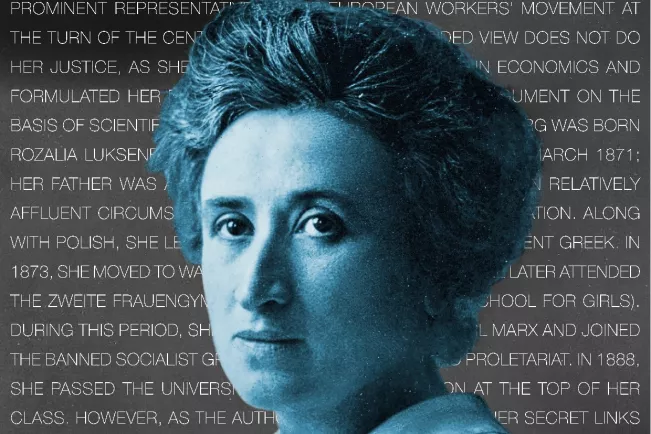
Biography Rosa Luxemburg (1871-1919)
Today, Rosa Luxemburg is primarily known as the most prominent representative of the European labour movement at the turn of the century, a Marxist and a passionate revolutionary. However, this one-sided view does not do justice to Rosa Luxemburg, who also held a doctorate in economics and whose political views and arguments were shaped by her academic work.
Rosa Luxemburg is born Rozalia Luxemburg, daughter of Line Luxemburg, née Löwenstein, in Zamość, Poland, on 5 March 1871. Her father is Moris Luxemburg, a Jewish merchant and timber trader. Rosa Luxemburg grows up in affluent circumstances and moves to Warsaw with her parents in 1873. There she later attends the Second Girls' Gymnasium and enjoys a humanistic education. In addition to Polish, she learns German, Russian, Latin and Ancient Greek. During this time, she studies the writings of Karl Marx and joins the banned socialist group ‘Second Proletariat’. She graduates from high school in 1888 as the best in her class. However, when her secret connections to the socialist movement become known, she is forced to flee Warsaw and moves to Zurich. There, she enrols at the university in 1889 to study economics, history and law, among other subjects.
In Zurich, at that time a stronghold of persecuted socialists, Rosa Luxemburg encounters the labour movement and, in 1893, founds the SDKP (Social Democracy of the Kingdom of Poland) with like-minded people, as well as the magazine ‘Sache der Arbeiter’ (Workers' Cause) in Paris. She writes numerous essays in which she advocates an international revolution of the working class. In 1897, Luxemburg receives her doctorate from the University of Zurich with a thesis entitled ‘Poland's Industrial Development’. Shortly afterwards, she decides to move to Germany to join the SPD. To this end, she enters into a sham marriage with Gustav Lübeck, thereby obtaining German citizenship for her move to Berlin in 1898.
Soon, however, a split in the young labour movement becomes apparent. In 1899, Luxemburg publishes her essay ‘Social Reform or Revolution?’, in which she calls for a socialist revolution of the working class and decisively rejects the idea of reform formulated by the social democratic theorist and politician Eduard Bernstein. Rosa Luxemburg understands the Marxism she propagates as a self-critical method of analysing capitalism, in which she describes capitalism as the constituent framework in which other forms of oppression such as anti-Semitism, sexism and racism can develop. The doctor of economics formulates her political views and argumentative weapons solely based on scientific debate. Against this backdrop, she believes that the liberation of the working class and other marginalised groups is only possible through a socialist revolution.
In 1904 and 1906, she is imprisoned for insulting Emperor Wilhelm II and criticising the militarism of the German Empire. In 1913, she calls for conscientious objection.
In the same year, she publishes the economic treatise ‘The Accumulation of Capital: An Attempt at an Economic Explanation of Imperialism,’ in which she makes a decisive contribution to the debate on imperialism in the run-up to the First World War.
A year later, the labour movement splits due to irreconcilable differences. When the SPD parliamentary group in the Reichstag approves war credits for the First World War on 4 August 1914, Luxemburg founds the ‘Gruppe Internationale’ (International Group), which becomes increasingly well known as the Spartacus Group from 1916 onwards. All opponents of the war soon join the group. Luxemburg spent most of the First World War in prison due to her vehement criticism of the war and repeated calls for a general strike.
In autumn 1918, defeat in the war looms for the German Empire. When the November Revolution breaks out on 9 November 1918, Rosa Luxemburg is released from prison. She returns to Berlin and works as an editor for the Spartacus League newspaper Die Rote Fahne (The Red Flag). On 17 December, she advocates for a socialist council government in her essay ‘National Assembly or Council Government’. At the Reich Council Congress, however, the majority votes in favour of a parliamentary democracy. Rosa Luxemburg then participates in the founding of the Communist Party of Germany (KPD) on 30 December 1918.
In January 1919, a general strike later known as the ‘Spartacus uprising’ is brutally suppressed with the help of Freikorps troops, and Luxemburg is once again imprisoned and mistreated. On 15 January 1919, she is murdered together with her party colleague Karl Liebknecht.
The anniversary of Rosa Luxemburg and Karl Liebknecht's deaths is still an international socialist day of remembrance, commemorated, among other things, by the annual Liebknecht-Luxemburg demonstration in Berlin.
Contact points
Centre for Science and Technology Transfer (ZWT)
Campus
Sankt Augustin