Biomedical Sciences (MSc)
Testimonials Biomedical Research
Etang Collins Etang (M.Sc. Biomedical Sciences, 2023)
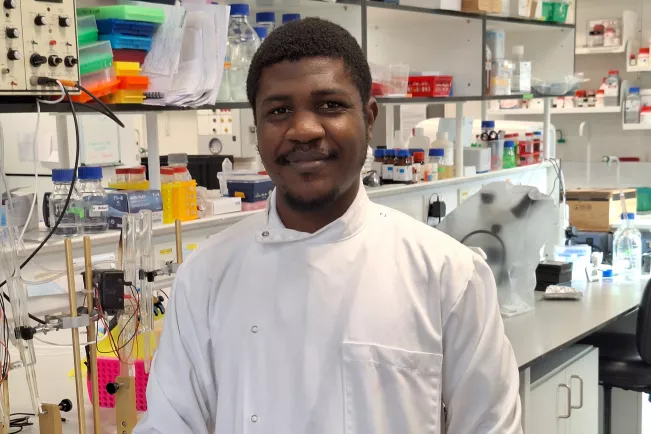
What degree did you obtain before enrolling in the Biomedical Sciences Master’s programme at H-BRS?
Before enrolling in the Biomedical Sciences Master’s programme at H-BRS, I obtained a Bachelor's degree in Medical Laboratory Science from the Faculty of Health Sciences, University of Bamenda, Cameroon.
When did you graduate from Biomedical Sciences Master’s programme at H-BRS?
I graduated from the Biomedical Sciences Master’s programme at H-BRS in 2023.
What is your current position/profession, and what is your research about?
Currently, I am a PhD student at the University of St. Andrews, in the United Kingdom. I am investigating how corticosteroids regulate sodium transport in the human distal nephron (specifically, the human cortical collecting duct).
How did the Biomedical Sciences programme prepare you for your current position?
With how well the Biomedical Sciences programme is structured, that is, theoretical courses in the first three semesters and an internship/thesis project in the final semester, this prepared me with a sound theoretical knowledge and practical skills, which I was able to transfer to my new role as a PhD student. The variety of courses in the first three semesters broadened my knowledge of science and gave me a good foundation to be able to make informed decisions about my career path, as it was well structured to suit both academia and an industrial career path.
What did you particularly like about the Biomedical Sciences Master’s programme at H-BRS?
I liked the courses that the program offered, the structure in which they were offered and the commitment of the lecturers to all students. Furthermore, I enjoyed doing my thesis in H-BRS since I was doing what I love, which was thanks to the variety of carrier path to choose from.
Mihriban Yilmaz (M.Sc. Biomedical Sciences, 2025)
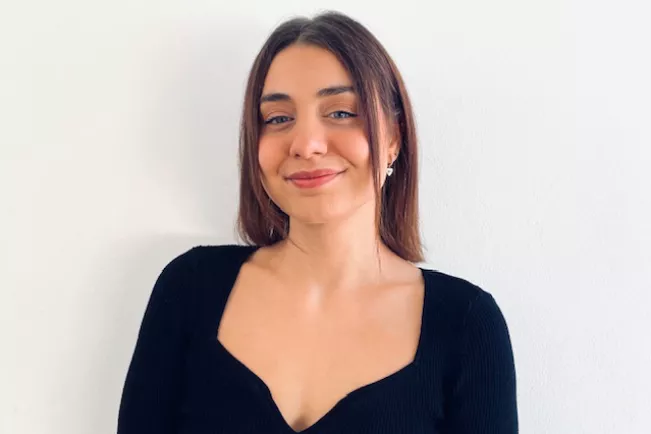
What degree did you obtain before enrolling in the Biomedical Sciences Master’s programme at H-BRS?
I obtained my Bachelor’s degree in Forensic Science at Hochschule Bonn-Rhein-Sieg (H-BRS), Germany.
When did you graduate from Biomedical Sciences Master’s programme at H-BRS?
By completing additional modules from the Applied Biology program, I was able to qualify for and enroll in the Biomedical Sciences Master’s program, which I successfully completed in September 2025.
What is your current position/profession, and what is your research about?
Immediately after graduating, I joined the International Max Planck Research School (IMPRS) PhD program and am currently a PhD student in Dr. Monika Scholz’s research group, Neural Information Flow, at the Max Planck Institute for Neurobiology of Behavior. My research focuses on understanding memory formation at the circuit level using Caenorhabditis elegans as a model organism.
How did the Biomedical Sciences programme prepare you for your current position?
The Biomedical Sciences Master’s programme at H-BRS prepared me exceptionally well for my current position by offering a broad and diverse range of biological disciplines. This allowed me to explore different fields and identify my specific research interests. The many practical and research-oriented modules, particularly the module neurobiology, provided not only a strong theoretical foundation but also valuable hands-on experience. Most importantly, the program shaped my scientific way of thinking by training me to critically evaluate evidence, approach complex problems analytically, and work independently in an academic research environment.
What did you particularly like about the Biomedical Sciences Master’s programme at H-BRS?
What I particularly appreciated about the Biomedical Sciences Master’s program was the supportive and personal learning atmosphere. Due to the small cohort size, students benefited from close interaction with lecturers and individualized guidance tailored to their knowledge, interests, and strengths. This mentorship played a crucial role in my academic development and helped prepare me for a career in research.
Overall, the Biomedical Sciences Master’s program at H-BRS offered an excellent balance of breadth, depth, and practical experience. It provided a strong foundation for my current PhD research and future career in biomedical science.
Frederica Ricucci (M.Sc. Biomedical Sciences, 2024)
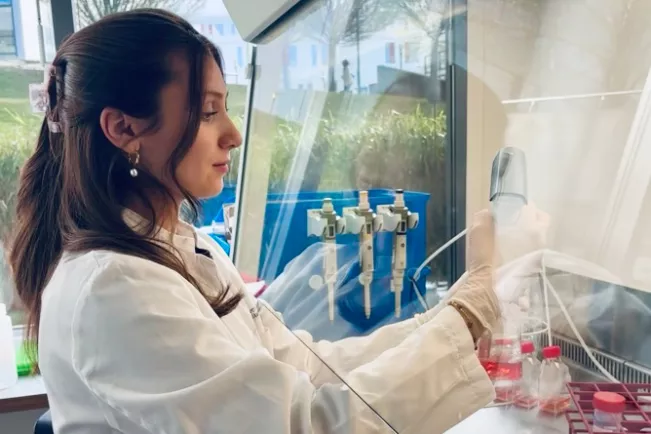
What degree did you obtain before enrolling in the Biomedical Science Master’s programme at H-BRS?
Before enrolling in the Biomedical Sciences Master’s program, I obtained a Bachelor's degree in Applied Biology from Hochschule Bonn-Rhein-Sieg in Rheinbach.
When did you graduate from Biomedical Science Master’s programme at H-BRS?
I graduated from the Biomedical Sciences Master’s programme in March 2025.
What is your current position/profession and what is your research about?
Currently I am working as a PhD student at the University Hospital Bonn within the Clinic for Pediatric Immunology and Rheumatology. My research focuses on the identification and characterization of novel genes associated with inborn errors of immunity. Through this work, I aim to elucidate the underlying disease mechanism while also contributing to a deeper understanding of fundamental human immunology.
How did the Biomedical Sciences programme prepare you for your current position?
The Biomedical Sciences Master’s program provided me with a strong theoretical foundation and significantly enhanced my critical thinking abilities. In particular, the extensive hands-on research experience gained through various practical courses prepared me very well for an academic research environment. It allowed me to develop a deeper understanding of a wide range of laboratory techniques, such as PCR, mammalian cell culture, flow cytometry as well as western blotting, which I now continue to use regularly in my PhD research project.
What did you particularly like about the Biomedical Science Master’s programme at H-BRS?
I particularly appreciated the programme’s strong practical focus and the many opportunities it offered to engage with research beyond laboratory work itself. For example, the lunchtime research seminars provided valuable insights into ongoing projects and encouraged scientific exchange and discussion. In addition, the programme’s international setting was a major strength. Working alongside students and researchers from diverse cultural and academic backgrounds greatly enriched discussions, broadened my scientific perspective, and prepared me well for the global nature of academic research.
Links
Further links