Communications and Marketing
H-BRS presents the new university development plan
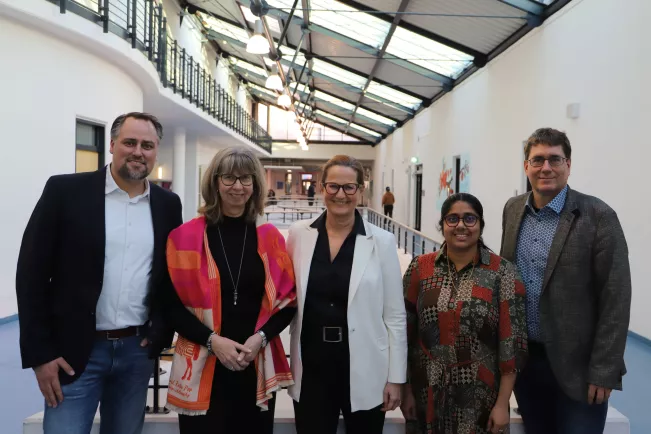
"The university development plan describes how we want to take responsibility as a university and actively shape change. It formulates ambitious yet realistic goals," says President Marion Halfmann.
The strategic development of the university is taking place against the backdrop of far-reaching changes. Demographic change, geopolitical developments, rapid technological progress, advancing climate change and changing financial conditions in the higher education system characterise the initial situation.
Action areas of education, research and transfer at the centre
The three action areas of education, research and transfer are at the centre of HEP4. In teaching, the university focuses on holistic support for students - from study orientation to graduation. Pre-study programmes are being expanded in a targeted manner, students are being supported through coaching formats and digital and AI-supported teaching and examination formats are being further developed.
In research, H-BRS is strengthening its application-oriented and interdisciplinary approaches. In particular, the focal areas of security research, sustainability, resource conservation and energy efficiency, visual computing, life sciences and health as well as artificial intelligence and autonomous systems are being further developed. Cooperations with partners from business and society are being expanded.
Transfer is also becoming increasingly important: the university is promoting start-up activities, intensifying cooperation with companies and developing new formats for the exchange between science and practice. This results in joint development projects, particularly in the future fields of digitalisation, artificial intelligence, sustainability and security, start-up ideas are supported and research results are transferred into concrete applications.

The university's profile fields play a special role, in which it bundles and systematically develops its strengths. In the field of digitalisation and artificial intelligence, corresponding skills are systematically anchored in teaching and research and linked to questions of responsible use. In this context, digital and AI-supported applications are integrated into teaching and learning formats, data-based skills are strengthened and new research approaches in areas such as autonomous systems and digital technologies are further developed.
Internationalisation is being strategically developed further, including through the expansion of international collaborations and English-language study programmes.
Hambloch-Gesinn: Important impetus
"The areas of digitalisation and internationalisation in particular show how future-oriented the university is positioning itself. This provides important impetus for teaching, research and transfer," says Sylvie Hambloch-Gesinn, Chairwoman of the University Council.
In the profile field of innovation and entrepreneurship, the university is strengthening the promotion of start-ups and supporting the implementation of ideas in marketable applications. At the same time, the topic of social responsibility and sustainability is becoming increasingly important: sustainability aspects are integrated into studies, research and university operations and understood as a cross-sectional task.
In order to successfully realise its goals, the university is also strengthening its internal prerequisites. The focus is on efficient structures and processes, a high level of student attractiveness, the promotion of equality and diversity as well as an open and appreciative university culture.
Ideas from members of the university
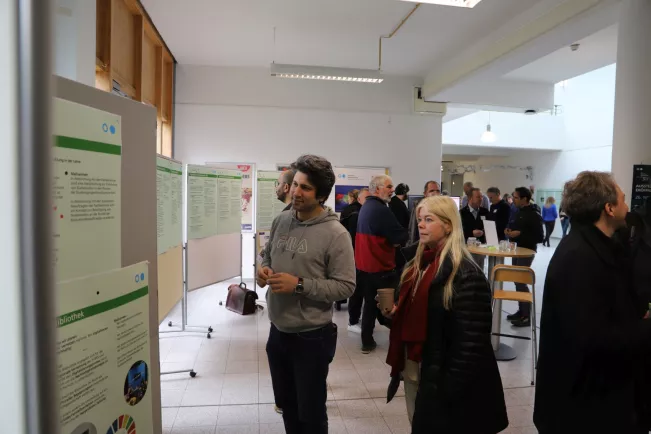
Numerous ideas from members of the university have been incorporated into HEP4. Employees, students and alumni all took part in drawing up the plan, which has now been approved by the Presidential Board.
"The University Development Plan is the result of an intensive joint process. Many members of the university have contributed their perspectives and thus made a significant contribution to the strategic direction," says Professor Andreas Gadatsch, Chair of the Senate.
The objectives and planned measures of HEP4 are regularly reviewed, prioritised and further developed in order to be able to react flexibly to new developments.
Shaping change - H-BRS university development plan 2026 to 2030
Contact us

Daniela Greulich
Deputy Head of executive department Communications and Marketing/Press and Public Relations, Press Officer
Location
Sankt Augustin
Room
E 237
Address
Grantham-Allee 20
53757, Sankt Augustin
Telephone
+49 2241 865 641Links
Weiterführende Links