Communications and Marketing
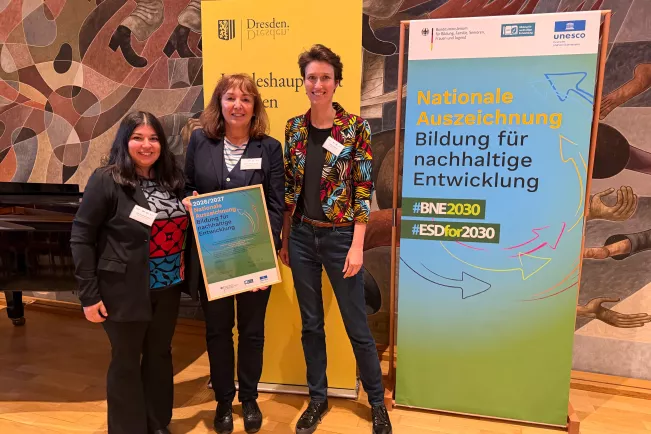
IZNE receiving award for educational work
The agricultural sector is an important economic factor in sub-Saharan Africa. There, the Federal Ministry of Research, Technology and Space (BMFTR) is funding four regional research and development projects in their endeavours to drive forward the transition to sustainable land management. The joint projects of European and African partners in Ghana, Togo, Namibia, Senegal, Burkina Faso and Benin are concerned, for example, with innovations for sustainable land management in smallholder farms or with digital support in livestock farming.
Transfer of research results into practice
How can the research results from these projects be successfully transferred into teaching and learning at African institutions? Researchers at Hochschule Bonn-Rhein-Sieg University of Applied Sciences have been working on this question in the BMFTR accompanying project INTERFACES and have developed the e-learning certificate "Research and Innovation for Sustainable Land Management in Africa". "Innovative research results are thus quickly put into practice," says research assistant Berenice Fischer. The BMBSFJ and the German UNESCO Commission have now honoured the IZNE at H-BRS for this innovative approach to education for sustainable development (ESD) and the United Nations' Global Sustainability Goals. In addition to Berenice Fischer, the IZNE project team consists of Dr Eefje Aarnoudse, Monalisa Maremba and Professor Wiltrud Terlau.
Holistic approach of the e-certificate
The certificate is aimed at students as well as employees from agricultural practice or employees of ministries and non-governmental organisations. In six modules, participants deal with topics ranging from the development of land management in Africa, the special features of rural areas and the effects of climate change to digital solutions and new research findings. The curricular guidelines of the African Union for land management were taken into account. Each module is designed for one week and includes interactive learning materials for self-study and local case studies as well as live group formats. The digital learning programme takes a holistic approach that encourages critical reflection and sustainable decision-making and brings together the expertise of more than 20 researchers. It was developed by the IZNE at H-BRS in close cooperation with the University of Environment and Sustainable Development (UESD) in Ghana and the Forum for Agricultural Research in Africa (FARA). The H-BRS e-learning team provided support with the digital implementation.
Participants as multipliers
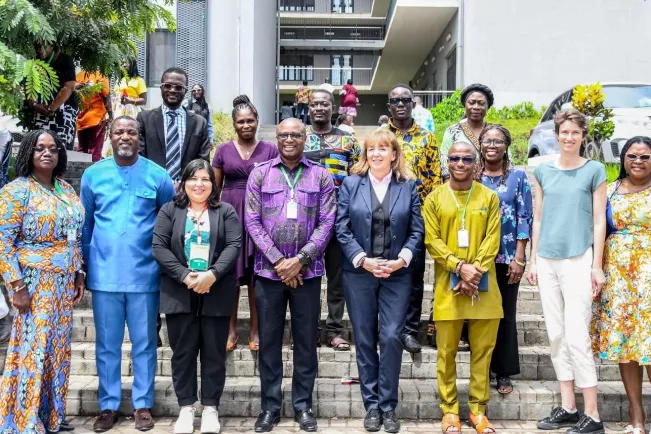
The learning platform was officially launched in Accra (Ghana) in the middle of last year. Since then, nine participants from Ghana have successfully completed the training programme. Currently, 38 students from Ghana, Tanzania, Nigeria, Ethiopia and Togo are completing the course, which has been updated again following the pilot phase. "The participants also act as multipliers for the dissemination of knowledge," says Professor Wiltrud Terlau, who is responsible for the INTERFACES project at H-BRS. On the part of UESD, Vice President Professor Edward Wiafe Debrah was very involved in the development of the e-certificate programme and praised its potential to reach students in remote areas during the presentation.
E-certificate programme to be continued after the end of the project
The INTERFACES project ends at the end of September 2026, but the e-certificate programme is expected to be offered beyond this date. The African cooperation partners are convinced of the practical benefits of the programme and want to continue it, says Terlau. For the researchers, this is a great appreciation of their joint work - as is the award from the BMBSFJ and the German Commission for UNESCO.
Background:
According to the German Commission for UNESCO, the "National Award - Education for Sustainable Development" recognises organisations, networks and municipalities that are committed to shaping our society in a sustainable way that is worth living in as part of the UNESCO ESD 2030 programme. Sustainable development means ensuring human dignity and equal opportunities for all in an intact environment. Education plays a key role in this. It enables people to make informed decisions and to better understand and assess the impact of their actions on future generations and other regions of the world.
The implementation of education for sustainable development is enshrined as a global goal in the United Nations 2030 Agenda, according to the UNESCO Commission. The UNESCO ESD 2030 programme, which was launched in 2020, aims to structurally anchor ESD in the education system.
Press photo for download
Contact us

Silvia Berenice Fischer
Research associate 'Responsible Economy and Natural Resources', Ph.D. student
Location
Sankt Augustin
Room
F 308
Address
Grantham-Allee 20
53757, Sankt Augustin
Telephone
+49 2241 865 9813
Wiltrud Terlau
Professor of Economics, Resilient and Sustainable Development, Director of the International Centre for Sustainable Development (IZNE), Department of Economics
Research fields
Location
Rheinbach
Room
B 111
Address
von-Liebig-Straße 20
53359, Rheinbach
Telephone
+49 2241 865 410Location
Sankt Augustin
Room
Raum F 305
Address
Grantham-Allee 20,
53757, Sankt Augustin

Daniela Greulich
Deputy Head of executive department Communications and Marketing/Press and Public Relations, Press Officer
Location
Sankt Augustin
Room
E 237
Address
Grantham-Allee 20
53757, Sankt Augustin
Telephone
+49 2241 865 641