Artificial intelligence at the H-BRS
KI:connect@H-BRS – Your secure access to artificial intelligence
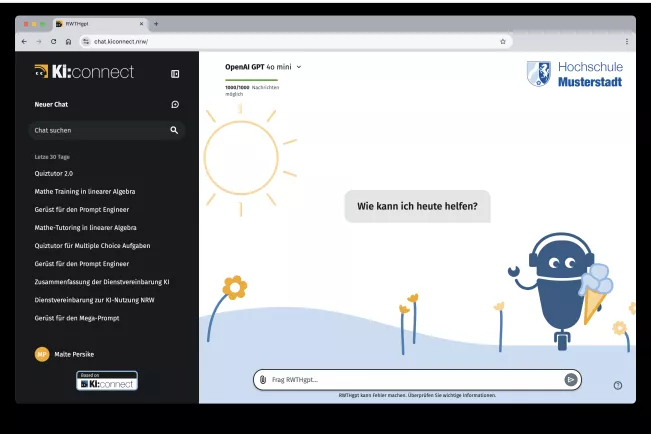
Starting October 15, 2025: AI within reach!
With KI:connect@H-BRS, you get access to powerful AI tools that can support your studies, teaching, research, and administration via a state-wide, data protection-compliant platform.
Whether developing ideas, writing texts, structuring or visualizing – KI:connect makes entering the world of generative artificial intelligence easy, secure and practical.
What is KI:connect@H-BRS?
KI:connect@H-BRS is Bonn-Rhein-Sieg University of Applied Sciences' access point to the state-wide platform KI:connect.nrw, which is operated by RWTH Aachen on behalf of the Ministry of Culture and Science of the State of North Rhine-Westphalia.
It offers university members a secure environment in which to use the following generative AI models directly in their browser – without having to register with external providers: OpenAI GPT-5.2, GPT-5, GPT-4.1, GPT-4.1 Mini, DeepSeek R1, Llama 3.1 8B Instruct, Qwen 3 32B, Codestral 22B, and Qwen QwQ 32B
A particular advantage is that your prompts are pseudonymized by RWTH Aachen before being forwarded to the respective language models. This means that your identity remains protected – data protection-friendly, convenient, and usable university-wide.
What does the platform offer me?
With KI:connect@H-BRS, you can use powerful AI models for a wide variety of tasks, e.g., to:
- Develop ideas and concepts
- Prepare or revise texts
- Create presentations or summaries
- Structure teaching and learning materials
- Support code or data analysis
- Generate creative designs and visualizations.
Available models:
- Commercial models from OpenAI (GPT-5.2, GPT-5, GPT-4.1, and GPT-4.1 Mini) – with personal usage quota
- Free models (DeepSeek R1, Llama 3.1 8B Instruct, Qwen 3 32B, Codestral 22B, and Qwen QwQ 32B) – hosted by the Gesellschaft für wissenschaftliche Datenverarbeitung Göttingen (GWDG)
Both model types can be selected and used directly via the portal.
How to use KI:connect@H-BRS?
- Open the KI:connect.nrw web interface.
- Select “Bonn-Rhein-Sieg University of Applied Sciences IDM” as your institution.
- You will be automatically redirected to the H-BRS login page (MIA login).
- Log in with your MIA account – that's it!
- Your entries are processed securely:
- Your MIA ID is pseudonymized by a temporary ID.
- Your prompt (the text entry) is transmitted separately.
- There is no direct communication between your account and external AI providers (e.g., OpenAI).
- This means your data remains protected – and you can use generative AI without having to register or share your data.
Using (virtual) API-key
In addition to using the platform in a browser, KI:connect allows OpenAI models to be integrated into your own software, tools, and apps using virtual API keys (vAPI keys).
To ensure that the same technical and organizational regulations apply to the use of AI models via vAPI keys as to the use via browser interface, the vAPI keys establish a connection to the KI:connect.nrw portal and not directly to the AI models themselves. Accordingly, the use of the models via vAPI keys counts toward the user’s usage quota.
You can generate and manage your individual vAPI keys on your own in the KI:connect.nrw web interface. To do this, log in to the portal, click on your account name (at the bottom left of the side menu) and then on "API Keys Management."
KI:connect.nrw currently uses OpenAI’s standard Chat Completions API. For details on using vAPI keys in third-party software (including the option to test keys you have generated yourself), please visit:
Working safely and responsibly
AI tools open up new possibilities—but they also require an awareness of legal, technical, and ethical issues.
The university supports you by offering learning and information materials with practical relevance:
🎓 Self-study course “Fundamentals of Artificial Intelligence” (LEA, currently only in German, English version will follow shortly)
The course provides practical insights into how AI works, as well as the opportunities, risks, and relevant legal framework for its usage.
→ To the training course in LEA: Grundlagen der Künstlichen Intelligenz
Legal documents and notices
- Terms of Use KI:connect@H-BRS: Usage conditions for research, teaching, studies, transfer, and administration
- Privacy Notice for KI:connect@H-BRS
- Checklist „Permissible Use of AI Systems at H-BRS“: Dos and don'ts when using generative AI
We have summarized frequently asked questions about how KI:connect@H-BRS works below.
Further explanations on how to use the web interface can be found on the KI:connect.nrw project website:
Further questions?
Our FAQs on KI:connect provide information on features, models, data security, and shared chats.
What is KI:connect.nrw?
KI:connect.nrw is a state-wide project led by RWTH Aachen and funded by the Ministry of Culture and Science of the State of North Rhine-Westphalia.
The platform provides all universities in North Rhine-Westphalia with secure, data protection-compliant access to generative AI systems.
With KI:connect@H-BRS, Bonn-Rhein-Sieg University of Applied Sciences uses this environment to provide its students and employees with various language models in a centralized manner.
What is the difference between ChatGPT and the OpenAI models in KI:connect?
ChatGPT is the web app provided by OpenAI that is optimized for dialogues and has its own user interface. It combines various OpenAI models with additional functions such as internet search, file uploads, and analysis tools.
In KI:connect, on the other hand, the OpenAI models (e.g., GPT-5.2, GPT-5, GPT-4.1, and GPT-4.1-Mini) are integrated via an API. This means: The models work within the KI:connect.nrw interface with their own default settings for the system prompt and other control parameters. External tools such as internet search are currently not activated. Performance, speed, and costs vary depending on the model: “Mini” models are faster and cheaper, while larger models usually deliver more complex and precise results.
What features does KI:connect.nrw offer?
The platform offers an intuitive working environment with the following features:
- Chat area: Start, rename, save, or delete new chats
- Share function: Share chats with other university members (the shared status is “frozen”)
- File upload: Use the paperclip in the input field to upload files (e.g., PDFs, Office documents, images) and have them analyzed
🔎 Note: Detailed instructions can be found in the online help.
Which language models are available in KI:connect?
The following models are currently available:
- GPT models from OpenAI (commercial, with usage quota)
- GPT-5.2, GPT-5, GPT-4.1 und GPT-4.1 Mini
- Free models hosted by the GWDG (Gesellschaft für wissenschaftliche Datenverarbeitung Göttingen)
- DeepSeek R1, Llama 3.1 8B Instruct, Qwen 3 32B, Codestral 22B und Qwen QwQ 32B
The list of available models will be updated regularly. An overview with model descriptions and recommendations for use can be found on the following GWDG website.
Can my entries be viewed by others? How secure are my entries?
Basically, all entries and outputs that you make and receive in your account are only visible to you. Chats are stored in encrypted form. This means that no one but you can view them.
However, if you want to share chats with others, you can do so. To do this, click on the three dots to the right of a chat title and then click on Share. The current status of the chat will then be “frozen” and you can send the link to other people. If these people also have an account on KI:connect.nrw, they can continue working on the shared chat using their own account.
How reliable are the responses at KI:connect?
KI:connect.nrw currently has no connection to search engines or curated databases.
The outputs are based exclusively on the training data of the underlying language models. This can result in content errors, incomplete representations, or outdated information - the quality of the results varies depending on the topic.
An important point of reference is the so-called knowledge cut-off:
This refers to the last date the model's training data was updated. A knowledge cut-off in September 2024 therefore means that information after this date is not taken into account.
Please always check the outputs critically before using them.
In our training and information materials, we also point out typical risks associated with using AI, such as:
Hallucinations: The model “invents” facts or sources that do not exist.
Bias: Distorted representations due to unbalanced training data, which can favor stereotypical or discriminatory results.
Pseudo-accuracy: Linguistically convincing but factually incorrect or simplified answers.
💡 Tip: Always use AI results as a draft or source of inspiration - not as the final truth.
Who can I contact if I have any questions?
Depending on your concern, there are different points of contact available to you:
- For technical questions or problems with registration: ServicePoint of the Institute for IT Services (ITS)
- For legal questions or questions about data protection: Legal and Compliance Office
- For questions about the use of AI in teaching: Centre for Teaching Development and Innovation (ZIEL)
Documents
to download