30 years Hochschule Bonn-Rhein-Sieg
Exhibition Visionary Female Researchers: Sofja Kovalevskaya
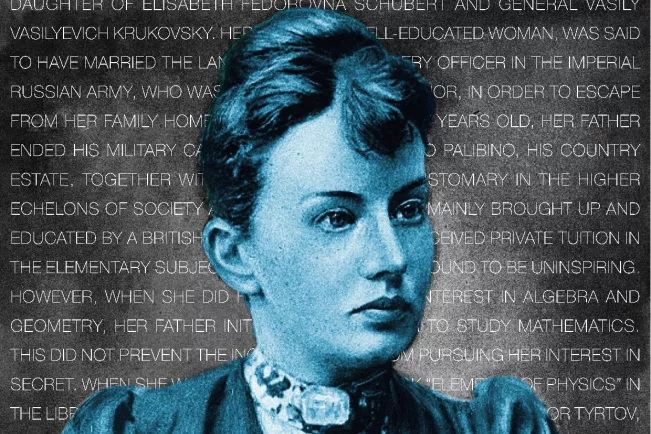
Biography of Sofya Kovalevskaya (1850-1891)
Sofya Vasilyevna Kovalevskaya is born in Moscow on 15 January 1850, the second daughter of Elisabeth Fyodorovna Schubert and General Vasily Vasilyevich Krukowski. Her mother, an educated woman, decides to marry the artillery officer of the Imperial Russian Army and landowner, who is twenty years her senior, possibly also to break away from her parents' home.
When Sofja is eight years old, her father ends his military career and retires with his family to his estate in Palibino. As is typical in upper-class circles at the time, she is educated by a British governess and receives supplementary private tuition in the basic subjects, which she initially finds uninspiring. When her interest in algebra and geometry is awakened, her father initially forbids her from taking mathematics lessons. But Sofya is not discouraged and teaches herself the subject. At the age of 14, she discovers the book ‘Elements of Physics’ by Professor Tyrtov, a neighbour of the family, in the home library. She works through the formulas and theories presented in it with great perseverance and analyses them independently. When she presents Tyrtov with a summary of her self-taught study of his book, he is impressed by the analytical acuity of the young Kowaleswkaja and persuades her parents to allow her to take lessons in higher mathematics.
In 1868, she moves to Saint Petersburg and receives private tuition in analytical geometry and infinitesimal calculus from Professor Alexander Strannolubski. During this time, she also meets Fyodor Dostoyevsky, for whom she harbours a temporary admiration, as she later writes in her memoirs. Dostoyevsky, on the other hand, is attracted to her older sister Anna, who visits her in Saint Petersburg.
Anna, who is eight years older, has been a formative figure for Sofya since childhood – not only as her closest confidante, but also in political terms. Under Anna's influence, Sofja joins the so-called ‘Nihilist Movement’ – an intellectual youth movement in Russia in the 1860s. This movement opposes conservative moral values and political structures, advocates for the enlightenment and education of the rural population, and fights for the emancipation and scientific education of women.
At this time, men in Russia exclude women from university studies and even forbid them from attending lectures as guest students. In Western Europe, on the other hand, some universities are already opening their doors to women. However, Russian women do not have their own passports at this time and can only travel abroad if accompanied by their father or husband, in whose passport they are registered. Sofya Kovalevskaya refuses to accept this restrictive discrimination. Determined to study mathematics and natural sciences, she finds a pragmatic solution: in 1868, she enters into a sham marriage with the student Vladimir Onufriyevich Kovalevsky, also a supporter of the nihilists. At that time, it is considered a matter of honour in the circles of the movement to enable women to access education in this way, as they have no academic opportunities in their homeland.
First, the Kowalewskis move to Heidelberg, where Sofja's determination wins her permission to attend mathematics lectures. After two semesters, in the spring of 1870, she moves to Berlin. There, women are still denied regular university studies, but she convinces the renowned mathematician Karl Weierstrass to teach her as a private student.
Weierstrass supports her intensively in her research and accompanies her with her dissertation, on which she works tirelessly from November 1872 onwards. Finally, in 1874, at Weierstrass's suggestion and with his support, Sofja Kowalewskaja applies to the University of Göttingen for admission to doctoral studies. To prove her scientific qualifications beyond doubt, she submits three papers – each of which, according to Weierstrass, would have been sufficient as a dissertation. At the age of 24, she receives her doctorate ‘in absentia’ with the highest grade of ‘summa cum laude’.
After completing her doctorate, Sofya returns to St. Petersburg with her husband, where she continues to devote herself to mathematical problems. In 1878, she gives birth to their daughter. In 1880, Sofya re-establishes contact with Weierstrass and continues her mathematical research. However, the Kowalewskis' marriage finally breaks down at this point. In 1881, Sofja separates from her husband and moves to Berlin with their daughter. As a single migrant mother, she is financially dependent on herself and, with the support of her mathematician friends, seeks employment at a European university. Getting such a job is very difficult for a woman, but completely impossible for a married woman who lives separately from her husband. The academic world only changes for her after a personal tragedy: in 1883, her husband, whose financial speculations have ruined him, takes his own life. This gives Sofya at least the social status of a widow, which makes it easier for her to gain access to academic positions. Thanks to the support of her Swedish friend and colleague, Gösta Mittag Leffler, a student of Weierstrass, Sofya Kovalevskaya is appointed as a private lecturer at the newly founded University of Stockholm in 1882. She holds her first lecture there in the winter semester of 1883/84 and is appointed professor of higher analysis in the same year. This makes Sofja Kowalewskaja the first woman in the world to lecture as a professor of mathematics.
Her position is initially financed by private donations and is limited to five years. Her scientific breakthrough comes in 1888, when she is awarded the prestigious Bordin Prize by the Paris Academy of Sciences for her work ‘On the motion of a rigid body around a fixed point under the influence of gravity’. As a result, her professorship is converted into a regular, lifelong professorship in 1889. But just two years later, on 10 February 1891, Sofya Kovalevskaya dies at the age of only 41 from the effects of pneumonia, which is inadequately treated medically.
Contact points
Centre for Science and Technology Transfer (ZWT)
Campus
Sankt Augustin