30 years Hochschule Bonn-Rhein-Sieg
Exhibition Visionary Female Scientists: Ada Lovelace
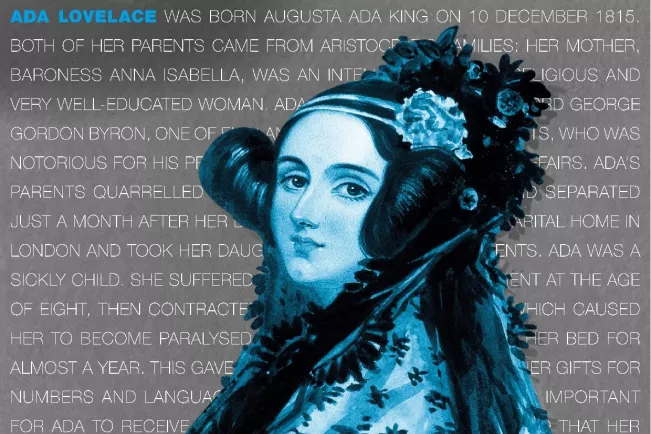
Biography Ada Lovelace (1815-1852)
Ada Lovelace was born Augusta Ada King on 10 December 1815. Both her parents came from aristocratic families: her mother, Baroness Anna Isabella, was an intelligent, religious and highly educated woman. Ada never got to know her father, Lord George Gordon Byron, one of England's greatest Romantic poets, who was known for his dissolute lifestyle and numerous affairs. Ada's parents quarrelled shortly after their marriage and separated just one month after her birth. Ada's mother left their home in London with her daughter and moved in with her parents.
Ada is a sickly child. At the age of eight, she suffers from temporary impairment of her vision, contracts measles at the age of 14 and, as a result, suffers from paralysis that forces her to stay in bed for almost a year. During this time, she immerses herself in her passion for mathematics and languages, which significantly promotes her intellectual development.
Her mother ensures that Ada receives an exceptional education that goes far beyond the usual standard, so her daughter is taught by the best tutors. She fears that Ada may have inherited her father's negative tendencies and wants to keep them in check through academic drill. Among Ada's tutors is mathematics professor Augustus de Morgan, who specialises in logic and algebra and encourages Ada's enthusiasm for numbers and machines. Ada spends many hours studying new inventions and technical diagrams and, at the age of 13, invents a steam-powered flying machine and the ‘science’ of flyology.
On 8 July 1835, at the age of 19, Ada marries Baron William King and gives birth to three children. In 1838, her husband is elevated to Earl, and Ada becomes Countess Lovelace.
After an initial meeting with the influential mathematics professor Charles Babbage in 1833, she quickly becomes fascinated by his work on the ‘analytical engine’, a calculating machine. In 1842, Babbage gives a lecture on his invention at the University of Turin, a kind of explanation and operating manual for the planned machine, which is published in Italian. At Babbage's request, Ada Lovelace translates the article into English in 1843 and adds extensive notes and additions of her own. The so-called ‘Lovelace's Notes’ are about twice as long as the original article when published and contain several concepts that are far ahead of the state of research around 1840.
Particularly noteworthy is her idea that the machine could do more than just perform calculations; it would also be capable of solving more general tasks if given the right programmes. Today, this idea is regarded as a fundamental basis of computer science. Ada therefore plays an important role in the early debates on artificial intelligence. Her statement that machines can only do what humans tell them to do has gone down in the history of computer science as ‘Lady Lovelace's Objection’ and is still cited today in epistemological discussions.
Despite her far-reaching scientific achievements, Ada Lovelace remains known for a long time more for her famous father than for her own work. It was not until the 1950s that Ada Lovelace's achievements in computer science were rediscovered and recognised. In 1980, an important new programming language was developed on behalf of the US Department of Defence to standardise the approximately 400 different military computer languages that existed at the time. This programming language was named ‘Ada’ after Ada Lovelace.
After the birth of her third child, Ada falls seriously ill. She dies on 27 November 1852 at the age of only 36. At Ada's own request, she is buried next to her father in the family grave in Hucknall, England.
Sponsoring

Hisolutions has sponsored the portrait of Ada Lovelace and supported the exhibition Visionary female researchers with a donation of €3,000.
HiSolutions is an owner-managed consulting firm and one of the leading specialists in IT security, digitalisation and IT management in German-speaking countries. For over 30 years, we have been combining highly specialised expertise with conceptual strength, innovative power and implementation competence.
More than 350 employees at five locations support institutions from almost all industries and public administration in creating future-proof solutions that guarantee maximum cost-effectiveness and security and are precisely tailored to the technical and business needs of our customers.
Our culture is characterised by mutual trust, cooperative leadership and individual support. We support career ambitions with creative freedom and further training, but also help our employees to achieve a good work-life balance. HiSolutions has received multiple awards for various innovations, as an employer and in a nationwide consultant comparison as a ‘Top Consultant’.
Contact points
Centre for Science and Technology Transfer (ZWT)
Campus
Sankt Augustin