30 years Hochschule Bonn-Rhein-Sieg
Exhibition Visionary Female Researchers: Lise Meitner
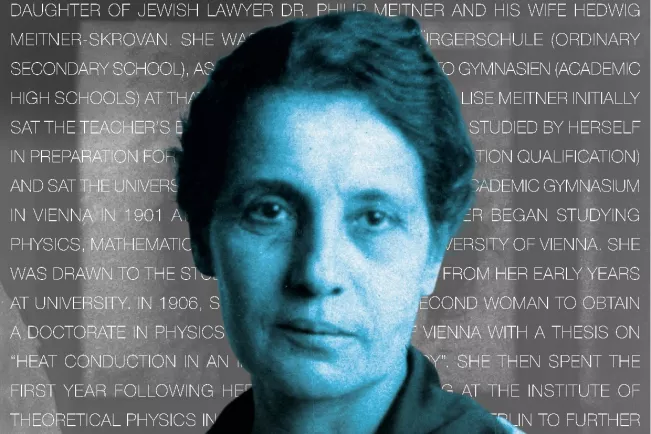
Biography of Lise Meitner (1878-1968)
Elise Meitner was born in Vienna on 17 November 1878 as the third daughter of Hedwig Meitner-Skrovan and her husband, the Jewish lawyer Dr Philip Meitner. She completed her schooling at a middle-class school, as girls were not admitted to grammar schools at the time. After leaving school, Lise Meitner first passed the French teacher's examination. She also prepared for the Matura (A-levels) on her own and passed her school-leaving examination in 1901 at the age of 22 at the Akademisches Gymnasium in Vienna.
In 1901, Meitner began her studies in physics, mathematics and philosophy at the University of Vienna. Already in the first few years, she focussed on questions of radioactivity. In 1906, she became the second woman to gain a doctorate in physics at the University of Vienna, specialising in heat conduction in inhomogeneous substances, and worked the first year after her doctorate at the Institute of Theoretical Physics in Vienna.
In 1907, she moved to the University of Berlin, where Max Planck taught and researched, to continue her scientific education. There she met the young chemist Otto Hahn, with whom she would work closely over the following decades and remain friends for the rest of her life. As women were not yet allowed to study in Prussia at the time, Leitner always had to enter the university's Institute of Chemistry through the back entrance and was not allowed to enter the students' lecture rooms and experimental rooms. This ban was only lifted in 1909, after women's studies were officially introduced in Prussia.
Leitner and Hahn achieved considerable research success in the following years, which also attracted a great deal of international attention. From 1912 to 1915, Lise Meitner was an unofficial assistant to Max Planck. in 1912, Hahn and Meitner's working conditions improved considerably when they were able to continue their research in the radioactive department set up by Hahn at the newly founded Institute of Chemistry of the Kaiser Wilhelm Society in Berlin-Dahlem. Meitner initially continued to work for free, but became a scientific member of the Kaiser Wilhelm Institute for Chemistry in 1913.
During the First World War, Meitner trained as an X-ray assistant and nurse and was deployed to a military hospital on the Eastern Front from July 1915. However, she returned to the Berlin institute in October 1916.
From 1918, Lise Meitner headed the physical-radioactive department of the Kaiser Wilhelm Institute for Chemistry and received an appropriate salary for the first time. in 1922, she qualified as a professor and was thus authorised to work as a lecturer. in 1926, she became an associate professor of experimental nuclear physics at the University of Berlin.
After the National Socialists came to power at the beginning of 1933, Lise Meitner was initially confident that she would be able to continue working without restrictions. However, in the same year, her teaching licence was revoked as a result of the "Law for the Restoration of the Professional Civil Service" due to her Jewish ancestry. However, she was initially able to continue her work at the non-governmental Kaiser Wilhelm Institute with Otto Hahn on irradiation experiments with neutrons . in 1938, when Germany annexed Austria, Lise Meitner became a German citizen and, although she had already been baptised as a Protestant in 1908, was particularly vulnerable as a Jew by birth. Otto Hahn therefore secretly organised her escape in 1938 together with the Dutch chemist Dirk Coster. She finally reached Sweden via Holland and Denmark, where she continued her research at the Nobel Institute until 1946.
As a staunch pacifist, Meitner vehemently refused to accept research contracts for the construction of an atomic bomb during the war years, although she was repeatedly asked to do so by the USA.
In 1938, Leitner worked with her nephew, the chemist Otto Robert Frisch, on the interpretation of a radiochemical discovery published by Otto Hahn, a process that he initially described as the "bursting of the uranium nucleus". Meitner and Frisch then put forward the hypothesis that the bursting in the narrower sense was the "fission" of the uranium nucleus and thus coined the term nuclear fission; they would later be able to prove their thesis experimentally. These explanations and proofs were in turn fundamental to Otto Hahn's further exploration of the subject, which Meitner was unable to continue to the same extent as he due to her political persecution.
In 1945, Otto Hahn was awarded the Nobel Prize for Chemistry for the year 1944 for the discovery and radiochemical proof of nuclear fission. Lise Meitner and Otto Robert Frisch are not considered, which is still criticised today in view of their theoretical contribution to Hahn's discovery. Although Meitner publicly expressed her understanding about the sole awarding of the prize to Hahn, her lack of protest also reflects the structural mechanisms that have long prevented women in science from receiving the recognition they deserve for their achievements. Meitner was repeatedly referred to as Hahn's "collaborator", which outraged her.
In the post-war period, Lise Meitner received numerous honours around the world, particularly in the Federal Republic of Germany; for example, the first "Otto Hahn Prize for Chemistry and Physics" in 1955 and the Peace Class of the Order Pour-le-Mérite, the highest German award of all, in 1957. She was nominated for both honours by Otto Hahn. in 1959, the "Hahn-Meitner Institute for Nuclear Research" (HMI) was officially inaugurated in Berlin in the presence of both namesakes.
In 1960, Lise Meitner moved to Otto Robert Frisch in Cambridge, where she spent the last eight years of her life. Until her death at the age of 89, she campaigned for the peaceful use of nuclear fission.
Lise Meitner died on 27 October 1968, the same year as Otto Hahn.
Contact points
Centre for Science and Technology Transfer (ZWT)
Campus
Sankt Augustin