30 years Hochschule Bonn-Rhein-Sieg
Exhibition Visionary Female Researchers: Jocelyn Bell Burnell
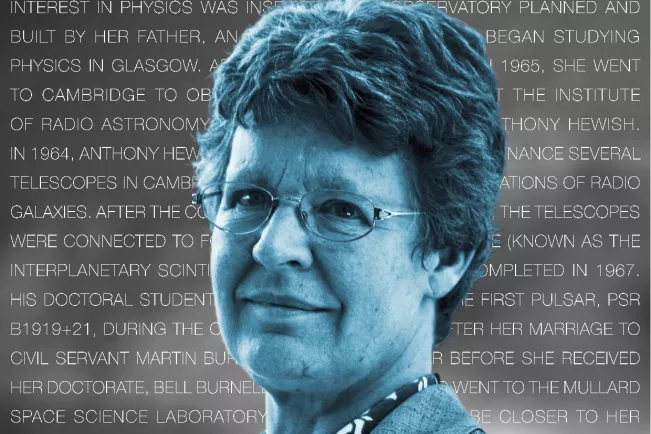
Biography Jocelyn Bell Burnell (1943)
Jocelyn Bell Burnell is born Susan Jocelyn Bell on 15 July 1943 in Belfast, Northern Ireland.
As a young girl, an observatory designed and built by her father, an architect, sparks her interest in physics.
In 1960, Bell begins studying physics in Glasgow. After graduating in 1965, she moves to Cambridge to pursue a PhD under the supervision of Anthony Hewish at the Institute of Radio Astronomy.
In 1964, Anthony Hewish raises funds to finance several telescopes in Cambridge to improve the observation capabilities of radio galaxies. Construction begins in 1965, and the telescopes, which are interconnected to form a large radio telescope array (Interplanetary Scintillation Array), are completed in 1967. As part of this project, doctoral student Jocelyn Bell Burnell notices the first pulsar, PSR B1919+21, making a groundbreaking discovery.
After marrying government official Martin Burnell in 1968, a year before completing her doctorate, Bell Burnell moved to the Mullard Space Science Laboratory in Southampton to be closer to her husband.
In 1974, Anthony Jewish is awarded the Nobel Prize in Physics together with Martin Ryle for his role in the discovery of pulsars. Jocelyn Bell Burnell, whose keen observation, sound interpretation and analysis were instrumental for the discovery of the pulsar at the time, and who is still listed second after Hewish in the original publication of the discovery, is not considered for the Nobel Prize. The Nobel Committee is heavily criticised by the scientific community for this decision. In contrast, a year earlier (1973), she had been awarded the Michelson Medal of the Franklin Institute in Philadelphia together with Hewish.
In the following years, Bell Burnell researches and teaches at the most prestigious physics institutes in Great Britain and Ireland, making a name for herself in the scientific community with numerous awards. In 1978, she receives the J. Robert Oppenheimer Memorial Prize and in 1989 the Herschel Medal from the Royal Astronomical Society, of which she is president from 2002 to 2004.
At the same time, Bell Burnell teaches at the Open University, a British distance learning university, where she is appointed professor of physics in 1991, a position she holds until 2001. From 2001 until her retirement in 2004, she is Dean of Natural Sciences at the University of Bath. In 2003, Jocelyn Bell Burnell is appointed a Fellow of the Royal Society. In 2007, she is awarded the title of Dame Commander of the Order of the British Empire by Queen Elizabeth II, thereby receiving a personal knighthood.
From 2008 to 2010, she is President of the Institute of Physics and from 2014 to 2018 President of the Royal Society of Edinburgh.
In 2018, Jocelyn Bell Burnell receives the Breakthrough Prize, worth three million dollars, more than the Nobel Prize, for her extraordinary achievements in the field of physics. Shortly afterwards, Bell tells the BBC in an interview that she does not want to keep the prize money but instead use it to fund scholarships for underrepresented groups at physics institutes: women, ethnic minorities and refugees.
From 2019 to 2024, she is Chancellor of the University of Dundee, and since 2025 heads the Brunel University in London. In 2021, Burnell is awarded the Royal Society's Copley Medal – one of the oldest and most prestigious scientific honours in the world.
In 2025, Burnell is inducted into the Order of the Companions of Honour – one of the highest civilian honours in the United Kingdom – for her contributions to astronomy, physics and the promotion of diversity in science.
The Bell Burnell Graduate Scholarship Fund, which she founded, has already awarded over £1 million in grants by 2024.
Contact points
Centre for Science and Technology Transfer (ZWT)
Campus
Sankt Augustin