30 years Hochschule Bonn-Rhein-Sieg
Exhibition Visionary Female Researchers: Hannah Arendt
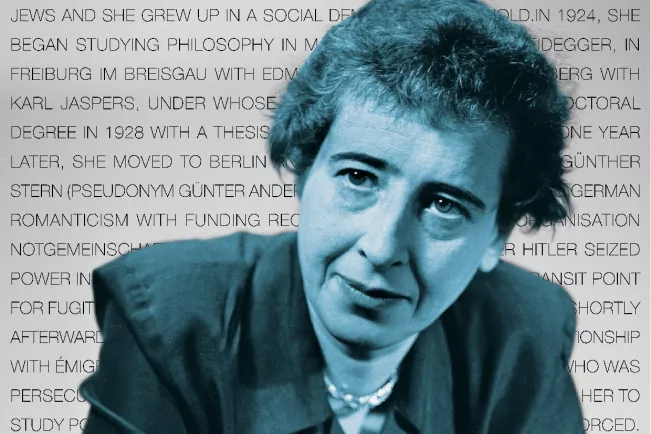
Biography Hannah Arendt (1906-1975)
Hannah Arendt is born Johanna Arendt on 14 October 1906 in Linden, now part of Hanover. She grows up in a social democratic, assimilated Jewish family.
From 1924 onwards, she studies philosophy in Marburg under Martin Heidegger, in Freiburg im Breisgau under Edmund Husserl and in Heidelberg under Karl Jaspers, under whom she obtains her doctorate in 1928 with a thesis on ‘The Concept of Love in Augustine’.
A year later, she moves to Berlin and marries the philosopher Günther Stern (pseudonym: Günter Anders).
Arendt begins researching German Romanticism, which is funded by a scholarship from the ‘Notgemeinschaft der Deutschen Wissenschaft’ (Emergency Association of German Science).
After Hitler seizes power in 1933, Arendt and Stern's flat becomes a transit point for persecuted people. Stern emigrates to Paris, followed shortly afterwards by Arendt, but she soon separates from Stern. Her acquaintance with her future husband Heinrich Blücher, an emigrant, journalist persecuted in Germany and member of the Communist Party of Germany, inspires her to engage with political theory and Marxism. In 1937, she divorces Stern.
In 1940, Arendt is deported to the notorious internment camp at Gurs, near the Pyrenees. At the last minute, she manages to escape deportation. Together with her mother, whom she had brought from Königsberg to Paris in 1939 with the help of a friend, and Heinrich Blücher, whom she had married the year before, she flees via Lisbon to New York in 1941.
After considerable initial difficulties, she works as a journalist and becomes chief editor at a large publishing house. She writes polemical articles to inform the public about the persecution of Jews and to stir them into action. Hannah Arendt soon makes a name for herself as a political philosopher in the United States, working as a professor and visiting professor at numerous universities, including Princeton, Harvard and Berkeley. She is invited to give lectures and seminars abroad, receives numerous awards and ten honorary doctorates.
In 1949, she returned to Europe for the first time since fleeing the Nazis. Her reunion with Germany fills her with sadness. She finds the lack of political reckoning with past events appalling.
In her main political work, Origins of Totalitarianism (1951), she links the conditions that gave rise to nation-state totalitarianism in the 19th century with the emergence of anti-Semitism. Using her concept of totalitarianism, she also examines the structural similarities between fascism and Stalinism. This work established her as an important social and political scientist.
In 1960, Hannah Arendt publishes her action theory study ‘Vita Activa or On Active Living’. In it, she distinguishes between three types of human activity: labour, production and action. Arendt analyses that since the beginning of modernity, labour has been exaggerated at the expense of political freedom of action.
In 1961, she begins reporting on the Eichmann trial in Jerusalem for the magazine ‘New Yorker’. Her articles are controversially discussed because of her criticism of the behaviour of the Jewish Councils and her portrayal of Adolf Eichmann himself and his motives. In 1963, her articles are published in book form under the title ‘Eichmann in Jerusalem: A Report on the Banality of Evil’.
Hannah Arendt devotes herself to her academic work, lectures and publications until the end of her life, in which she examines the mechanisms of political systems, the responsibility of the individual and the importance of thinking and judgement. After suffering her first heart attack in 1974, she resumes her writing and teaching activities.
Hannah Arendt dies of heart failure on 4 December 1975, surrounded by friends in her New York apartment.
Sponsoring

The Spectral Service AG has taken over the sponsorship of the portrait of Hannah Arendt and supported the exhibition Visionary Women Researchers with 3000 euros.
Spectral Service, founded in 1990 by Bernd Diehl and Werner Ockels, offers instrumental analysis at the highest level as a service. We cooperated closely with universities at an early stage; since 1993, we have supervised over 30 diploma, bachelor's and master's theses as well as several doctorates. in 2010, Spectral Service was transformed into a public limited company and has been family-owned since 2012 together with Gabriele Randel and Lukas Diehl. We have specialised in NMR and are one of the world's leading specialists in quantitative NMR with our locations in Cologne and, since 2017, Steelyard Analytics in Gaithersburg (Maryland, USA). Research and teaching are a central part of our work, including our long-standing collaboration with H-BRS, where I am an honorary professor. As an owner-managed company, we are committed to ethical and sustainable corporate management. During our Master's degree in Philosophy, Politics and Economics, we got to know Hannah Arendt as one of the most important thinkers of the 20th century and are delighted to be able to honour her with this sponsorship.
Contact points
Centre for Science and Technology Transfer (ZWT)
Campus
Sankt Augustin