30 years Hochschule Bonn-Rhein-Sieg
Exhibition Visionary Female Researchers: Tu Youyou
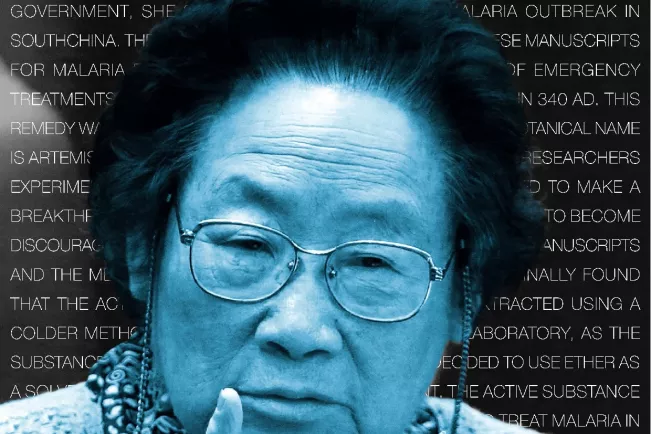
Biography Tu Youyou (1930)
Tu Youyou is born on 30 December 1930 in Ningbo, Republic of China. Her parents, a teacher and her father Tu Yongxiang, place great importance on education and enable their daughter to access higher education. Tu decides to study pharmacy at Peking University, graduating in 1955. She also deepened her knowledge of traditional Chinese medicine to bridge the gap between modern science and centuries-old healing knowledge.
In 1969, as lead scientist, Tu Youyou joins a secret research project run by the Chinese government to develop an effective treatment for malaria. She travels to malaria-endemic areas in southern China to study the disease in situ. Under her leadership, the research team analyses historical Chinese medical texts for herbal remedies for malaria. In the process, she comes across an emergency medicine written by the scholar Ge Hong in 340 AD, which recommends extracts from annual mugwort (Artemisia annua). Initial experiments with Artemisia extracts are unsuccessful. Tu Youyou does not give up and searches for a new method to optimally isolate the active ingredient.
She meticulously studies the ancient manuscripts and the preparation methods described therein. She discovers that the active ingredient artemisinin must be extracted using a colder method than is usual in the laboratory, as high temperatures destroy it. She therefore uses ether as a solvent, as it has a low boiling point. She successfully treats mice and monkeys with malaria using this newly extracted active ingredient. After the drug is successfully tested on malaria patients in a subsequent series of trials, the long-awaited breakthrough is achieved in 1973.
Although Tu Youyou and her team made a groundbreaking discovery, the Chinese government forbids them from publishing the results of the secret military project. The first international article on the drug does not appear until 1982 – without Tu Youyou's name among the authors. For decades, her crucial role in the development of artemisinin remains unknown.
It is not until 2007 that American malaria researchers Louis Miller and Xinzhuan Suauf specifically ask about the actual discoverer of the active ingredient at a scientific meeting in Shanghai. At first, they do not receive a clear answer. Only after thoroughly studying official records do they find clues leading to Tu Youyou. In 2011, they publish their findings in the scientific journal Cell, bringing Tu Youyou's scientific achievements to international attention. For the discovery and preparation of artemisinin, Tu Youyou receives the Lasker Award, the highest medical award in the USA, in the same year. In 2015, she finally receives the Nobel Prize in Physiology and Medicine – a historic recognition for her decades of work.
In a video message on the Nobel Prize announcement, Tu Youyou emphasises: ‘The discovery is the result of our entire team's work.’ She stresses that the award is dedicated not only to her, but to the entire research team and to traditional Chinese medicine as a whole.
Contact points
Centre for Science and Technology Transfer (ZWT)
Campus
Sankt Augustin