30 years Hochschule Bonn-Rhein-Sieg
Exhibition Visionary Female Researchers: Frances H. Arnold
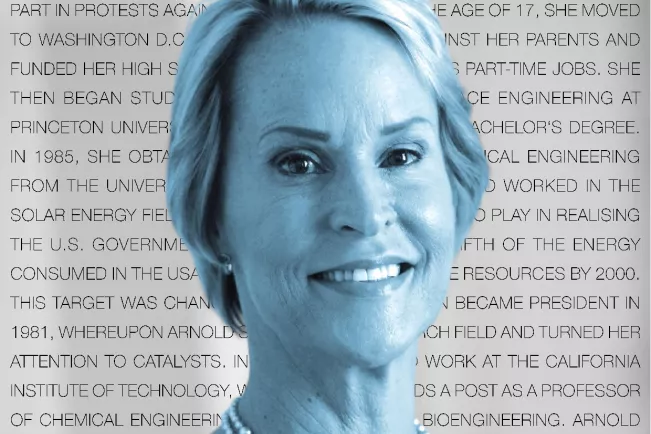
Biography Frances H. Arnold (1956)
Frances Hamilton Arnold is born on 25 July 1956 in Pittsburgh, Pennsylvania, and grows up in a suburb as the daughter of nuclear engineer William Howard Arnold. In her youth, she joins the protest movement against the Vietnam War. Rebelling against her parents, she moves to Washington, D.C. at the age of 17, where Arnold finances her high school education by working part-time jobs.
She begins studying aeronautical engineering and mechanical engineering at Princeton University, graduating with a bachelor's degree in 1979. In 1985, she earns her doctorate in chemical engineering from the University of California, Berkeley, and works in the field of solar energy under the US government's goal of generating one-fifth of the energy in the United States from renewable resources by the year 2000. When this goal changes with the presidency of Ronald Reagan in 1981, Arnold quickly changes her field of research and begins working on catalysts. In 1986, she begins her work at the California Institute of Technology, where she continues to work today as a professor of chemical engineering, biochemistry and bioengineering.
Arnold is known as a pioneer in the use of directed evolution methods in the development of new proteins for applications in medicine, biocatalysis and biofuels, for example. She achieved the first directed evolution of an enzyme back in 1993. Using this technique, she creates high-performance proteins that only have the desired properties. Today, her technique is mainly used in drug research.
In 2005, Arnold co-founds Gevo Inc., a company that researches methods for producing biofuels. Here, she develops an enzyme that works under anaerobic conditions, thereby saving high ventilation costs. She also works on enzymes that produce biofuel from cellulose instead of sugars.
In 2018, she becomes the fifth woman among the approximately 180 previous laureates to receive the Nobel Prize in Chemistry. Arnold receives half of the Nobel Prize; the other half is shared by biotechnologists George Smith and Gregory Winter. All three are considered pioneers of directed evolution. With it, they lay the foundation for ‘greener’ chemistry. In doing so, they have revolutionised chemistry and the development of medicines, according to the Nobel Committee in Stockholm.
Arnold also receives other prestigious honours and awards. In 2013, she is awarded the National Medal of Technology and Innovation by Barack Obama. The medal is considered the highest honour the US government bestows on scientists. In 2016, she becomes the first woman to receive the Millennium Technology Prize, worth one million Euro, and in 2019, she receives the Bower Award and Prize for Achievement in Science.
She is currently working as a Professor at the California Institute of Technology (Caltech) and Director of the Donna and Benjamin M. Rosen Bioengineering Center.
In 2023, she is awarded an honorary doctorate (Doctor of Science) from the University of Oxford. In the same year, she also receives the Perkin Medal, one of the most prestigious US awards for applied chemistry.
In 2025, Frances H. Arnold is honored with the highest award of the American Chemical Society's, the Priestley Medal, for her leadership in sustainable chemistry, her pioneering work in directed evolution, and her commitment to promoting women in science.
Contact points
Centre for Science and Technology Transfer (ZWT)
Campus
Sankt Augustin