🎓Learning to Embrace Change: Adaptive and Open-Ended Continual Learning for Embodied Autonomous Systems
Doctoral project at a glance
Period
01.01.2023 to 01.01.2027


Project Description
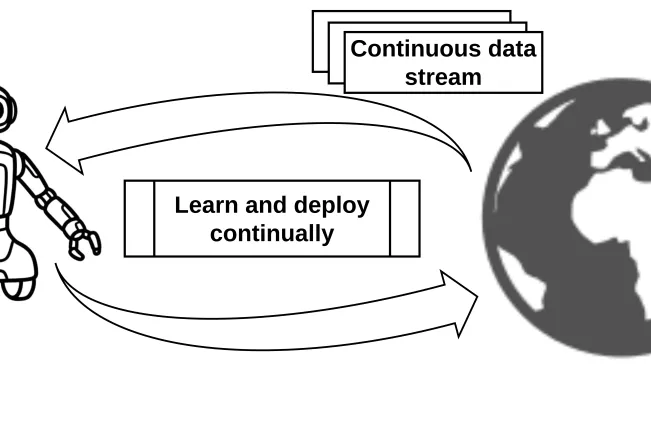
Autonomous systems and robots operate in dynamic environments that change gradually or radically over time. To perform tasks in such ever-changing environments, the robot should continuously learn and adapt its capabilities. Continual learning (CL) is a machine learning method that learns from continuous streams of data. CL aims to balance the trade-off between the capabilities to be maintained and those to be enhanced, a characteristic that current machine learning struggles with. This PhD thesis focuses on using the physical interaction of a robot, such as exploiting spatio-temporal information about the environment, to obtain more robust data for addressing the continual learning problem.
Cooperation partners
The project is being carried out in cooperation with Ruhr University Bochum, where it is supervised by Prof. Dr. Tobias Glasmachers.