Communications and Marketing
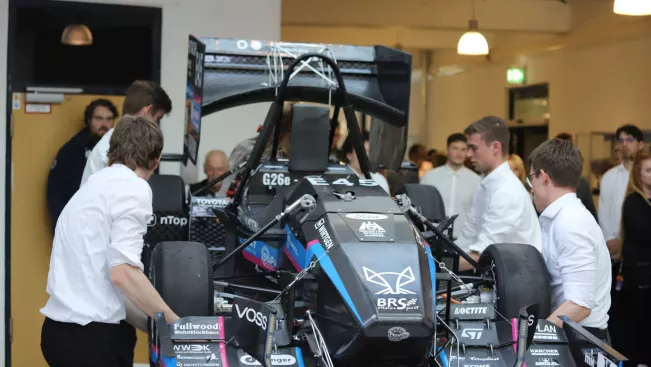
BRS Motorsport presents electric racing car G26e Eduard
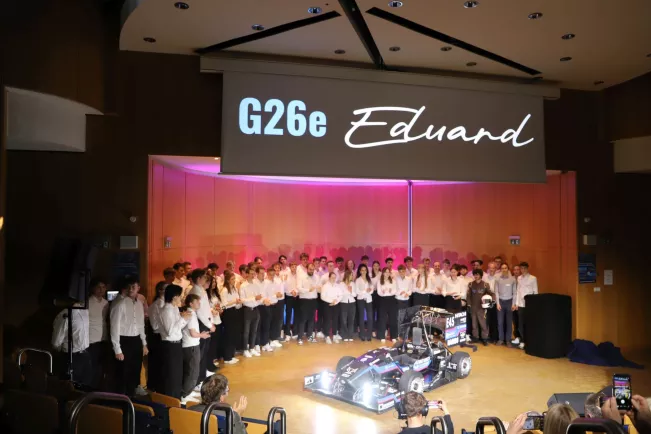
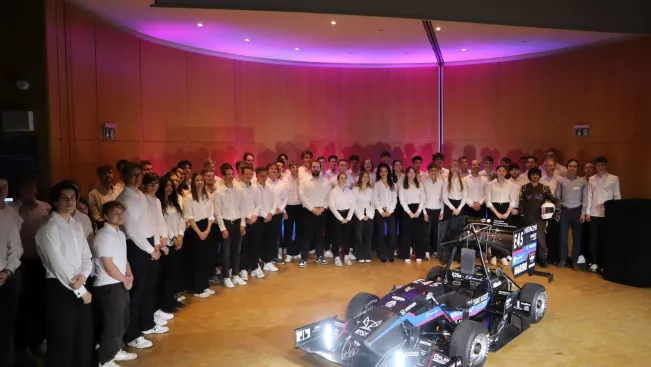
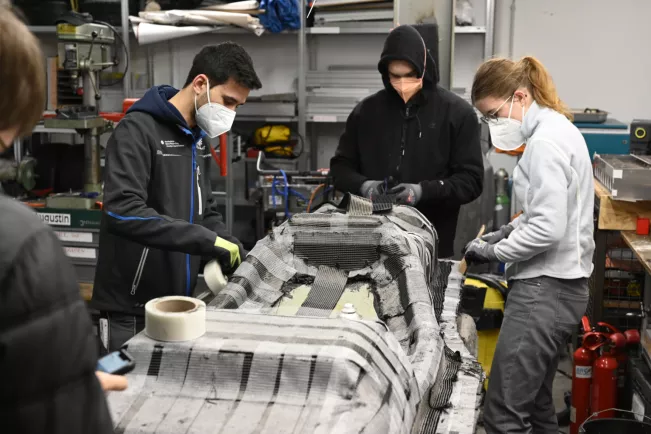
Once again, the days leading up to the presentation date were tight: The students worked on their new racing car literally right up to the last minute so that they could present it to the public in immaculate condition. However, the members of the student motorsport group are used to working night shifts. During the hot phase of chassis construction, they worked in a four-shift model to build the bodywork from carbon, adhesive film and aluminium honeycomb layer by layer. The group has been working on the completely handcrafted one-off for around a year. They have spent an estimated 30,000 working hours on the computer-aided design, assembly and testing of the components.
It is the twelfth electric formula racing car that students have built with the support of the university. For each season, the students organised in the BRS Motorsport association build a new car to take part in the races of the international Formula Student class. The club is open to all departments and currently has around 60 members.
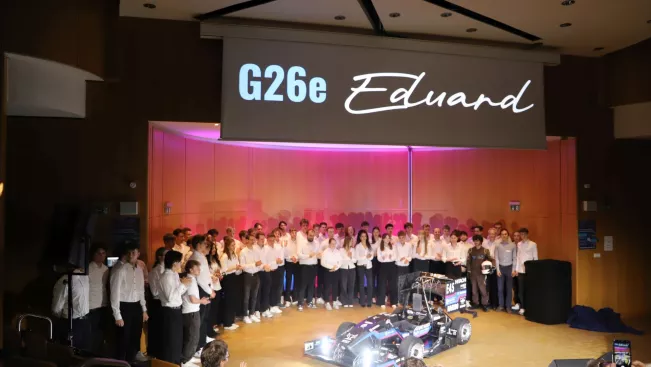
The students presented the new model to the public at a ceremony in the Audimax on the Sankt Augustin campus on Friday. The racer, nicknamed "Eduard", has four electric motors with a total output of 80 kilowatts, which should accelerate it to 100 kilometres per hour in 2.3 seconds. The acceleration value for the G26e, as it is officially called, comes from the extensive simulations that the students carried out with the help of mainframe computers at the university. The actual values now have to be determined in the test drives. To do this, they are allowed to use the 800 metre-long asphalt runway at the nearby Hangelar airfield.
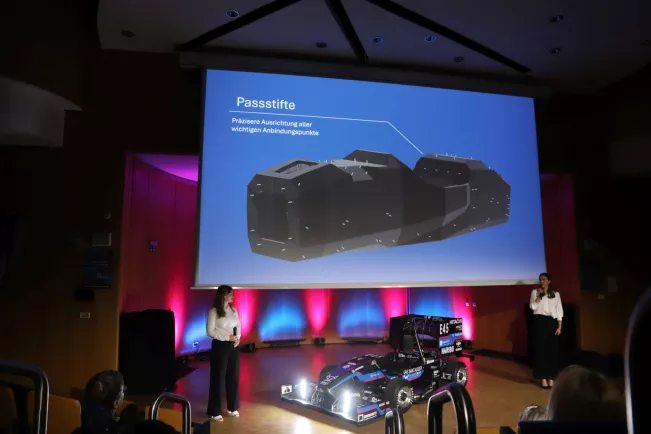
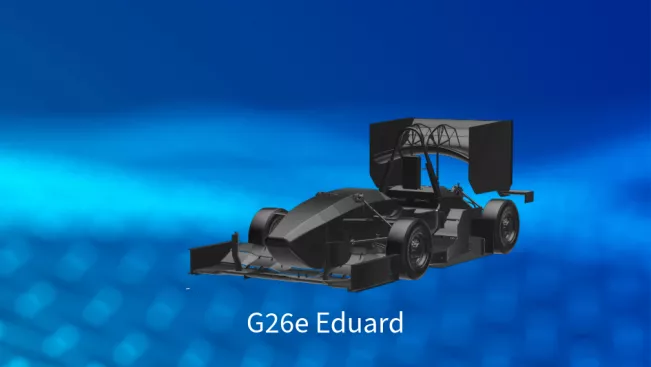
The student tinkerers have worked on every detail, from the chassis to the steering, the cooling, the brakes and the battery to the software, in order to achieve even better performance on the racetrack. Aerodynamics play a decisive role here. The students had already focussed on so-called three-dimensional geometries in the predecessor model. The various wings on the car are not designed as straight surfaces, but have curved shapes. This is particularly demanding in terms of production, but the aerodynamics are significantly improved as a result.
In order to be able to race in the upcoming season, extensive changes had to be made. This is because a new set of rules sets tighter limits on the dimensions of the aerodynamic add-on parts. The rear wing in particular had to be redesigned in order to comply with the rules and be highly effective at the same time.
"With the G26e, we are building on our mechanical concept from last year, eliminating small weak points, optimising components and relying on a revised aero package," says Fabienne Senge, Sustainability Engineering student and Technical Director. "A lot of knowledge transfer is currently taking place. Bachelor's theses, new vehicle developments and the targeted training of the many new team members have created a close-knit team that will ensure our success in the coming years. The G26e is now ready for the racetrack."
The list of new or revised assemblies and components in the G26e racer is long. For example, a specialised working group has developed a new, efficiency-optimised gearbox. The students analysed large amounts of data from racing operations, which showed them in which speed and load ranges the racing car actually moves in different situations. They also succeeded in reducing the weight of the gearbox on each of the four driven wheels by around 1.5 kilograms. With a racing car weighing only around 200 kilograms, the missing kilos have a noticeable effect on the driving dynamics.
Another working group has designed and produced a new battery management system - one of the central safety systems for an electric vehicle. The system ensures that individual cells of the high-voltage battery are discharged in a targeted manner in order to equalise voltage differences. It also has 32 sensors that monitor the cell temperatures. The working group responsible for the chassis has also done a great job and redesigned the layer structure of the carbon laminate. For example, the students have changed the orientation of the fibres of the composite material so that the loads on the structure are better distributed.
The first indications of whether the numerous innovations and detailed improvements will pay off will be shown by the test drives that the student motorsport athletes want to start immediately after the public digital presentation. Things will then get serious for the students and their G26e at the first international race of the season in the Czech Republic in July. The competition is considered to be particularly demanding, with the top league of European universities represented.
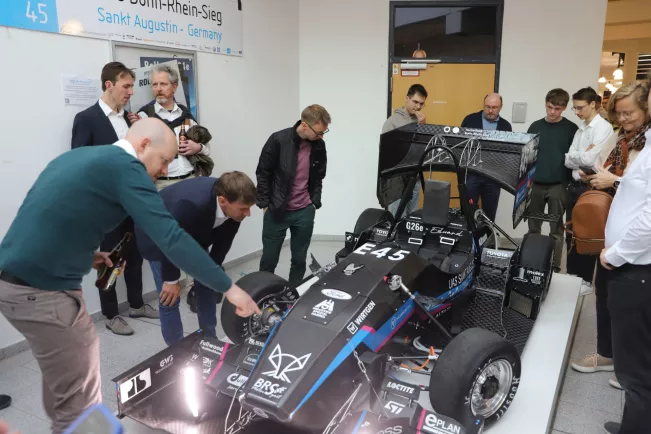
"After a year of development, meetings and an intensive production phase, I am proud of what we have achieved as a whole team. We are looking forward to attacking again as a team in the Czech Republic and France. We have already gained good experience there in recent years," says team leader Bernhard Winkelhake, a computer science student in his 6th semester.
The students are also using their expertise in electronics and software to develop technical solutions for autonomous driving. Their goal: a vehicle that can master the racetrack without a driver. They have already come a long way on the way there. For example, the complex laser-based sensors that guide the car during navigation work very reliably. When localising and mapping the route, the student inventors rely on a special algorithm that enables the vehicle to localise itself in an unknown environment and simultaneously create a precise map of the route. The brakes currently pose a major challenge, as they have to manage without pedalling.
In the upcoming season, however, a human driver will be at the wheel of the G26e. The students are therefore well prepared for the competitions in which they will compete against the best European Formula Student teams. The race will kick off from 19 to 24 July in Most in the Czech Republic. The winding track there is associated with exciting memories for the BRS Motorsport team: The team took first place in the prestigious "Engineering Design" category and second place in the "Cost and Manufacturing" category there in 2023. After the race in the Czech Republic, the young BRS Motorsport team will be competing in Lyon, France, from 24 August.
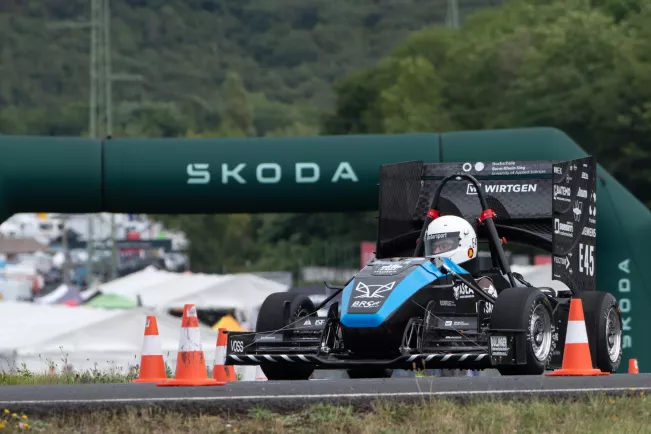
About 30 team members will be travelling to each of the multi-day races with the racing car and extensive equipment, so the logistics are correspondingly complex. For the students, it is an affair of the heart in which they invest countless hours of their free time. Costs are nevertheless incurred, with the largest item being the construction of the racing car. Although the university supports the team, the students would not be able to afford this effort without external supporters.
Severin Hudelmayer, Business Administration student and responsible for sponsorship, says: "Our project would not be possible without the support of our partners and sponsors. We are very pleased that we have been able to gain some new partners in addition to our long-standing partners. Every helping hand, every sponsor and every supporter contributes to the success of this season."
From the point of view of Professor Dirk Reith, who supervises the project at the university as Faculty Advisor, one special feature is the way in which racing car construction is anchored in the university's curriculum: "By integrating the team into teaching, we can tailor electives and projects directly to the team's work, sometimes even across departments. This allows us to immediately put a lot of theoretical knowledge into a practical context and utilise it."
Race car construction at the H-BRS
Press photos for download
Contact us

Dirk Reith
Computational Science and Engineering , Managing Director of the TREE Institute, Faculty Advisor BRS Motorsport
Research fields
Location
Sankt Augustin
Room
B 223
Address
Grantham-Allee 20
53757 Sankt Augustin
Telephone
+49 2241 865 9678
Location
Sankt Augustin
Room
E 240
Address
Grantham-Allee 20
53757, Sankt Augustin
Telephone
+49 2241 865 9560