Communications and Marketing
Reforestation using AI and drones: H-BRS demonstrates the ‘Garrulus’ research project to NRW Minister Gorißen
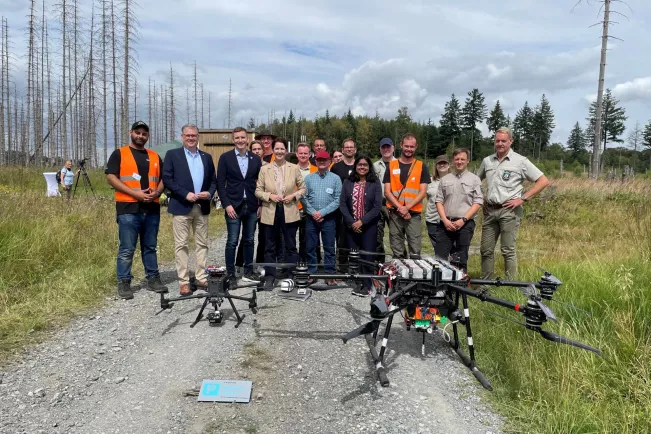
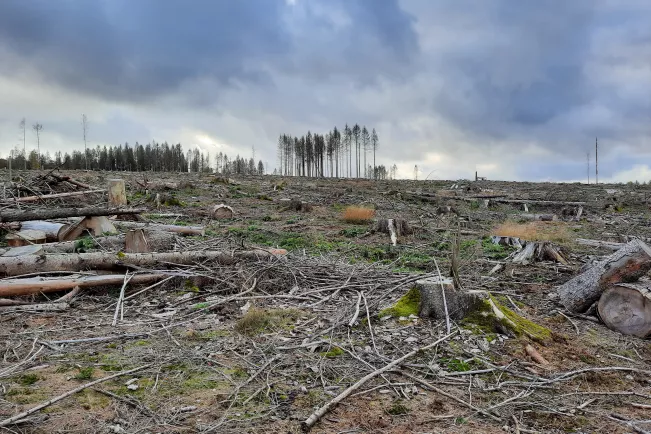
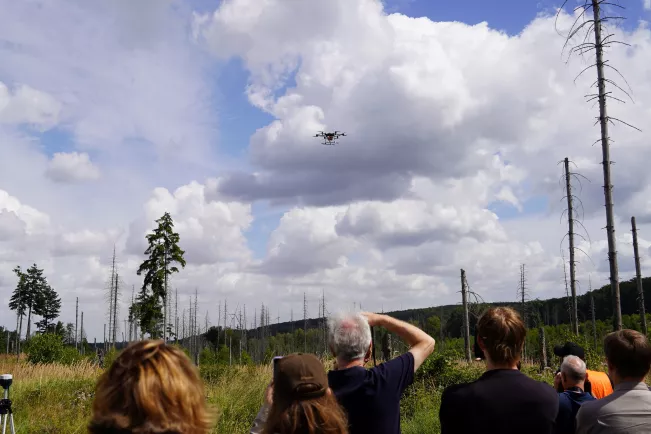
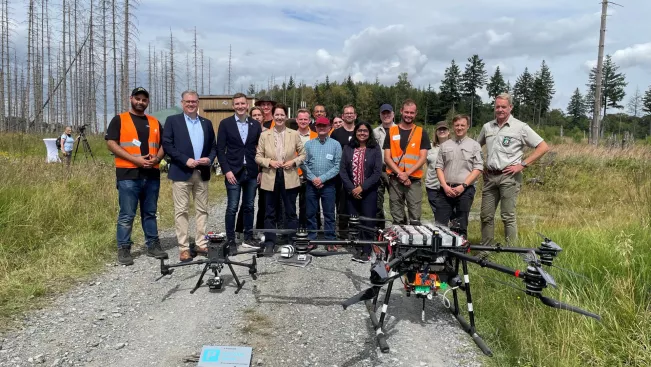
Anyone walking through the local forests cannot fail to notice it: discoloured tree crowns, bare branches and flaking bark show that trees have died over a wide area as a result of bark beetle infestation. Recently, the situation with the pest has eased somewhat – but reforestation remains a key priority. Storms and droughts have also taken their toll. According to the latest North Rhine-Westphalia Forest Condition Report from 2025, a third of the trees are severely damaged. Researchers at the Hochschule Bonn-Rhein-Sieg have now developed an innovative method for reforestation using drones as part of the ‘Garrulus’ project; they demonstrated a prototype of this to North Rhine-Westphalia’s Minister for Agriculture, Silke Gorißen, today in the Arnsberg Forest.
Gorißen: Project has the potential to strengthen forestry with regard to sustainability
“Our forests are indispensable – as habitats, climate protectors, places of recreation and sources of timber,” said Minister Silke Gorißen at the site. “At the same time, they are under enormous pressure due to climate change. That is why we need new ideas and modern technologies to support reforestation. The ‘Garrulus’ project impressively demonstrates how artificial intelligence, drone technology and scientific expertise can help to reforest damaged forest areas precisely and efficiently using seeds. The state government is deliberately supporting ‘Garrulus’ because the project has the potential to strengthen the forestry sector with a focus on sustainability.”
The method consists of three steps
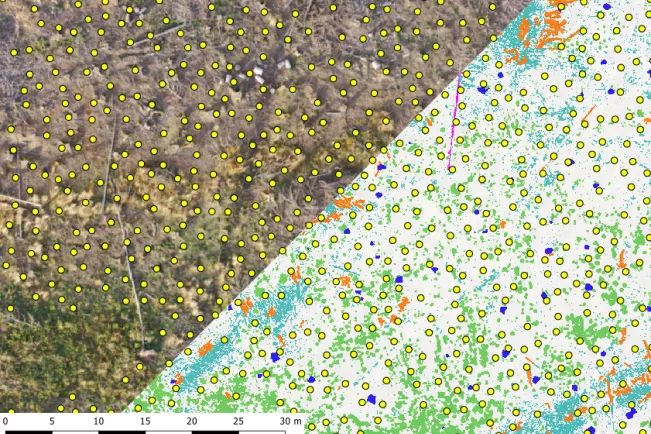
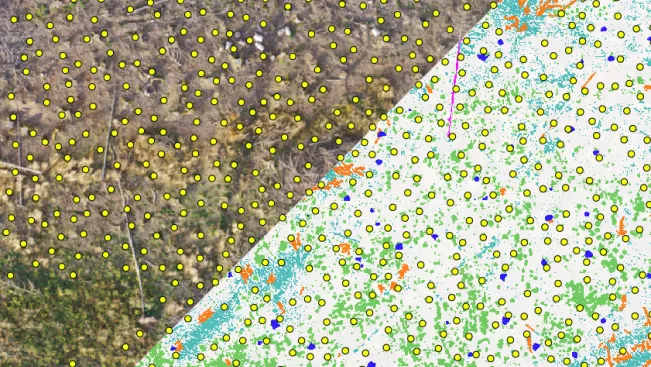
The newly developed method consists of three steps: First, the researchers use a survey drone, equipped with various cameras and sensors, to map the damaged forest area. The resulting high-resolution images are then analysed using newly developed artificial intelligence (AI) models – tree stumps, for example, are identified, as are vegetation and exposed soil. Based on this data, the AI then proposes a reforestation plan identifying the optimal locations for the successful germination of new trees. In the third step, a seeding drone is deployed; it hovers at a height of ten to 15 metres above the ground and, always under human control, deposits capsules containing seeds and nutrients into the soil at these points.
A coordinated system combining drone technology and AI analysis of forest soils
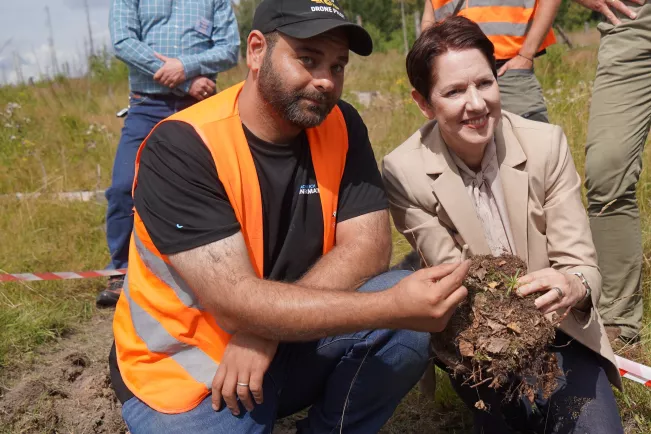
“What makes ‘Garrulus’ special is that it combines the entire reforestation process within a coordinated system of drone deployment and machine learning. Thanks to the AI-supported analysis of damaged forest soils, seeding is carried out precisely by drone rather than through random scattering of capsules – and its success can be verified using the same drone,” says project manager Ahmad Drak. In Central Europe, large areas of forest need to be reforested quickly and resiliently due to damage caused by drought, storms and bark beetles. However, manual planting is expensive and time-consuming, which is why the scalable and precise workflow developed in the Garrulus project offers genuine practical added value. “The future prospects for this method are promising: The core components – high-resolution mapping, segmentation, targeted sowing and drone-based monitoring – work and demonstrate the potential of this technology for reforestation.” Further applications in digital forestry, such as the automated mapping of forest areas, are also conceivable.
Development of a prototype as the project’s objective
The “Garrulus” project began in 2021 and will end in December 2026. The aim was to develop a prototype that would provide a scientifically sound basis for future market-ready applications. The team of researchers from the Department of Computer Science at H-BRS includes Ahmad Drak, Maximilian Johenneken, Brennan Penfold, Ludovico Scarton, Mohammad Wasil and Leon Dijks. The project is led by Professors Alexander Asteroth and Sebastian Houben.
“As computer scientists, we wouldn’t have thought a few years ago that our research would one day take us right into the heart of the forest,” says Professor Alexander Asteroth. “But this is precisely where we can see whether an approach yields real benefits: If, in spring, a seedling is growing exactly where our model predicted a good location, that says more than any simulation.”
Reforestation tested in practice at every stage
Professor Sebastian Houben emphasises that the “Garrulus” project has tested drone-assisted reforestation in practice at every stage. “As individual scientists, we often seem powerless in the face of climate change. Today, with Garrulus, we are sending a clear signal that modern robotics and intelligent environmental sensing can make a significant contribution to the climate adaptation of our forests. Our three-stage approach – comprising site selection, seed dispersal and regeneration monitoring – has addressed all critical issues relating to technological feasibility.”
“Garrulus is a prime example of what application-oriented research and successful knowledge transfer can achieve at a university of applied sciences,” said Professor Teena Hassan, Vice President International Affairs and Digital Transformation, in the Arnsberg Forest. “Garrulus also demonstrates how AI and autonomous systems offer new opportunities to tackle the major challenges of our time. This is responsible AI from North Rhine-Westphalia.”
The “Garrulus” research project is funded by the State of North Rhine-Westphalia with a total of 1.78 million euros. The external partner is the State Forestry and Timber Agency of North Rhine-Westphalia (Landesbetrieb Wald und Holz NRW), which supports the researchers by providing expertise, infrastructure and experimental plots. The research project is being carried out at the H-BRS by researchers from the Institute of Technology, Resource and Energy-efficient Engineering (TREE).
‘Garrulus’ project: Press images available for download

Contact

Location
Sankt Augustin
Room
A 035
Address
Grantham-Allee 20
53757, Sankt Augustin

Research fields
Location
Sankt Augustin
Room
A 022.3
Address
Grantham-Allee 20
53757, Sankt Augustin
Telephone
+49 2241 865 255
Sebastian Houben
Professor for Robot Vision and Machine Learning, International Affairs Representative, Head of Examination Board Master Autonomous Systems
Location
Sankt Augustin
Room
C230
Address
Grantham-Allee 20
53757, Sankt Augustin
Telephone
+49 2241 865 293
Daniela Greulich
Deputy Head of executive department Communications and Marketing/Press and Public Relations, Press Officer
Location
Sankt Augustin
Room
E 237
Address
Grantham-Allee 20
53757, Sankt Augustin
Telephone
+49 2241 865 641