SupraGenSys 2 - Design, optimisation and evaluation of energy-efficient, superconducting generator systems
Research project at a glance
Funding type
Period
01.10.2023 to 30.09.2026

Project Description
In SupraGenSys 2, a fully superconducting 10 MW scaled system is to be demonstrated. This requires extensive calculations, as well as the design and construction of the corresponding subsystems, until these are finally brought together to form a demonstrator. This will allow the concept of a fully superconducting generator to be tested and trialled. This requires close cooperation between the consortium, which has already proven itself in SupraGenSys and has been expanded for SupraGenSys 2 due to its potential.
The knowledge gained during the design, construction and operation of the demonstrator will be incorporated into the optimised generator design. It is therefore planned to continuously develop the calculation tools during the project. This is the only way to ensure that design-related changes (e.g. boreholes) are taken into account in the electromagnetic design and that their influence is made transparent. This applies not only to the electromagnetic design, but also to the design of the passive parts of the generator, such as the support structure or bearings, and the cooling concepts developed, including the design of the cryostat. When realising the converter for the demonstrator, standard hardware that is also suitable for continuous operation should be used wherever possible.
The H-BRS sub-project focuses on the creation of 2D FEM models in a multiphysics environment and the calculation of stationary field problems in two-dimensional and three-dimensional space for the design of the 250 kW fully superconducting demonstrator generator (DG) (scaled 10 MW generator)
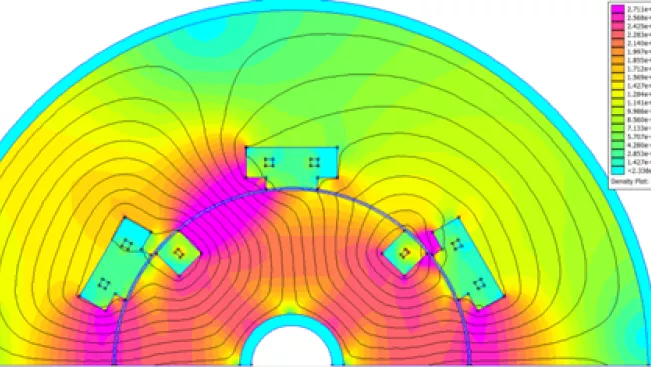
The findings from the previous SupraGenSys project will be used for the design of the 250 kW DG. The cryogenics and refrigeration system are being developed in close coordination. This means that adjustments to the design are unavoidable, which must be harmonised using 2D and 3D FEM calculations by H-BRS. H-BRS will implement the design of the DG as a model in the multiphysics environment of the COMSOL software and create FEM calculations. In addition to the rough electromagnetic design, the DG will also be designed for the expected thermal and mechanical requirements. H-BRS will therefore concentrate its investigations on the cross-system calculations, such as the slot forces or the electromagnetic force effect in the air gap. Field effects on the coils will also be investigated. Relevant operating cases will be calculated for both the DG and the multi-megawatt generator design. In a further work package, H-BRS will integrate the extended calculations into the design tool, taking into account the cooling concept and the design of the DG. In addition, H-BRS will support the extended concept study for the fully superconducting 10 MW generator.
Objectives of the sub-project
- Contribution to the design of the 250 kW fully superconducting DG by creating a 2D FEM calculation model in a multiphysics environment (COMSOL)
- Transfer of the results of the 2D FEM model from the DG to a multi-mode generatorModel from the DG to a multi-megawatt generator design
- Support of the thermal and mechanical requirements of the DG by numerical calculations
- Knowledge of the thermal and mechanical requirements of the DG is transferred to a multi-megawatt generator design
- Multiphysical field effects in the HTS coils are investigated for both the DG and the multi-megawatt generator design
- Coils are investigated
- Development of a tool for the analytical determination of the tangential and radial field in the HTS coils

Sponsors
Links to
Further links