30 years Hochschule Bonn-Rhein-Sieg
Exhibition Visionary Female Researchers: Caroline Herschel
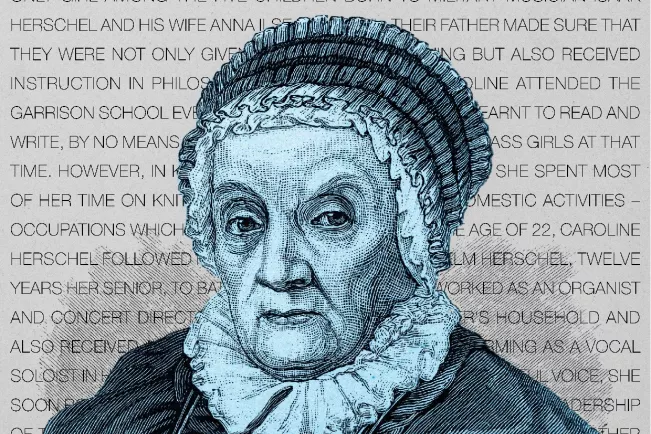
Biography Caroline Herschel (1750-1848)
Caroline Lucretia Herschel was born on 16 March 1750 in Hanover as the only girl of five children of Anne Ilse Herschel. Her father, the military musician Isaak Herschel, not only provided his children with a basic musical education, they also received lessons in philosophy and astronomy. Caroline attended the garrison school every day with her brothers and learnt to read and write, which was not a matter of course for a middle-class girl at the time. However, at her mother's request, she spends most of her time knitting, embroidering and doing other household chores, which the young girl detests.
At the age of 22, Caroline Herschel follows her brother Friedrich Wilhelm Herschel, who is twelve years her senior, to Bath in England, where he works as an organist and concert conductor. She took care of her brother's household, but also furthered her musical education by performing as a vocal soloist in her brother's concerts. Thanks to her convincing voice, she soon becomes the first singer, takes on the leading role in the choir and receives numerous offers to perform in other cities, which she turns down as she only wants to perform in public under her brother's direction.
In addition to music, her brother pursues another passion, astronomy, which Caroline soon shares with him. In addition to running the household and performing as a singer, she now devotes herself to astronomical studies, for example by assembling mirror telescopes together with her brother. In addition to her practical activities, she studied astronomical theory and learnt formulas for calculations and reductions as a basis for observing and scanning the sky.
The big turning point for Caroline Herschel came in 1781: Her brother discovered the planet Uranus rather by chance during a celestial survey. This discovery made him famous beyond the country's borders and, in addition to numerous honours, helped him to a position as Royal Court Astronomer in Windsor.
Caroline Herschel followed her brother to Windsor as a scientific assistant, deciding against a successful career as a singer in Bath and in favour of a position as her brother's assistant with a salary of 50 pounds a year, the first salary for a woman in a scientific position. Caroline began to explore the night sky on her own, dedicating herself to searching for comets and discovering eight tail stars between 1786 and 1797. She spent nights assisting her brother at observation posts, noting the star positions and analysing the nightly records. She wrote treatises on her observations, discovered fourteen nebulae and wrote a supplementary catalogue as well as a complete index to Flamsteed's atlas, which catalogued 561 stars.
For this work, she received much recognition from well-known astrometrists of her time such as Johann Franz Encke and Carl Friedrich Gauss. Nevertheless, she remained fundamentally modest and continued to put her work at the service of her brother, thereby fulfilling social expectations.
Her brother died in 1822. A few weeks after his death, Caroline Herschel returned to her hometown of Hanover, where she continued her scientific work. The most important scholars of her time exchanged ideas with her and the royal court also maintained contact with her. She received numerous awards and honours. in 1828, she was awarded the gold medal of the Royal Astronomical Society, among other things, and in 1835 she became the first woman to be made an honorary member of the society for the zonal catalogue she compiled with her brother. The catalogue contains the reduced observations of all the nebulae and star clusters discovered by Wilhelm Herschel. in 1838, the Royal Irish Academy of Sciences in Dublin appoints 88-year-old Caroline Herschel as a member. in 1846, at the age of 96, she received the gold medal of the Prussian Academy of Sciences on behalf of the King of Prussia.
Caroline Herschel died in Hanover at the age of 98 and was buried in her home town of Hanover.
Contact points
Centre for Science and Technology Transfer (ZWT)
Campus
Sankt Augustin