30 years Hochschule Bonn-Rhein-Sieg
Exhibition Visionary Female Researchers: Dorothea Christiane Erxleben
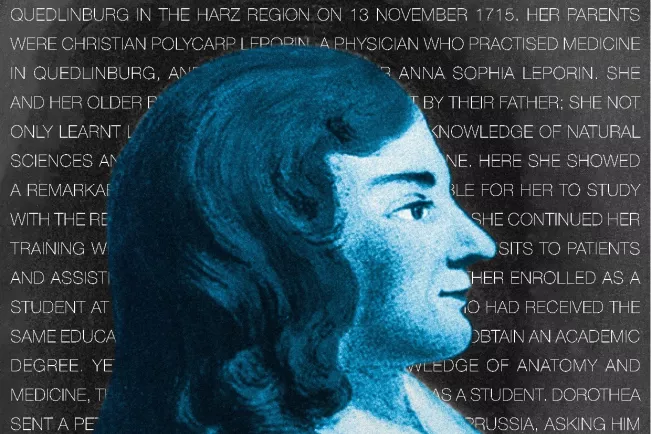
Biography of Dorothea Christiane Erxleben (1715-1762)
Dorothea Erxleben is born Dorothea Christiana Leporin on 13 November 1715 in Quedlinburg in the Harz Mountains. Her parents are Anna Sophia Leporin, the daughter of a pastor, and Christian Polykarp Leporin, a doctor practising in Quedlinburg. Together with her older brother, Dorothea is initially taught by her father, learning not only languages but also acquiring knowledge in the natural sciences and theoretical and practical medicine. She shows remarkable talent in this area, which later enables her to receive external tuition from the headmaster of Quedlinburg Grammar School. She continues her education with her father, accompanying him on his visits to patients and assisting him in his practice.
Her brother enrols at the University of Halle in 1740. Dorothea, who has had the same education as her brother, also aspires to obtain an academic degree. Despite her exceptional anatomical and medical knowledge, the university administration refuses to allow her to study at the university because of her gender. Dorothea sends a petition to the young Prussian king Frederick II, asking for permission to study medicine at the University of Halle. In 1741, she gets a positive response to her request from the relevant Prussian authorities, which allows her to attend the medical faculty in Halle, but her medical studies are delayed. She begins to put her thoughts on the question of women's education down on paper. In 1742, she publishes these thoughts and addresses the common prejudices and obstacles to women's education but convincingly refutes them.
During the First Silesian War (1740-1742), her older brother, with whom she now wants to attend university, receives a draft notice, which he evades by fleeing to a foreign country. Studying without her brother is out of the question for Dorothea, as she does not feel confident enough to study alone. She remains in Quedlinburg and, at the age of 26, marries the widowed deacon Johann Christian Erxleben, father of five children. She herself gives birth to four children in the following years. To ease the financial situation of her large family and pay off the debts of her father, who died in 1747, Dorothea cares for and treats the sick. When one of her patients dies from her illness, she is accused of malpractice by long-established doctors and reported to the authorities. As a result, an order is issued requiring her to take her doctoral examination in Halle within three months. On 6 January 1754, Dorothea submits her dissertation and files a new petition to the Prussian king, requesting admission to the doctoral programme, which is granted. On 6 May 1754, Dorothea Erxleben becomes the first woman in Germany to take the doctoral examination and passes it with great success.
She practises as a successful doctor until her death. Her speciality is treating women and children. Her medical skills are highly valued in higher social circles, and she becomes the personal physician to the abbess of Quedlinburg Abbey, among other things. On 13 June 1762, Dorothea Erxleben dies in Quedlinburg at the age of 46 because of an infection.
Contact points
Centre for Science and Technology Transfer (ZWT)
Campus
Sankt Augustin